印官员:不是牛顿最早发现万有引力 是印度数学家
原标题:印度地方官员:最早发现万有引力的不是牛顿,而是一名印度数学家!
[环球网综合报道]英国著名科学家牛顿最早发现万有引力定律,这是大家都公认的事实,但印度一位地方教育官员打算挑战历史。该官员称,最早发现万有引力的并不是牛顿,而是一名印度数学家,而且这位印度科学家发现万有引力的时间要比牛顿早一千多年。
据《印度时报》1月10日报道,向来发表有争议性言论而著称的拉贾斯坦邦教育部长瓦苏德夫•德夫纳尼声称,印度数学家和天文学家婆罗摩笈多二世(Brahmagupta-II,598-670)首先发现了万有引力定律,这比牛顿(1642-1727)发现的时间早了一千多年。
1月8日,在拉贾斯坦邦大学举行的第72届奠基仪式上,瓦苏德夫•德夫纳尼发问,为何该“事实”没有纳入学术大纲中?他说:“自上小学以来,我们的教材上写的都是牛顿发现了万有引力定律,但实际上,如果你重温历史,你会发现它是一位印度天文学家首先发现的。”
这一言论随后引发大量质疑声音。该部长随后在第二天还对此做出回应。他要求批评者们在对他的声明做出任何判断之前,先阅读婆罗摩笈多的文章和书籍。他称:“人们认为我做了一个虚构的声明。对此,我不予置评。我更希望那些对此表示怀疑和震惊的人至少先读一下婆罗摩笈多文章或现代科学家对他的研究成果。”
似乎是出于民族骄傲心理。印度一些历史学家们还通过提供包括硬币、文本和手稿在内的证据,来表达对这一观点的支持。拉贾斯坦邦大学历史学院院长夏尔马(K G Sharma)从婆罗摩笈多的著作《婆罗摩历算书》中援引了一首梵文诗来证明该声明:“一个物体落向地球,因为吸引物体是地球的本性,就像水的本性是流动一样。”他认为这个说法表明婆罗摩笈多对重力的理解。夏尔马还表示,在此之后有另一个印度天文学家巴斯卡拉二世(1114-1185)在1150年出版的著作《苏利亚历》中也对重力进行了详细阐述。
有印度网友在报道下方表示,很多知识一直存在,但科学家重要的是对知识做出解释,而不仅仅是发现。
とても興味深く読みました:
\documentclass[12pt]{article}
\usepackage{latexsym,amsmath,amssymb,amsfonts,amstext,amsthm}
\numberwithin{equation}{section}
\begin{document}
\title{\bf Announcement 388: Information and ideas on zero and division by zero\\
(a project)\\
(2017.10.29)}
\author{{\it Institute of Reproducing Kernels}\\
Kawauchi-cho, 5-1648-16,\\
Kiryu 376-0041, Japan\\
}
\date{\today}
\maketitle
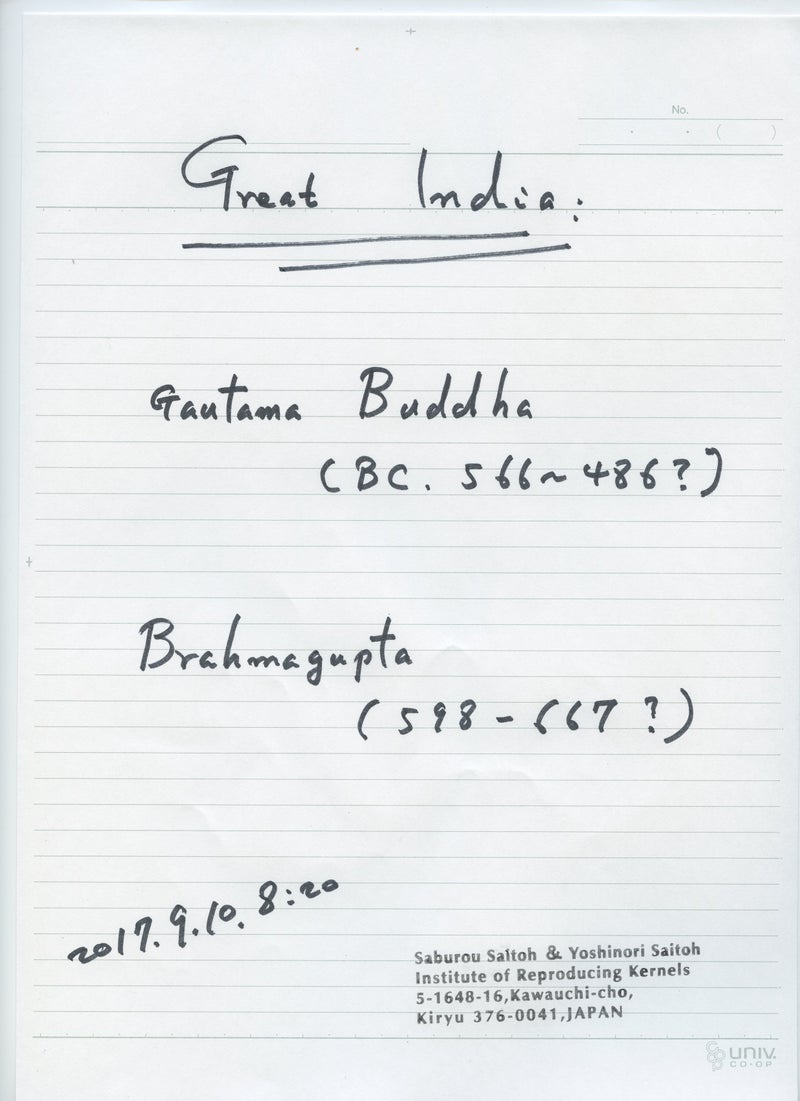
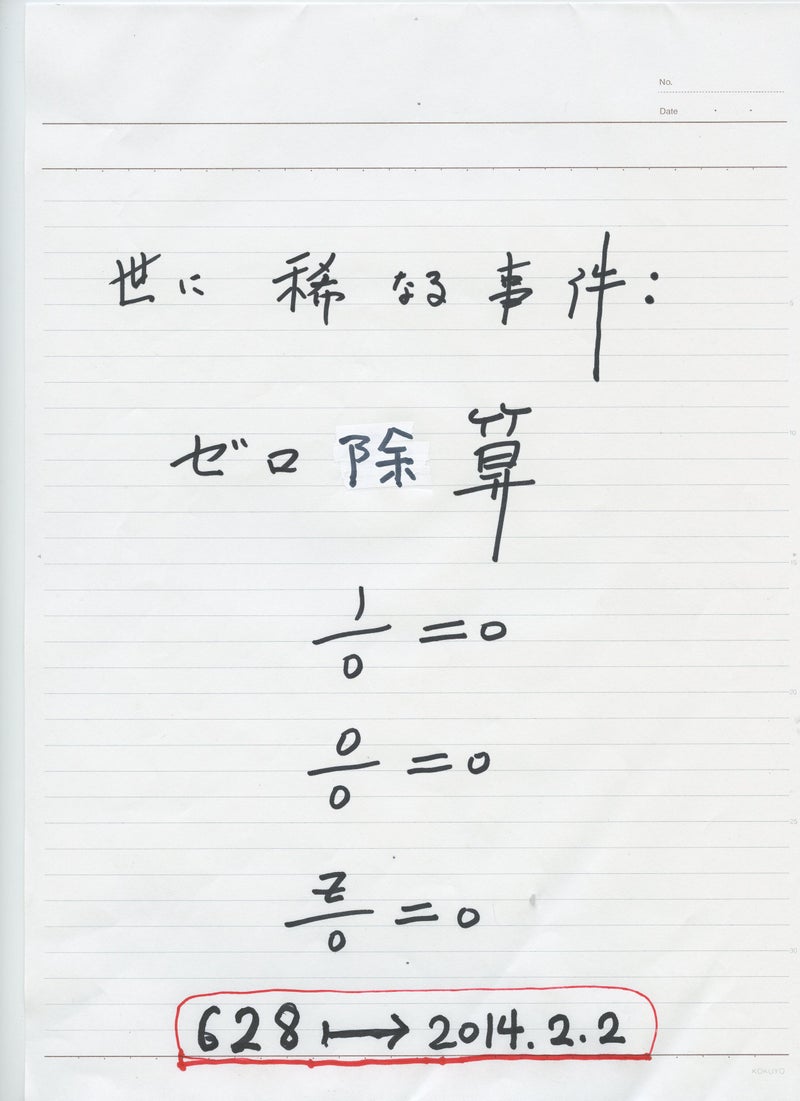
The Institute of Reproducing Kernels is dealing with the theory of division by zero calculus and declares that the division by zero was discovered as $0/0=1/0=z/0=0$ in a natural sense on 2014.2.2. The result shows a new basic idea on the universe and space since Aristotelēs (BC384 - BC322) and Euclid (BC 3 Century - ), and the division by zero is since Brahmagupta (598 - 668 ?).
In particular, Brahmagupta defined as $0/0=0$ in Brāhmasphuṭasiddhānta (628), however, our world history stated that his definition $0/0=0$ is wrong over 1300 years, but, we showed that his definition is suitable.
For the details, see the references and the site: http://okmr.yamatoblog.net/
We would like to write some story on zero and division by zero. For this purpose, we would like to gather some wide ideas and feelings on the zero and division by zero. For some precise facts and some wide viewpoints on these topics, please kindly send your ideas and feelings. For some valuable ones, we would like to immediately distribute them as in examples on the division by zero (now over 670 items).
For your kind comments, several lines will be well-comed
and or in A4 one page in word.
Please kindly send your ideas to the e-mail address:
\medskip
kbdmm360@yahoo.co.jp
\medskip
We would like to hear your valuable and interesting ideas on these topics.
\bibliographystyle{plain}
\begin{thebibliography}{10}
\bibitem{cs}
L. P. Castro and S. Saitoh, Fractional functions and their representations, Complex Anal. Oper. Theory {\bf7} (2013), no. 4, 1049-1063.
\bibitem{kmsy}
M. Kuroda, H. Michiwaki, S. Saitoh, and M. Yamane,
New meanings of the division by zero and interpretations on $100/0=0$ and on $0/0=0$,
Int. J. Appl. Math. {\bf 27} (2014), no 2, pp. 191-198, DOI: 10.12732/ijam.v27i2.9.
\bibitem{ms16}
T. Matsuura and S. Saitoh,
Matrices and division by zero z/0=0,
Advances in Linear Algebra \& Matrix Theory, 2016, 6, 51-58
Published Online June 2016 in SciRes. http://www.scirp.org/journal/alamt
\\ http://dx.doi.org/10.4236/alamt.2016.62007.
\bibitem{ms18}
T. Matsuura and S. Saitoh,
Division by zero calculus and singular integrals. (Submitted for publication)
\bibitem{mms18}
T. Matsuura, H. Michiwaki and S. Saitoh,
$\log 0= \log \infty =0$ and applications. Differential and Difference Equations with Applications. Springer Proceedings in Mathematics \& Statistics.
\bibitem{msy15}
H. Michiwaki, S. Saitoh and M.Yamada,
Reality of the division by zero $z/0=0$. IJAPM International J. of Applied Physics and Math. 6(2015), 1--8. http://www.ijapm.org/show-63-504-1.html
\bibitem{mos17}
H. Michiwaki, H. Okumura and S. Saitoh,
Division by Zero $z/0 = 0$ in Euclidean Spaces,
International Journal of Mathematics and Computation, 28(2017); Issue 1, 2017), 1-16.
\bibitem{osm17}
H. Okumura, S. Saitoh and T. Matsuura, Relations of $0$ and $\infty$,
Journal of Technology and Social Science (JTSS), 1(2017), 70-77.
\bibitem{ps18}
S. Pinelas and S. Saitoh,
Division by zero calculus and differential equations. Differential and Difference Equations with Applications. Springer Proceedings in Mathematics \& Statistics.
\bibitem{s14}
S. Saitoh, Generalized inversions of Hadamard and tensor products for matrices, Advances in Linear Algebra \& Matrix Theory. {\bf 4} (2014), no. 2, 87--95. http://www.scirp.org/journal/ALAMT/
\bibitem{s16}
S. Saitoh, A reproducing kernel theory with some general applications,
Qian,T./Rodino,L.(eds.): Mathematical Analysis, Probability and Applications - Plenary Lectures: Isaac 2015, Macau, China, Springer Proceedings in Mathematics and Statistics, {\bf 177}(2016), 151-182. (Springer) .
\bibitem{ttk}
S.-E. Takahasi, M. Tsukada and Y. Kobayashi, Classification of continuous fractional binary operations on the real and complex fields, Tokyo Journal of Mathematics, {\bf 38}(2015), no. 2, 369-380.
\bibitem{ann179}
Announcement 179 (2014.8.30): Division by zero is clear as z/0=0 and it is fundamental in mathematics.
\bibitem{ann185}
Announcement 185 (2014.10.22): The importance of the division by zero $z/0=0$.
\bibitem{ann237}
Announcement 237 (2015.6.18): A reality of the division by zero $z/0=0$ by geometrical optics.
\bibitem{ann246}
Announcement 246 (2015.9.17): An interpretation of the division by zero $1/0=0$ by the gradients of lines.
\bibitem{ann247}
Announcement 247 (2015.9.22): The gradient of y-axis is zero and $\tan (\pi/2) =0$ by the division by zero $1/0=0$.
\bibitem{ann250}
Announcement 250 (2015.10.20): What are numbers? - the Yamada field containing the division by zero $z/0=0$.
\bibitem{ann252}
Announcement 252 (2015.11.1): Circles and
curvature - an interpretation by Mr.
Hiroshi Michiwaki of the division by
zero $r/0 = 0$.
\bibitem{ann281}
Announcement 281 (2016.2.1): The importance of the division by zero $z/0=0$.
\bibitem{ann282}
Announcement 282 (2016.2.2): The Division by Zero $z/0=0$ on the Second Birthday.
\bibitem{ann293}
Announcement 293 (2016.3.27): Parallel lines on the Euclidean plane from the viewpoint of division by zero 1/0=0.
\bibitem{ann300}
Announcement 300 (2016.05.22): New challenges on the division by zero z/0=0.
\bibitem{ann326}
Announcement 326 (2016.10.17): The division by zero z/0=0 - its impact to human beings through education and research.
\bibitem{ann352}
Announcement 352(2017.2.2): On the third birthday of the division by zero z/0=0.
\bibitem{ann354}
Announcement 354(2017.2.8): What are $n = 2,1,0$ regular polygons inscribed in a disc? -- relations of $0$ and infinity.
\bibitem{362}
Announcement 362(2017.5.5): Discovery of the division by zero as $0/0=1/0=z/0=0$
\bibitem{380}
Announcement 380 (2017.8.21): What is the zero?
\end{thebibliography}
\end{document}
1/0=0、0/0=0、z/0=0
http://ameblo.jp/syoshinoris/entry-12276045402.html
1/0=0、0/0=0、z/0=0
ソクラテス・プラトン・アリストテレス その他
ゼロ除算の論文リスト:
List of division by zero:
L. P. Castro and S. Saitoh, Fractional functions and their representations, Complex Anal. Oper. Theory {\bf7} (2013), no. 4, 1049-1063.
M. Kuroda, H. Michiwaki, S. Saitoh, and M. Yamane,
New meanings of the division by zero and interpretations on $100/0=0$ and on $0/0=0$, Int. J. Appl. Math. {\bf 27} (2014), no 2, pp. 191-198, DOI: 10.12732/ijam.v27i2.9.
T. Matsuura and S. Saitoh,
Matrices and division by zero z/0=0,
Advances in Linear Algebra \& Matrix Theory, 2016, 6, 51-58
Published Online June 2016 in SciRes. http://www.scirp.org/journal/alamt
\\ http://dx.doi.org/10.4236/alamt.201....
T. Matsuura and S. Saitoh,
Division by zero calculus and singular integrals. (Differential and Difference Equations with Applications. Springer Proceedings in Mathematics \& Statistics.)
T. Matsuura, H. Michiwaki and S. Saitoh,
$\log 0= \log \infty =0$ and applications. (Submitted for publication).
H. Michiwaki, S. Saitoh and M.Yamada,
Reality of the division by zero $z/0=0$. IJAPM International J. of Applied Physics and Math. 6(2015), 1--8. http://www.ijapm.org/show-63-504-1....
H. Michiwaki, H. Okumura and S. Saitoh,
Division by Zero $z/0 = 0$ in Euclidean Spaces,
International Journal of Mathematics and Computation, 28(2017); Issue 1, 2017), 1-16.
H. Okumura, S. Saitoh and T. Matsuura, Relations of $0$ and $\infty$,
Journal of Technology and Social Science (JTSS), 1(2017), 70-77.
S. Pinelas and S. Saitoh,
Division by zero calculus and differential equations. (Differential and Difference Equations with Applications. Springer Proceedings in Mathematics \& Statistics).
S. Saitoh, Generalized inversions of Hadamard and tensor products for matrices, Advances in Linear Algebra \& Matrix Theory. {\bf 4} (2014), no. 2, 87--95. http://www.scirp.org/journal/ALAMT/
S. Saitoh, A reproducing kernel theory with some general applications,
Qian,T./Rodino,L.(eds.): Mathematical Analysis, Probability and Applications - Plenary Lectures: Isaac 2015, Macau, China, Springer Proceedings in Mathematics and Statistics, {\bf 177}(2016), 151-182. (Springer) .
List of division by zero:
L. P. Castro and S. Saitoh, Fractional functions and their representations, Complex Anal. Oper. Theory {\bf7} (2013), no. 4, 1049-1063.
M. Kuroda, H. Michiwaki, S. Saitoh, and M. Yamane,
New meanings of the division by zero and interpretations on $100/0=0$ and on $0/0=0$, Int. J. Appl. Math. {\bf 27} (2014), no 2, pp. 191-198, DOI: 10.12732/ijam.v27i2.9.
T. Matsuura and S. Saitoh,
Matrices and division by zero z/0=0,
Advances in Linear Algebra \& Matrix Theory, 2016, 6, 51-58
Published Online June 2016 in SciRes. http://www.scirp.org/journal/alamt
\\ http://dx.doi.org/10.4236/alamt.201....
T. Matsuura and S. Saitoh,
Division by zero calculus and singular integrals. (Differential and Difference Equations with Applications. Springer Proceedings in Mathematics \& Statistics.)
T. Matsuura, H. Michiwaki and S. Saitoh,
$\log 0= \log \infty =0$ and applications. (Submitted for publication).
H. Michiwaki, S. Saitoh and M.Yamada,
Reality of the division by zero $z/0=0$. IJAPM International J. of Applied Physics and Math. 6(2015), 1--8. http://www.ijapm.org/show-63-504-1....
H. Michiwaki, H. Okumura and S. Saitoh,
Division by Zero $z/0 = 0$ in Euclidean Spaces,
International Journal of Mathematics and Computation, 28(2017); Issue 1, 2017), 1-16.
H. Okumura, S. Saitoh and T. Matsuura, Relations of $0$ and $\infty$,
Journal of Technology and Social Science (JTSS), 1(2017), 70-77.
S. Pinelas and S. Saitoh,
Division by zero calculus and differential equations. (Differential and Difference Equations with Applications. Springer Proceedings in Mathematics \& Statistics).
S. Saitoh, Generalized inversions of Hadamard and tensor products for matrices, Advances in Linear Algebra \& Matrix Theory. {\bf 4} (2014), no. 2, 87--95. http://www.scirp.org/journal/ALAMT/
S. Saitoh, A reproducing kernel theory with some general applications,
Qian,T./Rodino,L.(eds.): Mathematical Analysis, Probability and Applications - Plenary Lectures: Isaac 2015, Macau, China, Springer Proceedings in Mathematics and Statistics, {\bf 177}(2016), 151-182. (Springer) .
Title page of Leonhard Euler, Vollständige Anleitung zur Algebra, Vol. 1 (edition of 1771, first published in 1770), and p. 34 from Article 83, where Euler explains why a number divided by zero gives infinity.
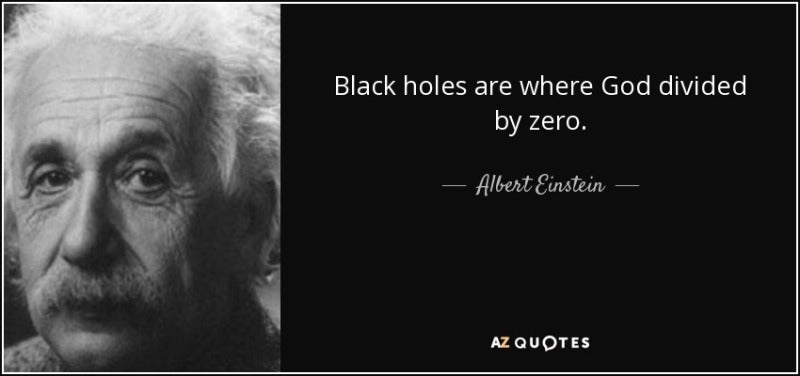
私は数学を信じない。 アルバート・アインシュタイン / I don't believe in mathematics. Albert Einstein→ゼロ除算ができなかったからではないでしょうか。
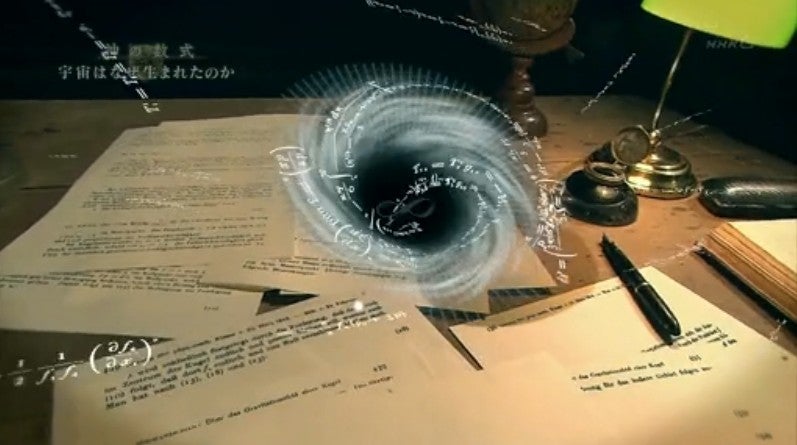
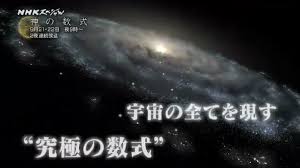
ドキュメンタリー 2017: 神の数式 第2回 宇宙はなぜ生まれたのか
〔NHKスペシャル〕神の数式 完全版 第3回 宇宙はなぜ始まったのか
NHKスペシャル〕神の数式 完全版 第1回 この世は何からできているのか
NHKスペシャル 神の数式 完全版 第4回 異次元宇宙は存在するか
ゼロ除算の論文
Mysterious Properties of the Point at Infinity
Mysterious Properties of the Point at Infinity
Algebraic division by zero implemented as quasigeometric multiplication by infinity in real and complex multispatial hyperspaces
Author: Jakub Czajko, 92(2) (2018) 171-197
 WSN 92(2) (2018) 171-197
Author: Jakub Czajko, 92(2) (2018) 171-197
WSN 92(2) (2018) 171-197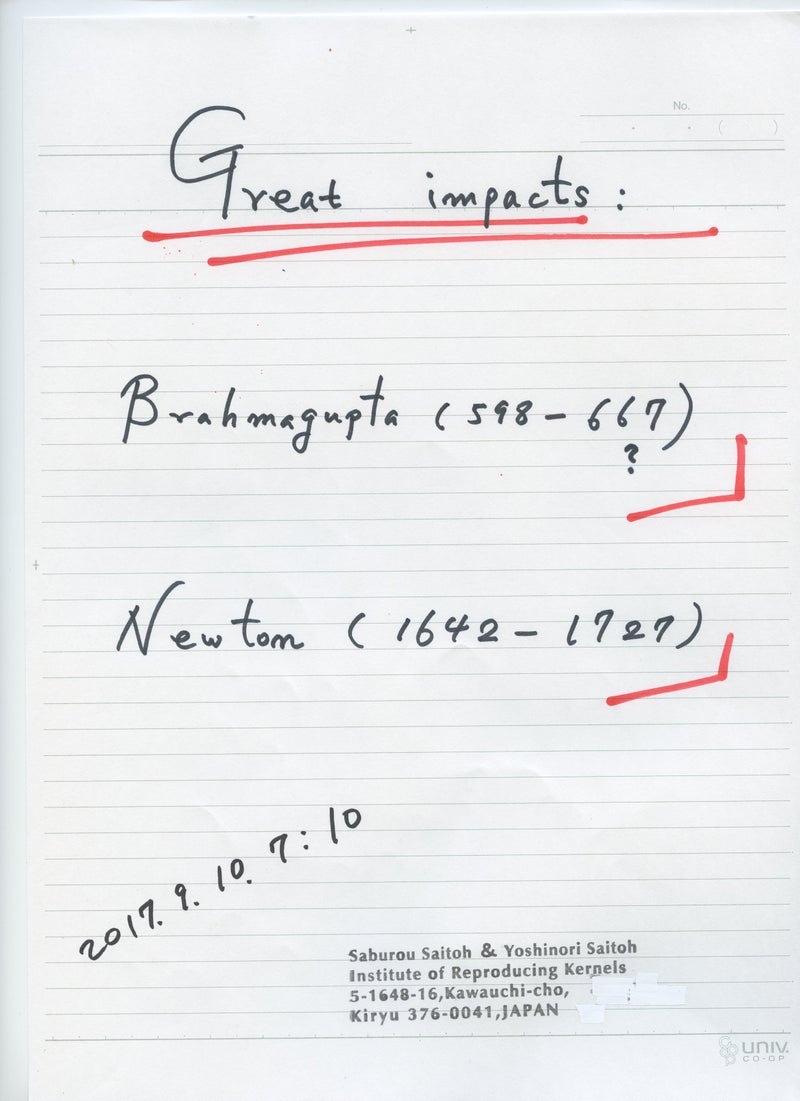











0 件のコメント:
コメントを投稿