弥生期土器に漢字、権力者以外にも文字伝わる?
長崎県壱岐市教育委員会は9日、同市のカラカミ遺跡で、「周」という漢字の左半分が刻まれた土器片(弥生時代後期、2世紀頃)が出土したと発表した。
同遺跡は、中国の歴史書「魏志倭人伝」に記された「一支国」の交易拠点跡とされ、当時の九州北部で広範囲に文字が伝わっていた可能性も出てきた。
漢字が記された資料は福岡市・志賀島で見つかった「漢委奴国王」の刻印を持つ金印や銘文のある鏡などがいち早く国内に入っているが、土器としては国内最古級となる。
土器片は縦7・5センチ、横8・8センチ。鉢(口径23センチ、高さ7・7センチ)の一部とみられ、文字は縁部分に刻まれていた。土器は中国・遼東半島周辺で作られたとみられ、交易を通じて一支国に入った可能性が高いという。
文字関連の弥生時代の遺物は、これまで倭人伝の「伊都国」の王都とされる三雲・井原遺跡(福岡県糸島市)で国内最古級の硯(中期後半~後期)や「竟」(鏡)という文字らしき線刻がある土器(後期)などが出土している。
西谷正・九州大名誉教授(東アジア考古学)は「権力者が持つ鏡ではなく、土器で文字が確認されたことで、多くの人が文字に触れていた可能性が出てきた」としている。
2018年01月10日 10時09分 Copyright © The Yomiuri Shimbun
とても興味深く読みました:考古学にとても興味があります:
Announcement 213: An interpretation of the identity $ 0.999999...... =1$
カテゴリ:カテゴリ未分類
\documentclass[12pt]{article}
\usepackage{latexsym,amsmath,amssymb,amsfonts,amstext,amsthm}
\numberwithin{equation}{section}
\begin{document}
\title{\bf Announcement 213: An interpretation of the identity $ 0.999999...... =1$
}
\author{{\it Institute of Reproducing Kernels}\\
Kawauchi-cho, 5-1648-16,\\
Kiryu 376-0041, Japan\\
\date{}
\maketitle
{\bf Abstract: } In this announcement, we shall give a very simple interpretation for the identity: $ 0.999999......=1$.
\bigskip
\section{ Introduction}
On January 8, 2008, Yuusuke Maede, 8 years old boy, asked the question, at Gunma University, that (Announcement 9(2007/9/1): Education for genius boys and girls):
What does it mean by the identity:
$$
0.999999......=1?
$$
at the same time, he said: I am most interesting in the structure of large prime numbers. Then, a teacher answered for the question by the popular reason based on the convergence of the series: $0.9, 0.99, 0.999,... $. Its answer seems to be not suitable for the 8 years old boy with his parents (not mathematicians). Our answer seems to have a general interest, and after then, such our answer has not been heard from many mathematicians, indeed.
This is why writting this announcement.
\medskip
\bigskip
\section{An interpretation}
\medskip
In order to see the essence, we shall consider the simplist case:
\begin{equation}
\frac{1}{2} + \frac{1}{2^2} + \frac{1}{2^3} + ... = 1.
\end{equation}
Imagine a tape of one meter length, we will give its half tape: that is,
\begin{equation}
\frac{1}{2}.
\end{equation}
Next, we will give its (the rest's half) half tape; that is, $\frac{1}{2}\cdot \frac{1}{2} = \frac{1}{2^2}$, then you have, altogether
\begin{equation}
\frac{1}{2} + \frac{1}{2^2} .
\end{equation}
Next, we will give the last one's half (the rest's half); that is, $\frac{1}{2}\cdot \frac{1}{2} \cdot \frac{1}{2}= \frac{1}{2^3}$,
then, you have, altogether
\begin{equation}
\frac{1}{2} + \frac{1}{2^2} + \frac{1}{2^3}.
\end{equation}
By this procedure, you will be able to obtain the small tapes endressly. Imagine all the sum as in the left hand side of (2.1). However, we will see that this sum is just the division of the one meter tape. Therefore, we will be able to confim the identity (2.1), clearly.
The question proposed by Y. Maede is just the small change the ratio $\frac{1}{2}$ by $\frac{9}{10}$.
\bigskip
\section{ Conclusion}
Y. Maede asked the true sense of the limit in the series:
$$
0.999999.....
$$
that is, this series is approaching to 1; however, is it equal or not ? The above interpretation means that the infinite series equals to one and it is just the infinite division of one. By this inverse approarch, the question will make clear.
\medskip
\bigskip
\section{Remarks}
Y. Maede stated a conjecture that for any prime number $p$ $( p \geqq 7)$, for $1$ of $ - 1$
\begin{equation}
11111111111
\end{equation}
may be divided by $p$ (2011.2.6.12:00 at University of Aveiro, by skype)
\medskip
(No.81, May 2012(pdf 432kb)
www.jams.or.jp/kaiho/kaiho-81.pdf).
\medskip
This conjecture was proved by Professors L. Castro and Y. Sawano,
independently. Y. Maede gave later an interesting interpretation for his conjecture.
\medskip
(2015.2.26)
\end{document}
\title{\bf Announcement 214: Surprising mathematical feelings of a 7 years old girl
}
\author{{\it Institute of Reproducing Kernels}\\
Kawauchi-cho, 5-1648-16,\\
Kiryu 376-0041, Japan\\
\date{}
\maketitle
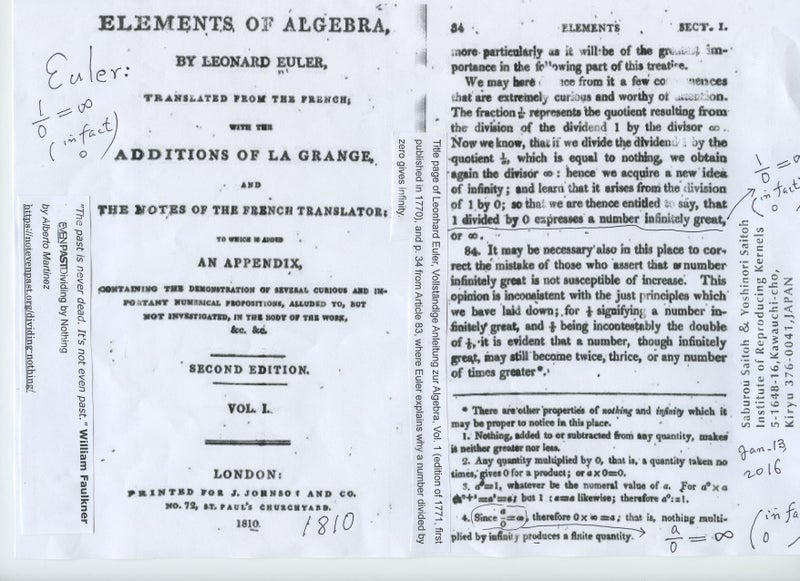
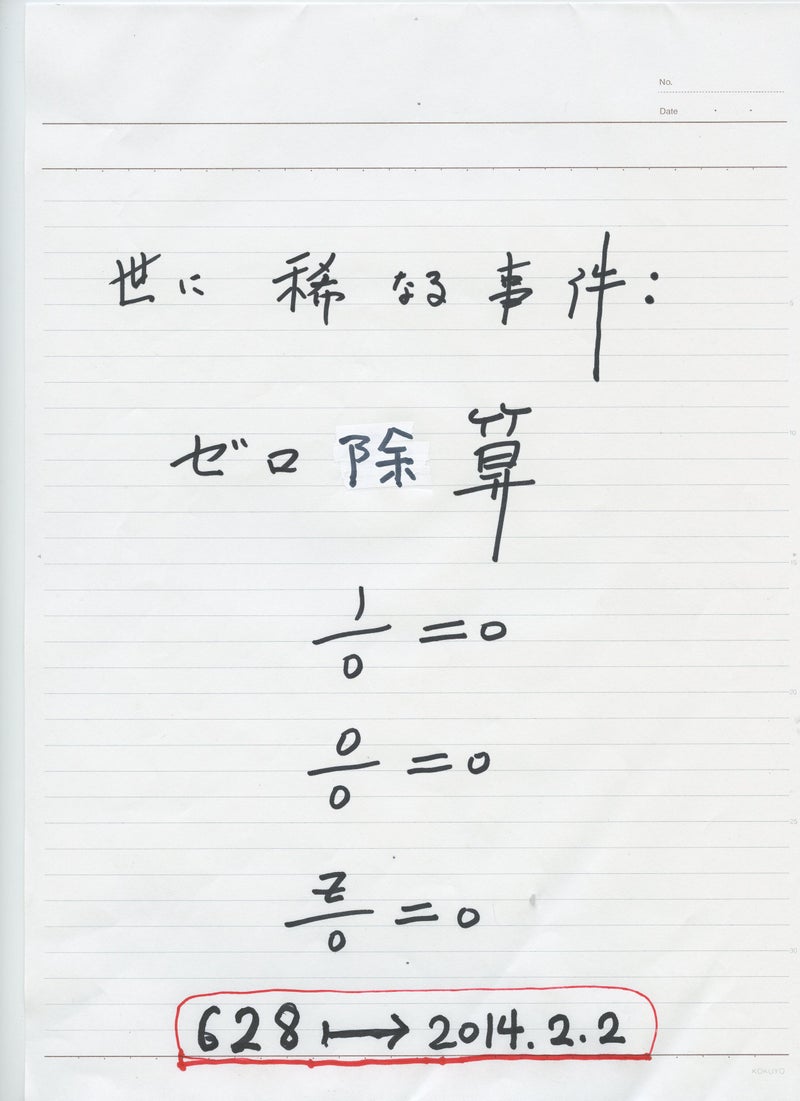
{\bf Abstract: } In this announcement, we shall give the two surprising mathematical feelings of 7 years old girl Eko Michiwaki who stated the division by 3 of any angle and the division by zero $100/0=0$ as clear and trivial ones. As well-known, these famous problems are historical, and her results will be quite original.
\bigskip
\section{ Introduction}
We had met, 7 years old girl, Eko Michiwaki on November 23, 2014 at Tokyo Institute of Technology and August 23, 2014 at Kusatu Seminor House, with our colleagues. She, surprisingly enough, stated there repeatedly the division by 3 of any angle and the division by zero $100/0=0$ as clear and trivial ones. As well-known, these famous problems are historical and her results will be quite original.
\section{The division of any angle by 3}
\medskip
Eko Michiwaki said:
divide a given angle with 4 equal angles; this is simly done. Next, we divide one divided angle
with 4 equal angles similarly and the three angles add to other 3 angles. By continuing this procedure, we will be able to obtain the division by 3 of any angle. Her idea may be stated mathematically as follows:
$$
\frac{1}{4} + \frac{1}{4^2} + \frac{1}{4^3} + ... ...= \frac{1}{3}.
$$
However, her idea seems to be more clear than the above mathematical formula. For this sentence, see \cite{ann3} for the sense of the limit.
\bigskip
\section{The division by zero $100/0=0$}
\medskip
As we stated in \cite{ann1}, she stated that division by zero $100/0=0$ is clear and trivial for our recent results \cite{cs,kmsy,s,ttk}. The basic important viewpoint is that division and product are different concepts and the division by zero $100/0=0$ is clear and trivial from the own sense of the division, independently of product \cite{ann1}. From the viewpoint, our colleagues stated as follows:
\medskip
On July 11, 2014, Seiichi Koshiba and Masami Yamane said at
Gunma University:
The idea for the division of Hiroshi Michiwaki and Eko Michiwaki (6 years
old daughter) is that division and product are different concepts and they
were calculated independently for long old years, by repeated addition and
subtraction, respectively. Mathematicians made the serious mistake for very
long years that the division by zero is impossible by considering that division
is the inverse operation of product. The division by zero was, however, clear
and trivial, as z/0=0, from the own nature of division.
\medskip
On February 21, 2015, Seiichi Koshiba and Masami Yamane visited our Institute and we confirmed this meaning of these sentences and the basic idea on the division by zero.
\medskip
(2015.2.27)
\bigskip
\bibliographystyle{plain}
\begin{thebibliography}{10}
\bibitem{cs}
L. P. Castro and S.Saitoh, Fractional functions and their representations, Complex Anal. Oper. Theory {\bf7} (2013), no. 4, 1049-1063.
\bibitem{kmsy}
M. Kuroda, H. Michiwaki, S. Saitoh, and M. Yamane,
New meanings of the division by zero and interpretations on $100/0=0$ and on $0/0=0$,
Int. J. Appl. Math. Vol. 27, No 2 (2014), pp. 191-198, DOI: 10.12732/ijam.v27i2.9.
\bibitem{s}
S. Saitoh, Generalized inversions of Hadamard and tensor products for matrices, Advances inLinear Algebra \& Matrix Theory. Vol.4 No.2 (2014), 87-95.http://www.scirp.org/journal/ALAMT/
\bibitem{ttk}
S.-E. Takahasi, M. Tsukada and Y. Kobayashi, Classification of continuous fractional binary operations on the real and complex fields, Tokyo Journal of Mathematics (in press).
\bibitem{ann1}
Announcement 179: Division by zero is clear as z/0=0 and it is fundamental in mathematics,
Institute of Reproducing Kernels, 2014.10.22.
\bibitem{ann2}
Announcement 185: The importance of the division by zero $z/0=0$, Institute of Reproducing Kernels, 2014.11.28.
\bibitem{ann3}
Announcement 213: An interpretation of the identity $ 0.999999...... =1$, Institute of Reproducing Kernels, 2015.2.26.
\end{thebibliography}
\end{document}
再生核研究所声明182(2014.11.26) 世界、縄張り、単細胞、宇宙
(初秋、猿の家族が2日間 20頭くらい訪れ まだ渋い 3本の甘柿を食べ尽くして 近くの山に姿を消した。2014.11.9 仕事の区切りがついて、研究室から山を眺めていて 今頃どこで何をしているだろうかと気遣って 人生を想って構想が湧いたが、焦点が絞れなかった。)
猿の1団には 生息領域が 相当にしっかり有ると言える。人間でも、江戸時代以前では概ね、終日歩いて行ける距離 概ね半径40キロメートル以内くらいに 普通の人の生活圏は限られていたと言えよう。生涯でもそれを越えた世界に立ち入るのは、希なことであったのではないだろうか。婚姻なども その範囲に多くは限られていたと言える。 多くの動物には 縄張りなどの生活圏が存在していると言える。
そこで、一人の人間Aの存在範囲に思いを巡らしたい。A の存在し、想像し、活動する世界全体を Aの世界Bとして、それは、B の世界、宇宙と考えよう。勿論、B はいわゆる外なる大きな 世界と複雑に関係しているが、A が認知できる一切の世界を Bと考えよう。
何が言いたいのか。それは、大きな世界に於ける 個人の存在の小ささである。特に、個人が大きな世界、人間社会に与える影響は 普通は極めて小さいと言うことである。基本的に次のように捉えられる:
再生核研究所声明 35: 社会と個人の在りよう ― 細胞の役割
再生核研究所声明85: 食欲から人間を考える ― 飽きること
言わば、個人の物理的な制限である。
歌の世界で例えてみよう。 日本には素晴らしい歌があって、歌謡界のレヴェルは高く、愛好者も実に多く、歌については 日本は世界最高の文化ではないだろうか。俳句や、生花、盆栽、折り紙などについても言えるのではないだろうか。
そこで、Aの好みであるが、美空ひばり様の多くの歌などは、多くの日本人を感動させるだろうが、好みには個性が有って、人それぞれ、また、好みはA 自身でも時や、状況、年代でも変化して、 共感,共鳴出来る人、真の理解者は ほとんど探せない状況ではないだろうか。 これは同じく、共感、共鳴している間でも微妙に感じるところが 違うのではないだろうか。言語、文化、習慣の違う外国人などには、美空ひばり様の歌の受け止め方は相当に違っている。 そう、この声明の趣旨は見えてきた:
世界B は Aにしか分からず、本質的に人間は孤独であり、己の世界をしっかりと捉える(治める)ことの重要性 の確認である。
しかしながら、人間は本能的に、共感、共鳴し、群がりたい存在であるから、自分の世界と相手の世界の調和、相性、関係をよく捉えて、 交流を図るべきである。 その時の鍵は 社会は多様であり、個性は様々であるから、相手の選択が大事だという視点である。
声明の題名にある縄張りとは、2つの世界が交流するときの お互いの干渉に於ける、相手の世界に与える影響の微妙な評価に対する気遣いである。― これは要するに、自分の価値観や世界観を押し付けないという配慮である。
そこで、類は友をなす諺のように、いろいろ気の合う仲間による いろいろな絆を大事に育てて行くのが、人生であるとも言える。
以 上













0 件のコメント:
コメントを投稿