№ 785
ゼロ除算算法で、図の式は、見通し良く直ちに得られる。
We wrote a simple draft on our division by zero. o
http://okmr.yamatoblog.net/ The contents are elementary and have wide connections to various fields beyond mathematics. We expect you write some philosophy, papers and essays on the division by zero from the attached source.
____________
The division by zero is uniquely and reasonably determined as 1/0=0/0=z/0=0 in the natural extensions of fractions. We have to change our basic ideas for our space and world.
\documentclass[12pt]{article}
\usepackage{latexsym,amsmath,amssymb,amsfonts,amstext,amsthm}
\numberwithin{equation}{section}
\begin{document}
\title{\bf Announcement
352: On the third birthday of the
division by zero z/0=0 \\
(2017.2.2)}
\author{{\it Institute of Reproducing Kernels}\\
Kawauchi-cho, 5-1648-16,\\
Kiryu 376-0041, Japan\\
}
\date{\today}
\maketitle
{\bf Abstract: } In this announcement, for its importance we would like
to state the
situation on the division by zero and propose basic new challenges
to education and research on our wrong world history of the division by zero.
\bigskip
\section{Introduction}
%\label{sect1}
By a {\bf natural extension} of the fractions
\begin{equation}
\frac{b}{a}
\end{equation}
for any complex numbers $a$ and $b$, we found the simple and
beautiful result, for any complex number $b$
\begin{equation}
\frac{b}{0}=0,
\end{equation}
incidentally in \cite{s} by the Tikhonov regularization for the
Hadamard product inversions for matrices and we discussed their properties and
gave several physical interpretations on the general fractions in \cite{kmsy}
for the case of real numbers.
The division by zero has a
long and mysterious story over the world (see, for example, H. G. Romig \cite{romig} and Google site with
the division by zero) with its physical viewpoints since the document of zero
in India on AD 628. In particular, note
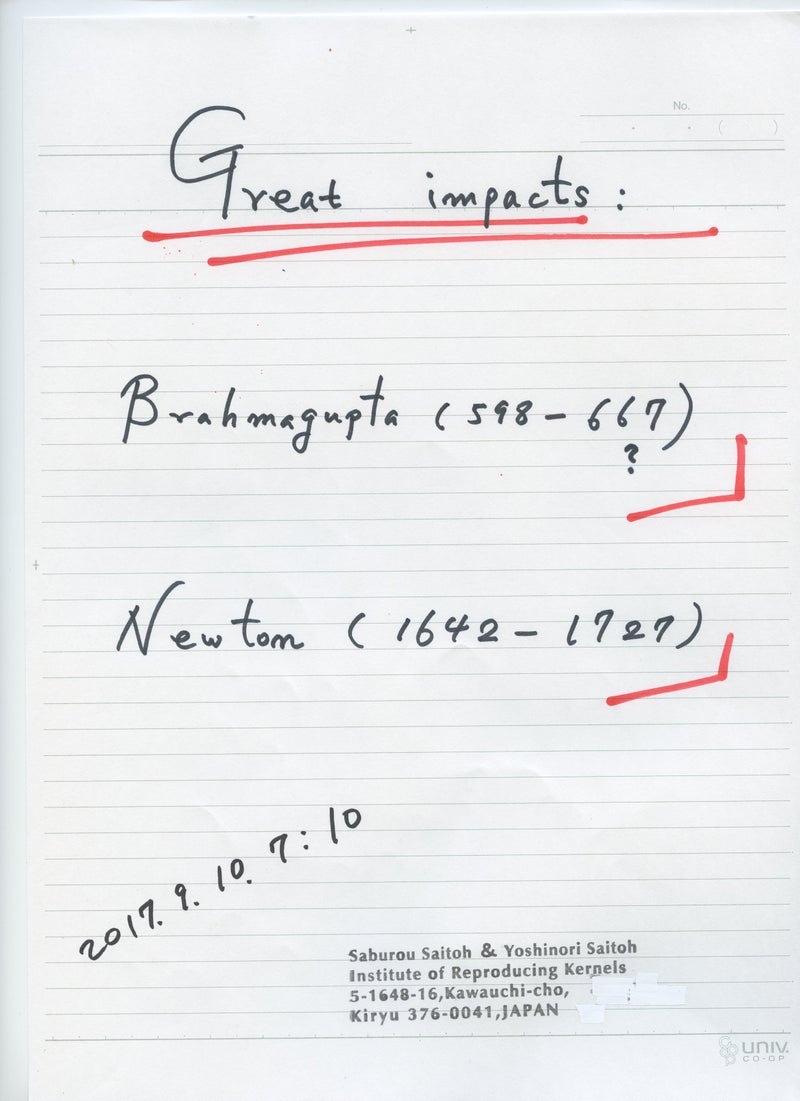
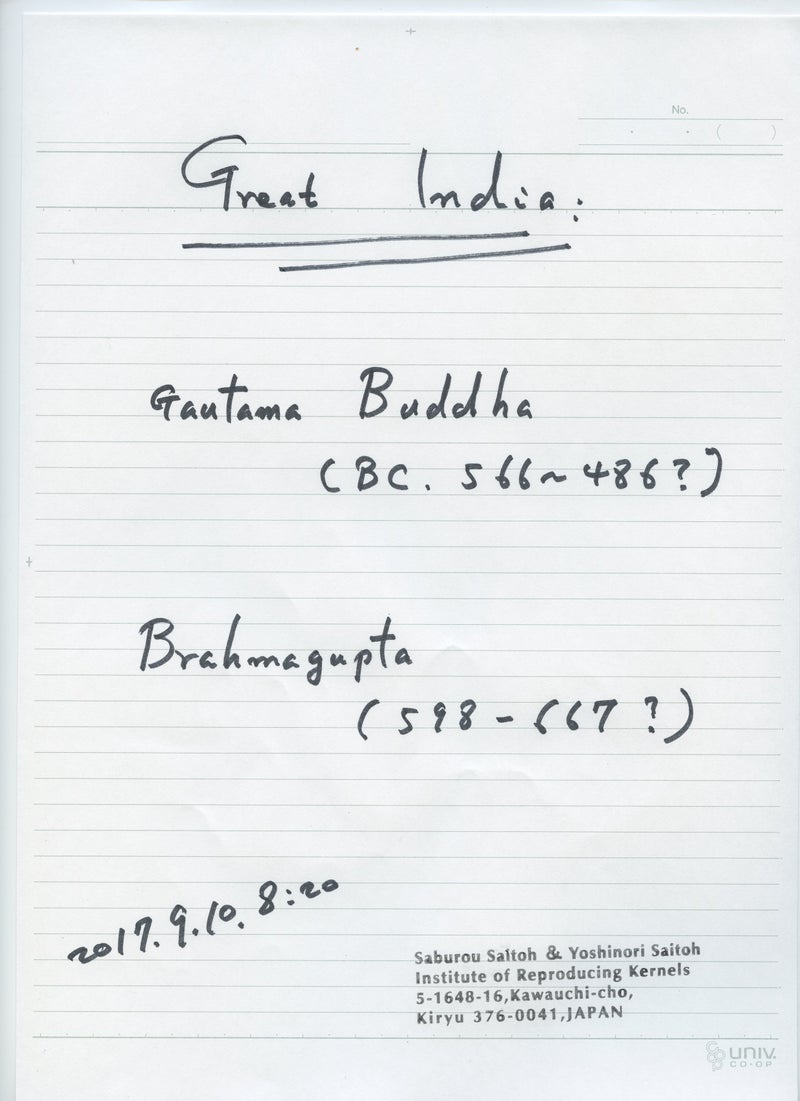
that Brahmagupta (598 -
668 ?) established the four
arithmetic operations by introducing $0$ and at the same time he defined as
$0/0=0$ in Brāhmasphuṭasiddhānta. Our world history, however, stated that his
definition $0/0=0$ is wrong over 1300 years, but, we will see that his
definition is suitable. However, we do not know the meaning and motivation
of the definition of $0/0=0$,
furthermore, for the important case $1/0$ we do not know any result there.
However,
Sin-Ei Takahasi
(\cite{kmsy}) established a simple and decisive interpretation (1.2) by
analyzing the extensions of fractions and by showing the complete
characterization for the property (1.2):
\bigskip
{\bf Proposition 1. }{\it Let F be a function
from ${\bf C }\times {\bf C }$ to ${\bf C }$ satisfying
$$
F (b, a)F (c, d)= F (bc, ad)
$$
for all
$$
a, b, c, d \in {\bf C }
$$
and
$$
F (b, a) = \frac {b}{a },
\quad a, b \in
{\bf C }, a \ne 0.
$$
Then, we obtain, for any $b \in {\bf C } $
$$
F (b, 0) = 0.
$$
}
Note that the complete proof
of this proposition is simply given by 2
or 3 lines.
We {\bf should define
$F(b,0)= b/0 =0$}, in general.
\medskip
We thus should consider, for any complex number $b$, as (1.2);
that is, for the mapping
\begin{equation}
W = \frac{1}{z},
\end{equation}
the image of $z=0$ is $W=0$ ({\bf should be defined}). This fact
seems to be a curious one in connection with our well-established popular image
for the point at infinity on the Riemann
sphere. Therefore, the division by zero will give great impacts to complex
analysis and to our ideas for the space and universe.
For Proposition 1, we see
some confusion even among mathematicians;
for the elementary function (1.3), we did not consider the value at
$z=0$, and we were not able to consider a value. Many and many people consider
its value by the limiting like $+\infty$, $-\infty$ or the point at infinity as
$\infty$. However, their basic idea comes from {\bf continuity} with the common
sense or based on the basic idea of Aristotle. However, by the division by zero
(1.2) we will consider its value of the function $W = \frac{1}{z}$ as zero at
$z=0$. We would like to consider the value so. We will see that this new
definition is valid widely in mathematics and mathematical sciences. However,
for functions, we will need some modification {\bf by the idea of the division by zero calculus
} as in stated in the sequel.
Meanwhile, the division by zero (1.2) is clear, indeed, for the
introduction of (1.2), we have several independent approaches as in:
\medskip
1) by the generalization of the fractions by the Tikhonov
regularization and by the Moore-Penrose generalized inverse,
\medskip
2) by the intuitive meaning of the fractions (division) by H.
Michiwaki - repeated subtraction method,
\medskip
3) by the unique extension of the fractions by S. Takahasi, as in the above,
\medskip
4) by the extension of the fundamental function $W = 1/z$ from ${\bf
C} \setminus \{0\}$ into ${\bf C}$ such that $W =1/z$ is a one to one and onto
mapping from $ {\bf C} \setminus \{0\} $ onto ${\bf C} \setminus \{0\}$ and the
division by zero $1/0=0$ is a one to one and onto mapping extension of the
function $W =1/z $ from ${\bf C}$ onto
${\bf C}$,
\medskip
and
\medskip
5) by considering the values of functions with the mean values of
functions.
\medskip
Furthermore, in (\cite{msy}) we gave the results in order to show
the reality of the division by zero in our world:
\medskip
\medskip
A) a field structure
containing the division by zero --- the Yamada field ${\bf Y}$,
\medskip
B) by the gradient of the $y$
axis on the $(x,y)$ plane --- $\tan \frac{\pi}{2} =0$,
\medskip
C) by the reflection $W =1/\overline{z}$ of $W= z$ with respect to
the unit circle with center at the origin on the complex $z$ plane --- the
reflection point of zero is zero, not the point at infinity.
\medskip
and
\medskip
D) by considering rotation of a right circular cone having some very
interesting
phenomenon from some
practical and physical problem.
\medskip
In (\cite{mos}), many
division by zero results in Euclidean spaces are given and the basic idea at the point at infinity
should be changed. In (\cite{ms}), we gave beautiful geometrical
interpretations of determinants from the viewpoint of the division by zero. The
results show that the division by zero is our basic and elementary mathematics
in our world.
\medskip
See J. A. Bergstra, Y.
Hirshfeld and J. V. Tucker \cite{bht}
and J. A. Bergstra \cite{berg} for the relationship between fields and
the division by zero, and the importance of the division by zero for computer
science. It seems that the relationship of the division by zero and field
structures are abstract in their papers.
Meanwhile, J. P. Barukcic and I. Barukcic (\cite{bb}) discussed the relation between the divisions $0/0$,
$1/0$ and special relative theory of Einstein. However, their logic seems to be
curious and their results contradict with ours.
Furthermore, T. S. Reis and J.A.D.W. Anderson
(\cite{ra,ra2}) extend the system of the real numbers by introducing an ideal
number for the division by zero.
Meanwhile, we should refer to
up-to-date information:
{\it Riemann Hypothesis Addendum - Breakthrough
Kurt Arbenz
https://www.researchgate.net/publication/272022137 Riemann
Hypothesis Addendum - Breakthrough.}
\medskip
Here, we recall Albert Einstein's words on mathematics:
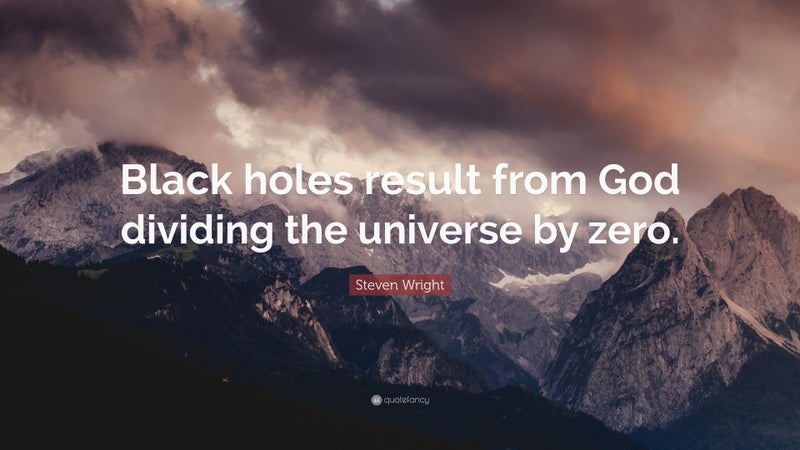
Blackholes are where God divided by zero.
I don't believe in mathematics.
George Gamow (1904-1968) Russian-born American nuclear physicist and
cosmologist remarked that "it is well known to students of high school
algebra" that division by zero is not valid; and Einstein admitted it as
{\bf the biggest blunder of his life}:
Gamow, G., My World Line
(Viking, New York). p 44, 1970.
Apparently, the division by
zero is a great missing in our mathematics and the result (1.2) is definitely
determined as our basic mathematics, as we see from Proposition 1. Note
its very general assumptions and
many fundamental evidences in our world in (\cite{kmsy,msy,mos,s16}).
The results will give great impacts on
Euclidean spaces, analytic geometry, calculus, differential equations, complex
analysis and physical problems.
The mysterious history of the division by zero over one thousand
years is a great shame of mathematicians
and human race on the world history, like the Ptolemaic system (geocentric
theory). The division by zero will become a typical symbol of foolish human race with long and
unceasing struggles. Future people will realize this fact as a definite common
sense.
We should check and fill our mathematics, globally and beautifully,
from the viewpoint of the division by zero. Our mathematics will be more
perfect and beautiful, and will give
great impacts to our basic ideas on the universe.
For our ideas on the division
by zero, see the survey style announcements.
\section{Basic Materials of Mathematics}
\medskip
(1): First, we should
declare that the divison by zero is {\bf possible in the natural and uniquley
determined sense and its importance}.
(2): In the elementary
school, we should introduce the concept of division (fractions) by the idea of
repeated subtraction method by H. Michiwaki whoes method is applied in computer
algorithm and in old days for calculation of division. This method will give a
simple and clear method for calculation of division and students will be happy
to apply this simple method at the first stage. At this time, they will be able
to understand that the division by zero is clear and trivial as $a/0=0$ for any
$a$. Note that Michiwaki knows how to apply his method to the complex number
field.
(3): For the introduction of
the elemetary function $y= 1/x$, we should give the definition of the function
at the origin $x=0$ as $y = 0$ by the division by zero idea and we should apply
this definition for the occasions of its appearences, step by step, following
the curriculum and the results of the division by zero.
(4): For the idea of the
Euclidean space (plane), we should introduce, at the first stage, the concept
of stereographic projection and the concept of the point at infinity -
one point compactification.
Then, we will be able to see the whole Euclidean plane, however, by the
division by zero, {\bf the point at infinity is represented by zero, not by
$\infty$}. We can teach the very
important fact with many geometric and analytic geometry methods. These topics
will give great pleasant feelings to many students.
Interesting topics are:
parallel lines, what is a line? - a line contains the origin as an isolated
point for the case that the native line does not through the origin.
All the lines pass the origin, our space is not the Eulcildean space and is not
Aristoteles for the strong discontinuity at the point at infinity (at the
origin). - Here note that an orthogonal coordinate system should be fixed first
for our all arguments.
(5): The inversion of the origin with respect to a circle with
center the origin is the origin itself, not the point at infinity - the very
classical result is wrong. We can also prove this elementary result by many
elementary ways.
(6): We should change the concept of gradients; on the usual
orthogonal coordinates $(x,y)$,
the gradient of the $y$ axis
is zero; this is given and proved by the fundamental result
$\tan (\pi/2) =0$. The result
is also trivial from the definition of the Yamada field.
\medskip
For the Fourier coefficients $a_k$ of a function :
$$
\frac{a_k \pi k^3}{4}
$$
\begin{equation}
= \sin (\pi k) \cos (\pi k) +
2 k^2 \pi^2 \sin(\pi k) \cos (\pi k) + 2\pi (\cos (\pi k) )^2 - \pi k,
\end{equation}
for $k=0$, we obtain immediately
\begin{equation}
a_0 = \frac{8}{3}\pi^2
\end{equation}
(see \cite{maple}, (3.4))({ -
Difficulty in Maple for
specialization problems}
).
\medskip
These results are derived also from
the {\bf division by zero calculus}:
For any formal Laurent
expansion around $z=a$,
\begin{equation}
f(z) = \sum_{n=-\infty}^{\infty} C_n (z - a)^n,
\end{equation}
we obtain the identity, by the division by zero
\begin{equation}
f(a) = C_0.
\end{equation}
\medskip
The typical example is that, as we can derive by the elementary way,
$$
\tan \frac{\pi}{2} =0.
$$
\medskip
We gave many examples with
geometric meanings in \cite{mos}.
This fundamental result leads to the important new definition:
From the viewpoint of the division by zero, when there exists the
limit, at $ x$
\begin{equation}
f^\prime(x) = \lim_{h\to 0}
\frac{f(x + h) - f(x)}{h} =\infty
\end{equation}
or
\begin{equation}
f^\prime(x) = -\infty,
\end{equation}
both cases, we can write them
as follows:
\begin{equation}
f^\prime(x) = 0.
\end{equation}
\medskip
For the elementary ordinary
differential equation
\begin{equation}
y^\prime = \frac{dy}{dx}
=\frac{1}{x}, \quad x > 0,
\end{equation}
how will be the case at the
point $x = 0$? From its general solution, with a general constant $C$
\begin{equation}
y = \log x + C,
\end{equation}
we see that, by the division
by zero,
\begin{equation}
y^\prime (0)= \left[
\frac{1}{x}\right]_{x=0} = 0,
\end{equation}
that will mean that the
division by zero (1.2) is very natural.
In addition, note that the
function $y = \log x$ has infinite order derivatives and all the values are zero
at the origin, in the sense of the division by zero.
However, for the derivative
of the function $y = \log x$, we have to fix the sense at the origin, clearly,
because the function is not differentiable, but it has a singularity at the
origin. For $x >0$, there is no problem for (2.8) and (2.9). At $x = 0$, we
see that we can not consider the limit in the sense (2.5). However,
for $x >0$ we have (2.8) and
\begin{equation}
\lim_{x \to +0} \left(\log x
\right)^\prime = +\infty.
\end{equation}
In the usual sense, the limit
is $+\infty$, but in the present case,
in the sense of the division by zero, we have:
\begin{equation}
\left[ \left(\log x
\right)^\prime \right]_{x=0}= 0
\end{equation}
and we will be able to
understand its sense graphycally.
By the new interpretation for
the derivative, we can arrange many formulas for derivatives, by the division
by zero. We can modify many formulas and statements in calculus and we can
apply our concept to the differential equation theory and the universe in
connetion with derivatives.
(7): We shall introduce the typical division by zero calculus.
For the integral
\begin{equation}
\int x(x^{2}+1)^{a}dx=\frac{(x^{2}+1)^{a+1}}{2(a+1)}\quad(a\ne-1),
\end{equation}
we obtain, by the division by zero calculus,
\begin{equation}
\int x(x^{2}+1)^{-1}dx=\frac{\log(x^{2}+1)}{2}.
\end{equation}
For example, in the ordinary differential equation
\begin{equation}
y^{\prime\prime} + 4 y^{\prime} + 3 y = 5 e^{- 3x},
\end{equation}
in order to look for a special solution, by setting $y = A e^{kx}$
we have, from
\begin{equation}
y^{\prime\prime} + 4 y^{\prime} + 3 y = 5 e^{kx},
\end{equation}
\begin{equation}
y = \frac{5 e^{kx}}{k^2 + 4 k + 3}.
\end{equation}
For $k = -3$, by the division by zero calculus, we obtain
\begin{equation}
y = e^{-3x} \left( - \frac{5}{2}x -
\frac{5}{4}\right),
\end{equation}
and so, we can obtain the special solution
\begin{equation}
y = - \frac{5}{2}x e^{-3x}.
\end{equation}
In those examples, we were able to give valuable functions for
denominator zero cases. The division by zero calculus may be applied to many
cases as a new fundamental calculus over l'Hopital's rule.
(8): When we apply the
division by zero to functions, we can consider, in general, many ways. For example,
for the function $z/(z-1)$, when we insert $z=1$ in numerator and denominator, we have
\begin{equation}
\left[\frac{z}{z-1}\right]_{z = 1} = \frac{1}{0} =0.
\end{equation}
However,
from the identity --
the Laurent expansion around
$z=1$,
\begin{equation}
\frac{z}{z-1} = \frac{1}{z-1} + 1,
\end{equation}
we have
\begin{equation}
\left[\frac{z}{z-1}\right]_{z
= 1} = 1.
\end{equation}
For analytic functions we can
give uniquely determined values at isolated singular points by the values by
means of the Laurent expansions as the division by zero calculus, however, the
values by means of the Laurent expansions are not always reasonable. We will
need to consider many interpretations for reasonable values. In many formulas
in mathematics and physics, however, we can see that the division by zero
calculus is reasonably valid. See \cite{kmsy,msy}.
\section{Albert Einstein's biggest blunder}
The division by zero is directly related to the Einstein's theory
and various
physical problems
containing the division by zero.
Now we should check the theory and the problems by the concept of the
RIGHT and DEFINITE division by zero. Now is the best time since 100 years from
Albert Einstein. It seems that the background knowledge is timely fruitful.
Note that the Big Bang also may be related to the division by zero
like the blackholes.
\section{Computer systems}
The above Professors listed are wishing the contributions in order
to avoid the division by zero trouble in computers. Now, we should arrange new computer systems in order not to meet the
division by zero trouble in computer systems.
By the division by zero
calculus, we will be able to overcome troubles in Maple for specialization
problems as in stated.
\section{General ideas on the
universe}
The division by zero may be related to religion, philosophy and the
ideas on the universe; it will create a new world. Look at the new world introduced.
\bigskip
We are standing on a new
generation and in front of the new world, as in the discovery of the
Americas. Should we push the research
and education on the division by zero?
\bigskip
\section{\bf Fundamental open
problem}
{\bf Fundamental open
problem}: {\it Give the definition of
the division by zero calculus for several -variables functions with
singularities.}
\medskip
In order to make clear the
problem, we give a prototype example.
We have the identity by the
divison by zero calculus: For
\begin{equation}
f(z) = \frac{1 + z}{1- z},
\quad f(1) = -1.
\end{equation}
From the real part and
imaginary part of the function, we have, for $ z= x +iy$
\begin{equation}
\frac{1 - x^2 - y^2}{(1 -
x)^2 + y^2} =-1, \quad \text{at}\quad
(1,0)
\end{equation}
and
\begin{equation}
\frac{y}{(1- x)^2 + y^2} =
0, \quad \text{at}\quad (1,0),
\end{equation}
respectively. Why the differences do happen? In general, we are interested in the above
open problem. Recall our definition for the division by zero calculus.
\bibliographystyle{plain}
\begin{thebibliography}{10}
\bibitem{bb}
J. P. Barukcic and I. Barukcic, Anti Aristotle -
The Division of Zero by Zero.
Journal of Applied Mathematics and Physics,
{\bf 4}(2016), 749-761.
doi: 10.4236/jamp.2016.44085.
\bibitem{bht}
J. A. Bergstra, Y. Hirshfeld and J. V. Tucker,
Meadows and the equational specification of division (arXiv:0901.0823v1[math.RA]
7 Jan 2009).
\bibitem{berg}
J.A. Bergstra, Conditional Values in Signed Meadow Based Axiomatic
Probability Calculus,
arXiv:1609.02812v2[math.LO] 17 Sep 2016.
\bibitem{cs}
L. P. Castro and S.
Saitoh, Fractional functions and their
representations, Complex Anal. Oper.
Theory {\bf7} (2013), no. 4, 1049-1063.
\bibitem{kmsy}
M. Kuroda, H. Michiwaki, S. Saitoh, and M. Yamane,
New meanings of the division by zero and interpretations on
$100/0=0$ and on $0/0=0$,
Int. J. Appl. Math. {\bf 27}
(2014), no 2, pp. 191-198, DOI:
10.12732/ijam.v27i2.9.
\bibitem{msy}
H. Michiwaki, S. Saitoh,
and M.Yamada,
Reality of the division by zero $z/0=0$. IJAPM
International J. of Applied Physics and Math. {\bf 6}(2015), 1--8.
http://www.ijapm.org/show-63-504-1.html
\bibitem{ms}
T. Matsuura and S. Saitoh,
Matrices and division by zero $z/0=0$, Advances in Linear Algebra
\& Matrix Theory, 6 (2016), 51-58.
http://dx.doi.org/10.4236/alamt.2016.62007 http://www.scirp.org/journal/alamt
\bibitem{mos}
H. Michiwaki, H. Okumura, and
S. Saitoh,
Division by Zero $z/0 = 0$ in Euclidean Spaces.
International Journal of
Mathematics and Computation Vol. 28(2017); Issue 1, 2017), 1-16.
\bibitem{ra}
T. S. Reis and J.A.D.W. Anderson,
Transdifferential and Transintegral Calculus,
Proceedings of the World Congress on Engineering and Computer
Science 2014 Vol I
WCECS 2014, 22-24 October, 2014, San Francisco, USA
\bibitem{ra2}
T. S. Reis and J.A.D.W. Anderson,
Transreal Calculus,
IAENG International J. of
Applied Math., {\bf 45}(2015): IJAM 45 1
06.
\bibitem{romig}
H. G. Romig, Discussions: Early History of Division by Zero,
American Mathematical Monthly, Vol. 31, No. 8. (Oct., 1924), pp.
387-389.
\bibitem{s}
S. Saitoh, Generalized inversions of Hadamard and tensor products
for matrices, Advances in Linear Algebra
\& Matrix Theory. {\bf 4} (2014), no. 2, 87--95. http://www.scirp.org/journal/ALAMT/
\bibitem{s16}
S. Saitoh, A reproducing kernel theory with some general
applications,
Qian,T./Rodino,L.(eds.): Mathematical Analysis, Probability and
Applications - Plenary Lectures: Isaac 2015, Macau, China, Springer Proceedings
in Mathematics and Statistics, {\bf
177}(2016), 151-182 (Springer).
\bibitem{ttk}
S.-E. Takahasi, M. Tsukada and Y. Kobayashi, Classification of continuous fractional
binary operations on the real and complex fields, Tokyo Journal of Mathematics, {\bf 38}(2015), no. 2, 369-380.
\bibitem{maple}
Introduction to Maple - UBC Mathematics
https://www.math.ubc.ca/~israel/m210/lesson1.pdf
\bibitem{ann179}
Announcement 179 (2014.8.30): Division by zero is clear as z/0=0 and
it is fundamental in mathematics.
\bibitem{ann185}
Announcement 185 (2014.10.22): The importance of the division by
zero $z/0=0$.
\bibitem{ann237}
Announcement 237 (2015.6.18):
A reality of the division by zero $z/0=0$ by geometrical optics.
\bibitem{ann246}
Announcement 246 (2015.9.17): An interpretation of the division by
zero $1/0=0$ by the gradients of lines.
\bibitem{ann247}
Announcement 247 (2015.9.22): The gradient of y-axis is zero and
$\tan (\pi/2) =0$ by the division by zero $1/0=0$.
\bibitem{ann250}
Announcement 250 (2015.10.20): What are numbers? - the Yamada field containing the division by
zero $z/0=0$.
\bibitem{ann252}
Announcement 252 (2015.11.1): Circles and
curvature - an interpretation by Mr.
Hiroshi Michiwaki of the division by
zero $r/0 = 0$.
\bibitem{ann281}
Announcement 281 (2016.2.1): The importance of the division by zero
$z/0=0$.
\bibitem{ann282}
Announcement 282 (2016.2.2): The Division by Zero $z/0=0$ on the
Second Birthday.
\bibitem{ann293}
Announcement 293 (2016.3.27):
Parallel lines on the Euclidean plane from the viewpoint of division by
zero 1/0=0.
\bibitem{ann300}
Announcement 300 (2016.05.22): New challenges on the division by
zero z/0=0.
\bibitem{ann326}
Announcement 326
(2016.10.17): The division by zero z/0=0 - its impact to human beings through
education and research.
\end{thebibliography}
\end{document}
Algebraic division by zero implemented as quasigeometric
multiplication by infinity in real and complex multispatial hyperspaces
Author: Jakub
Czajko, 92(2) (2018) 171-197
WSN 92(2) (2018)
171-197
\documentclass[12pt]{article}
\usepackage{latexsym,amsmath,amssymb,amsfonts,amstext,amsthm}
\numberwithin{equation}{section}
\begin{document}
\title{\bf Announcement 179: Division by zero is clear as z/0=0 and it is fundamental in mathematics\\
}
\author{{\it Institute of Reproducing Kernels}\\
Kawauchi-cho, 5-1648-16,\\
Kiryu 376-0041, Japan\\
\date{\today}
\maketitle
{\bf Abstract: } In this announcement, we shall introduce the zero division $z/0=0$. The result is a definite one and it is fundamental in mathematics.
\bigskip
\section{Introduction}
%\label{sect1}
By a natural extension of the fractions
\begin{equation}
\frac{b}{a}
\end{equation}
for any complex numbers $a$ and $b$, we, recently, found the surprising result, for any complex number $b$
\begin{equation}
\frac{b}{0}=0,
\end{equation}
incidentally in \cite{s} by the Tikhonov regularization for the Hadamard product inversions for matrices, and we discussed their properties and gave several physical interpretations on the general fractions in \cite{kmsy} for the case of real numbers. The result is a very special case for general fractional functions in \cite{cs}.
The division by zero has a long and mysterious story over the world (see, for example, google site with division by zero) with its physical viewpoints since the document of zero in India on AD 628, however,
Sin-Ei, Takahasi (\cite{taka}) (see also \cite{kmsy}) established a simple and decisive interpretation (1.2) by analyzing some full extensions of fractions and by showing the complete characterization for the property (1.2). His result will show that our mathematics says that the result (1.2) should be accepted as a natural one:
\bigskip
{\bf Proposition. }{\it Let F be a function from ${\bf C }\times {\bf C }$ to ${\bf C }$ such that
$$
F (b, a)F (c, d)= F (bc, ad)
$$
for all
$$
a, b, c, d \in {\bf C }
$$
and
$$
F (b, a) = \frac {b}{a }, \quad a, b \in {\bf C }, a \ne 0.
$$
Then, we obtain, for any $b \in {\bf C } $
$$
F (b, 0) = 0.
$$
}
\medskip
\section{What are the fractions $ b/a$?}
For many mathematicians, the division $b/a$ will be considered as the inverse of product;
that is, the fraction
\begin{equation}
\frac{b}{a}
\end{equation}
is defined as the solution of the equation
\begin{equation}
a\cdot x= b.
\end{equation}
The idea and the equation (2.2) show that the division by zero is impossible, with a strong conclusion. Meanwhile, the problem has been a long and old question:
As a typical example of the division by zero, we shall recall the fundamental law by Newton:
\begin{equation}
F = G \frac{m_1 m_2}{r^2}
\end{equation}
for two masses $m_1, m_2$ with a distance $r$ and for a constant $G$. Of course,
\begin{equation}
\lim_{r \to +0} F =\infty,
\end{equation}
however, in our fraction
\begin{equation}
F = G \frac{m_1 m_2}{0} = 0.
\end{equation}
\medskip
Now, we shall introduce an another approach. The division $b/a$ may be defined {\bf independently of the product}. Indeed, in Japan, the division $b/a$ ; $b$ {\bf raru} $a$ ({\bf jozan}) is defined as how many $a$ exists in $b$, this idea comes from subtraction $a$ repeatedly. (Meanwhile, product comes from addition).
In Japanese language for "division", there exists such a concept independently of product.
H. Michiwaki and his 6 years old girl said for the result $ 100/0=0$ that the result is clear, from the meaning of the fractions independently the concept of product and they said:
$100/0=0$ does not mean that $100= 0 \times 0$. Meanwhile, many mathematicians had a confusion for the result.
Her understanding is reasonable and may be acceptable:
$100/2=50 \quad$ will mean that we divide 100 by 2, then each will have 50.
$100/10=10 \quad$ will mean that we divide 100 by10, then each will have 10.
$100/0=0 \quad$ will mean that we do not divide 100, and then nobody will have at all and so 0.
Furthermore, she said then the rest is 100; that is, mathematically;
$$
100 = 0\cdot 0 + 100.
$$
Now, all the mathematicians may accept the division by zero $100/0=0$ with natural feelings as a trivial one?
\medskip
For simplicity, we shall consider the numbers on non-negative real numbers. We wish to define the division (or fraction) $b/a$ following the usual procedure for its calculation, however, we have to take care for the division by zero:
The first principle, for example, for $100/2 $ we shall consider it as follows:
$$
100-2-2-2-,...,-2.
$$
How may times can we subtract $2$? At this case, it is 50 times and so, the fraction is $50$.
The second case, for example, for $3/2$ we shall consider it as follows:
$$
3 - 2 = 1
$$
and the rest (remainder) is $1$, and for the rest $1$, we multiple $10$,
then we consider similarly as follows:
$$
10-2-2-2-2-2=0.
$$
Therefore $10/2=5$ and so we define as follows:
$$
\frac{3}{2} =1 + 0.5 = 1.5.
$$
By these procedures, for $a \ne 0$ we can define the fraction $b/a$, usually. Here we do not need the concept of product. Except the zero division, all the results for fractions are valid and accepted.
Now, we shall consider the zero division, for example, $100/0$. Since
$$
100 - 0 = 100,
$$
that is, by the subtraction $100 - 0$, 100 does not decrease, so we can not say we subtract any from $100$. Therefore, the subtract number should be understood as zero; that is,
$$
\frac{100}{0} = 0.
$$
We can understand this: the division by $0$ means that it does not divide $100$ and so, the result is $0$.
Similarly, we can see that
$$
\frac{0}{0} =0.
$$
As a conclusion, we should define the zero divison as, for any $b$
$$
\frac{b}{0} =0.
$$
See \cite{kmsy} for the details.
\medskip
\section{In complex analysis}
We thus should consider, for any complex number $b$, as (1.2);
that is, for the mapping
\begin{equation}
w = \frac{1}{z},
\end{equation}
the image of $z=0$ is $w=0$. This fact seems to be a curious one in connection with our well-established popular image for the point at infinity on the Riemann sphere.
However, we shall recall the elementary function
\begin{equation}
W(z) = \exp \frac{1}{z}
\end{equation}
$$
= 1 + \frac{1}{1! z} + \frac{1}{2! z^2} + \frac{1}{3! z^3} + \cdot \cdot \cdot .
$$
The function has an essential singularity around the origin. When we consider (1.2), meanwhile, surprisingly enough, we have:
\begin{equation}
W(0) = 1.
\end{equation}
{\bf The point at infinity is not a number} and so we will not be able to consider the function (3.2) at the zero point $z = 0$, meanwhile, we can consider the value $1$ as in (3.3) at the zero point $z = 0$. How do we consider these situations?
In the famous standard textbook on Complex Analysis, L. V. Ahlfors (\cite{ahlfors}) introduced the point at infinity as a number and the Riemann sphere model as well known, however, our interpretation will be suitable as a number. We will not be able to accept the point at infinity as a number.
As a typical result, we can derive the surprising result: {\it At an isolated singular point of an analytic function, it takes a definite value }{\bf with a natural meaning.} As the important applications for this result, the extension formula of functions with analytic parameters may be obtained and singular integrals may be interpretated with the division by zero, naturally (\cite{msty}).
\bigskip
\section{Conclusion}
The division by zero $b/0=0$ is possible and the result is naturally determined, uniquely.
The result does not contradict with the present mathematics - however, in complex analysis, we need only to change a little presentation for the pole; not essentially, because we did not consider the division by zero, essentially.
The common understanding that the division by zero is impossible should be changed with many text books and mathematical science books. The definition of the fractions may be introduced by {\it the method of Michiwaki} in the elementary school, even.
Should we teach the beautiful fact, widely?:
For the elementary graph of the fundamental function
$$
y = f(x) = \frac{1}{x},
$$
$$
f(0) = 0.
$$
The result is applicable widely and will give a new understanding for the universe ({\bf Announcement 166}).
\medskip
If the division by zero $b/0=0$ is not introduced, then it seems that mathematics is incomplete in a sense, and by the intoduction of the division by zero, mathematics will become complete in a sense and perfectly beautiful.
\bigskip
section{Remarks}
For the procedure of the developing of the division by zero and for some general ideas on the division by zero, we presented the following announcements in Japanese:
\medskip
{\bf Announcement 148} (2014.2.12): $100/0=0, 0/0=0$ -- by a natural extension of fractions -- A wish of the God
\medskip
{\bf Announcement 154} (2014.4.22): A new world: division by zero, a curious world, a new idea
\medskip
{\bf Announcement 157} (2014.5.8): We wish to know the idea of the God for the division by zero; why the infinity and zero point are coincident?
\medskip
{\bf Announcement 161} (2014.5.30): Learning from the division by zero, sprits of mathematics and of looking for the truth
\medskip
{\bf Announcement 163} (2014.6.17): The division by zero, an extremely pleasant mathematics - shall we look for the pleasant division by zero: a proposal for a fun club looking for the division by zero.
\medskip
{\bf Announcement 166} (2014.6.29): New general ideas for the universe from the viewpoint of the division by zero
\medskip
{\bf Announcement 171} (2014.7.30): The meanings of product and division -- The division by zero is trivial from the own sense of the division independently of the concept of product
\medskip
{\bf Announcement 176} (2014.8.9): Should be changed the education of the division by zero
\bigskip
\bibliographystyle{plain}
\begin{thebibliography}{10}
\bibitem{ahlfors}
L. V. Ahlfors, Complex Analysis, McGraw-Hill Book Company, 1966.
\bibitem{cs}
L. P. Castro and S.Saitoh, Fractional functions and their representations, Complex Anal. Oper. Theory {\bf7} (2013), no. 4, 1049-1063.
\bibitem{kmsy}
S. Koshiba, H. Michiwaki, S. Saitoh and M. Yamane,
An interpretation of the division by zero z/0=0 without the concept of product
(note).
\bibitem{kmsy}
M. Kuroda, H. Michiwaki, S. Saitoh, and M. Yamane,
New meanings of the division by zero and interpretations on $100/0=0$ and on $0/0=0$,
Int. J. Appl. Math. Vol. 27, No 2 (2014), pp. 191-198, DOI: 10.12732/ijam.v27i2.9.
\bibitem{msty}
H. Michiwaki, S. Saitoh, M. Takagi and M. Yamada,
A new concept for the point at infinity and the division by zero z/0=0
(note).
\bibitem{s}
S. Saitoh, Generalized inversions of Hadamard and tensor products for matrices, Advances in Linear Algebra \& Matrix Theory. Vol.4 No.2 (2014), 87-95. http://www.scirp.org/journal/ALAMT/
\bibitem{taka}
S.-E. Takahasi,
{On the identities $100/0=0$ and $ 0/0=0$}
(note).
\bibitem{ttk}
S.-E. Takahasi, M. Tsukada and Y. Kobayashi, Classification of continuous fractional binary operators on the real and complex fields. (submitted)
\end{thebibliography}
\end{document}
Title page of Leonhard Euler, Vollständige Anleitung zur Algebra, Vol. 1 (edition of 1771, first published in 1770), and p. 34 from Article 83, where Euler explains why a number divided by zero gives infinity.
私は数学を信じない。 アルバート・アインシュタイン / I don't believe in mathematics. Albert Einstein→ゼロ除算ができなかったからではないでしょうか。
1423793753.460.341866474681。
Einstein's Only Mistake: Division by Zero
ドキュメンタリー 2017: 神の数式 第2回 宇宙はなぜ生まれたのか
〔NHKスペシャル〕神の数式 完全版 第3回 宇宙はなぜ始まったのか
NHKスペシャル〕神の数式 完全版 第1回 この世は何からできているのか
NHKスペシャル 神の数式 完全版 第4回 異次元宇宙は存在するか
\documentclass[12pt]{article}
\usepackage{latexsym,amsmath,amssymb,amsfonts,amstext,amsthm}
\numberwithin{equation}{section}
\begin{document}
\title{\bf Announcement 362: Discovery of the division by zero as \\
$0/0=1/0=z/0=0$\\
(2017.5.5)}
\author{{\it Institute of Reproducing Kernels}\\
Kawauchi-cho, 5-1648-16,\\
Kiryu 376-0041, Japan\\
}
\date{\today}
\maketitle
{\bf Statement: } The Institute of Reproducing Kernels declares that the division by zero was discovered as $0/0=1/0=z/0=0$ in a natural sense on 2014.2.2. The result shows a new basic idea on the universe and space since Aristotelēs (BC384 - BC322) and Euclid (BC 3 Century - ), and the division by zero is since Brahmagupta (598 - 668 ?).
In particular, Brahmagupta defined as $0/0=0$ in Brāhmasphuṭasiddhānta (628), however, our world history stated that his definition $0/0=0$ is wrong over 1300 years, but, we will see that his definition is suitable.
For the details, see the references and the site: http://okmr.yamatoblog.net/
\bibliographystyle{plain}
\begin{thebibliography}{10}
\bibitem{kmsy}
M. Kuroda, H. Michiwaki, S. Saitoh, and M. Yamane,
New meanings of the division by zero and interpretations on $100/0=0$ and on $0/0=0$,
Int. J. Appl. Math. {\bf 27} (2014), no 2, pp. 191-198, DOI: 10.12732/ijam.v27i2.9.
\bibitem{msy}
H. Michiwaki, S. Saitoh, and M.Yamada,
Reality of the division by zero $z/0=0$. IJAPM International J. of Applied Physics and Math. {\bf 6}(2015), 1--8. http://www.ijapm.org/show-63-504-1.html
\bibitem{ms}
T. Matsuura and S. Saitoh,
Matrices and division by zero $z/0=0$, Advances in Linear Algebra
\& Matrix Theory, 6 (2016), 51-58. http://dx.doi.org/10.4236/alamt.2016.62007 http://www.scirp.org/journal/alamt
\bibitem{mos}
H. Michiwaki, H. Okumura, and S. Saitoh,
Division by Zero $z/0 = 0$ in Euclidean Spaces.
International Journal of Mathematics and Computation Vol. 28(2017); Issue 1, 2017), 1-16.
\bibitem{osm}
H. Okumura, S. Saitoh and T. Matsuura, Relations of $0$ and $\infty$,
Journal of Technology and Social Science (JTSS), 1(2017), 70-77.
\bibitem{romig}
H. G. Romig, Discussions: Early History of Division by Zero,
American Mathematical Monthly, Vol. 31, No. 8. (Oct., 1924), pp. 387-389.
\bibitem{s}
S. Saitoh, Generalized inversions of Hadamard and tensor products for matrices, Advances in Linear Algebra \& Matrix Theory. {\bf 4} (2014), no. 2, 87--95. http://www.scirp.org/journal/ALAMT/
\bibitem{s16}
S. Saitoh, A reproducing kernel theory with some general applications,
Qian,T./Rodino,L.(eds.): Mathematical Analysis, Probability and Applications - Plenary Lectures: Isaac 2015, Macau, China, Springer Proceedings in Mathematics and Statistics, {\bf 177}(2016), 151-182 (Springer).
\bibitem{ttk}
S.-E. Takahasi, M. Tsukada and Y. Kobayashi, Classification of continuous fractional binary operations on the real and complex fields, Tokyo Journal of Mathematics, {\bf 38}(2015), no. 2, 369-380.
\bibitem{ann179}
Announcement 179 (2014.8.30): Division by zero is clear as z/0=0 and it is fundamental in mathematics.
\bibitem{ann185}
Announcement 185 (2014.10.22): The importance of the division by zero $z/0=0$.
\bibitem{ann237}
Announcement 237 (2015.6.18): A reality of the division by zero $z/0=0$ by geometrical optics.
\bibitem{ann246}
Announcement 246 (2015.9.17): An interpretation of the division by zero $1/0=0$ by the gradients of lines.
\bibitem{ann247}
Announcement 247 (2015.9.22): The gradient of y-axis is zero and $\tan (\pi/2) =0$ by the division by zero $1/0=0$.
\bibitem{ann250}
Announcement 250 (2015.10.20): What are numbers? - the Yamada field containing the division by zero $z/0=0$.
\bibitem{ann252}
Announcement 252 (2015.11.1): Circles and
curvature - an interpretation by Mr.
Hiroshi Michiwaki of the division by
zero $r/0 = 0$.
\bibitem{ann281}
Announcement 281 (2016.2.1): The importance of the division by zero $z/0=0$.
\bibitem{ann282}
Announcement 282 (2016.2.2): The Division by Zero $z/0=0$ on the Second Birthday.
\bibitem{ann293}
Announcement 293 (2016.3.27): Parallel lines on the Euclidean plane from the viewpoint of division by zero 1/0=0.
\bibitem{ann300}
Announcement 300 (2016.05.22): New challenges on the division by zero z/0=0.
\bibitem{ann326}
Announcement 326 (2016.10.17): The division by zero z/0=0 - its impact to human beings through education and research.
\bibitem{ann352}
Announcement 352(2017.2.2): On the third birthday of the division by zero z/0=0.
\bibitem{ann354}
Announcement 354(2017.2.8): What are $n = 2,1,0$ regular polygons inscribed in a disc? -- relations of $0$ and infinity.
\end{thebibliography}
\end{document}
再生核研究所声明371(2017.6.27)ゼロ除算の講演― 国際会議 https://sites.google.com/site/sandrapinelas/icddea-2017 報告
http://ameblo.jp/syoshinoris/theme-10006253398.html
1/0=0、0/0=0、z/0=0
http://ameblo.jp/syoshinoris/entry-12276045402.html
1/0=0、0/0=0、z/0=0
http://ameblo.jp/syoshinoris/entry-12263708422.html
1/0=0、0/0=0、z/0=0
Algebraic division by zero implemented as quasigeometric multiplication by infinity in real and complex multispatial hyperspacesAuthor: Jakub Czajko, 92(2) (2018) 171-197 WSN 92(2) (2018) 171-197
2018.3.18.午前中 最後の講演: 日本数学会 東大駒場、函数方程式論分科会 講演書画カメラ用 原稿
*057 Pinelas,S./Caraballo,T./Kloeden,P./Graef,J.(eds.): Differential and Difference Equations with Applications: ICDDEA, Amadora, 2017. (Springer Proceedings in Mathematics and Statistics, Vol. 230) May 2018 587 pp.