2018年5月1日火曜日

Did Einstein really say that?

Did Einstein really say that?

As the physicist’s collected papers reach volume 15, Andrew Robinson sifts through the quotes attributed to him.
Beyond his towering contribution to physics, Albert Einstein was an avid commentator on education, marriage, money, the nature of genius, music-making, politics and more. His insights were legion, as we are reminded by this month’s publication of volume 15 in The Collected Papers of Albert Einstein. Even the website of the US Internal Revenue Service enshrines his words (as quoted by his accountant): “The hardest thing in the world to understand is the income tax.”
“There appears to be a bottomless pit of quotable gems to be mined from Einstein’s enormous archives,” notes Alice Calaprice, editor of The Ultimate Quotable Einstein (2011); one detects a hint of despair. Indeed, Einstein might be the most quoted scientist in history. The website Wikiquote has many more entries for him than for Aristotle, Galileo Galilei, Isaac Newton, Charles Darwin or Stephen Hawking, and even than Einstein’s opinionated contemporaries Winston Churchill and George Bernard Shaw.
But how much of this superabundance actually emanated from the physicist? Take this: “Astrology is a science in itself and contains an illuminating body of knowledge. It taught me many things and I am greatly indebted to it.” These lines, displayed by some astrology websites as Einstein’s, were exposed as an obvious hoax by the magazine Skeptical Inquirer in 2007. The real source was the foreword to a reissued book, Manuel d’astrologie (1965), first published by Swiss-Canadian astrologer Werner Hirsig in 1950. Einstein’s only known comment on astrology is in a 1943 letter to one Eugene Simon:
“I fully agree with you concerning the pseudo-science of astrology. The interesting point is that this kind of superstition is so tenacious that it could persist through so many centuries.”
Among the hundreds of quotes that Calaprice notes are misattributed to Einstein are many that are subtly debatable. Some are edited or paraphrased to sharpen or neaten the original. “Everything should be made as simple as possible, but no simpler” might, says Calaprice, be a compressed version of lines from a 1933 lecture by Einstein: “It can scarcely be denied that the supreme goal of all theory is to make the irreducible basic elements as simple and as few as possible without having to surrender the adequate representation of a single datum of experience.” More certain is the provenance of “The most incomprehensible thing about the Universe is that it is comprehensible”. That rewords a passage in a 1936 article in the Journal of the Franklin Institute: “The eternal mystery of the world is its comprehensibility … The fact that it is comprehensible is a miracle.”
Even “God does not play dice”, arguably Einstein’s most famous quote, isn’t quite his words. It derives from a letter written in German in December 1926 to his friend and sparring partner, theoretical physicist Max Born. It is published in the new volume of Einstein’s papers, in which the editors comment on its “varying translations” since the 1920s. Theirs is: “Quantum mechanics … delivers much, but does not really bring us any closer to the secret of the Old One. I, at any rate, am convinced that He does not play dice.” Einstein does not use the word ‘God’ (Gott) here, but ‘the Old One’ (Der Alte). This signifies a “personification of nature”, notes physicist and Nobel laureate Leon Lederman (author of The God Particle, 1993).
Einstein’s name has also been affixed since his death to quotes from elsewhere. “The definition of insanity is doing the same thing over and over and expecting different results,” for instance, was traced by Einstein archivist Barbara Wolff to US writer Rita Mae Brown’s Sudden Death (1983). “Not everything that can be counted counts, and not everything that counts can be counted,” was penned by sociologist William Bruce Cameron in his Informal Sociology (1963).
This cosmos of quotes — real, massaged and faked — speaks to Einstein’s status. More than 60 years after his death, his fame remains paramount. I feel there are at least four reasons why we are still fascinated by him.
One is that Einstein’s discoveries are elemental and existential, unifying concepts of space and time, mass and energy and forces. They shifted our picture of reality. And he made more than a stab at explaining them to the non-physicist. Hence his part-joking encapsulation of relativity to the hungry press in 1921, on his first visit to the United States: “It was formerly believed that if all material things disappeared out of the universe, time and space would be left. According to relativity theory, however, time and space disappear together with the things.”
There is also widespread empathy for Einstein’s resilience in his long struggle for security. His performance at his German school was good, but far from brilliant; he disliked the school for its regimentation and eventually abandoned it. He failed to get an academic position after graduation from university, partly because he mocked his physics teachers. In 1901, although semi-starving, he recognized the value of not conforming. He wrote to his fiancée that “impudence” was his “guardian angel”. It would guide him throughout his life.
Einstein was also highly engaged politically and socially, and often in the public eye. He supported the creation of a Jewish home in Palestine, helped to establish the Hebrew University of Jerusalem, and in 1952 was offered Israel’s presidency. Yet he had written in a speech in 1938: “My awareness of the essential nature of Judaism resists the idea of a Jewish state with borders, an army, and a measure of temporal power.” In 1933, he had publicly opposed Nazi Germany, fleeing to the United States by way of Britain, under some risk of assassination. Despite encouraging US president Franklin D. Roosevelt to build an atomic bomb in 1939, he was horrified by its use in 1945 in Japan. He spoke out against racial and ethnic discrimination in the United States. In the 1950s, he trenchantly criticized the hydrogen bomb and McCarthyism, and, right up to his death in 1955, he was targeted for deportation as a Soviet agent by FBI director J. Edgar Hoover.
Finally, there is Einstein’s ineffable wit. It is encapsulated by this aphorism, composed for a friend in 1930 (really: I’ve checked with the Einstein Archives in Jerusalem): “To punish me for my contempt of authority, Fate has made me an authority myself.”
Nature 557, 30 (2018)
doi: 10.1038/d41586-018-05004-4
Nature Briefing
Sign up for the daily Nature Briefing email newsletter
Stay up to date with what matters in science and why, handpicked from Nature and other publications worldwide.

とても興味深く読みました:
ゼロ除算の発見と重要性を指摘した:日本、再生核研究所

再生核研究所声明 277(2016.01.26)アインシュタインの数学不信 ― 数学の欠陥

(山田正人さん:散歩しながら、情念が湧きました:2016.1.17.10時ころ 散歩中)

西暦628年インドでゼロが記録され、四則演算が考えられて、1300年余、ようやく四則演算の法則が確立された。ゼロで割れば、何時でもゼロになるという美しい関係が発見された。ゼロでは割れない、ゼロで割ることを考えてはいけないは 1000年を超える世界史の常識であり、天才オイラーは それは、1/0は無限であるとの論文を書き、無限遠点は 複素解析学における100年を超える定説、確立した学問である。割り算を掛け算の逆と考えれば、ゼロ除算が不可能であることは 数学的に簡単に証明されてしまう。
しかしながら、ニュートンの万有引力の法則,アインシュタインの特殊相対性理論にゼロ除算は公式に現れていて、このような数学の常識が、物理的に解釈できないジレンマを深く内蔵してきた。そればかりではなく、アリストテレスの世界観、ゼロの概念、無とか、真空の概念での不可思議さゆえに2000年を超えて、議論され、そのため、ゼロ除算は 神秘的な話題 を提供させてきた。実際、ゼロ除算の歴史は ニュートンやアインシュタインを悩ましてきたと考えられる。
ニュートンの万有引力の法則においては 2つの質点が重なった場合の扱いであるが、アインシュタインの特殊相対性理論においては ローレンツ因子 にゼロになる項があるからである。
特にこの点では、深刻な矛盾、問題を抱えていた。
特殊相対性理論では、光速の速さで運動しているものの質量はゼロであるが、光速に近い速さで運動するものの質量(エネルギー)が無限に発散しているのに、ニュートリノ素粒子などが、光速に極めて近い速度で運動しているにも拘わらず 小さな質量、エネルギーを有しているという矛盾である。
そこで、この矛盾、ゼロ除算の解釈による矛盾に アインシュタインが深刻に悩んだものと思考される。実際 アインシュタインは 数学不信を公然と 述べている:

What does Einstein mean when he says, "I don't believe in math"?
アインシュタインの数学不信の主因は アインシュタインが 難解で抽象的な数学の理論に嫌気が差したものの ゼロ除算の間違った数学のためである と考えられる。(次のような記事が見られるが、アインシュタインが 逆に間違いをおかしたのかは 大いに気になる:Sunday, 20 May 2012
Einstein's Only Mistake: Division by Zero)

簡単なゼロ除算について 1300年を超える過ちは、数学界の歴史的な汚点であり、物理学や世界の文化の発展を遅らせ、それで、人類は 猿以下の争いを未だに続けていると考えられる。
数学界は この汚名を速やかに晴らして、数学の欠陥部分を修正、補充すべきである。 そして、今こそ、アインシュタインの数学不信を晴らすべきときである。数学とは本来、完全に美しく、永遠不滅の、絶対的な存在である。― 実際、数学の論理の本質は 人類が存在して以来 どんな変化も認められない。数学は宇宙の運動のように人間を離れた存在である。
再生核研究所声明で述べてきたように、ゼロ除算は、数学、物理学ばかりではなく、広く人生観、世界観、空間論を大きく変え、人類の夜明けを切り拓く指導原理になるものと思考される。
以 上

Impact of ‘Division by Zero’ in Einstein’s Static Universe and Newton’s Equations in Classical Mechanics. Ajay Sharma physicsajay@yahoo.com Community Science Centre. Post Box 107 Directorate of Education Shimla 171001 India


再生核研究所声明 278(2016.01.27): 面白いゼロ除算の混乱と話題

Googleサイトなどを参照すると ゼロ除算の話題は 膨大であり、世にも珍しい現象と言える(division by zero: 約298 000 000結果(0.51秒)
検索結果
https://en.wikipedia.org/wiki/ Division_by_zero
数学では、ゼロ除算は、除数(分母)がゼロである部門です。このような部門が正式に配当である/ 0をエスプレッソすることができます(2016.1.19.13:45)).

問題の由来は、西暦628年インドでゼロが記録され、四則演算が考えられて、1300年余、ゼロでは割れない、ゼロで割ることを考えてはいけないは 1000年を超える世界史の常識であり、天才オイラーは それは、1/0は無限であるとの論文を書き、無限遠点は 複素解析学における100年を超える定説、確立した学問である。割り算を掛け算の逆と考えれば、ゼロ除算が不可能であることは 数学的に簡単に証明されてしまう。しかしながら、アリストテレスの世界観、ゼロの概念、無とか、真空の概念での不可思議さゆえに2000年を超えて、議論され、そのため、ゼロ除算は 神秘的な話題 を提供させてきた。
確定した数学に対していろいろな存念が湧き、話題が絶えないことは 誠に奇妙なことと考えられる。ゼロ除算には 何か問題があるのだろうか。
先ず、多くの人の素朴な疑問は、加減乗除において、ただひとつの例外、ゼロで割ってはいけないが、奇妙に見えることではないだろうか。例外に気を惹くは 何でもそうであると言える。しかしながら、より広範に湧く疑問は、物理の基本法則である、ニュートンの万有引力の法則,アインシュタインの特殊相対性理論に ゼロ除算が公式に現れていて、このような数学の常識が、物理的に解釈できないジレンマを深く内蔵してきた。実際、ゼロ除算の歴史は ニュートンやアインシュタインを悩ましてきたと考えられる。
ニュートンの万有引力の法則においては 2つの質点が重なった場合の扱いであるが、アインシュタインの特殊相対性理論においては ローレンツ因子 にゼロになる項があるからである。
特にこの点では、深刻な矛盾、問題を抱えていた。
特殊相対性理論では、光速の速さで運動しているものの質量はゼロであるが、光速に近い速さで運動するものの質量(エネルギー)が無限に発散しているのに、ニュートリノ素粒子などが、光速に極めて近い速度で運動しているにも拘わらず 小さな質量、エネルギーを有しているという矛盾である。それゆえにブラックホール等の議論とともに話題を賑わしてきている。最近でも特殊相対性理論とゼロ除算、計算機科学や論理の観点でゼロ除算が学術的に議論されている。次のような極めて重要な言葉が残されている:
George Gamow (1904-1968) Russian-born American nuclear physicist and cosmologist remarked that "it is well known to students of high school algebra" that division by zero is not valid; and Einstein admitted it as the biggest blunder of his life [1]:
1. Gamow, G., My World Line (Viking, New York). p 44, 1970

スマートフォン等で、具体的な数字をゼロで割れば、答えがまちまち、いろいろなジョーク入りの答えが出てくるのも興味深い。しかし、計算機がゼロ除算にあって、実際的な障害が起きた:

ヨークタウン (ミサイル巡洋艦)ヨークタウン(USS Yorktown, DDG-48/CG-48)は、アメリカ海軍ミサイル巡洋艦タイコンデロガ級ミサイル巡洋艦の2番艦。艦名はアメリカ独立戦争ヨークタウンの戦いにちなみ、その名を持つ艦としては5隻目。
艦歴[編集]
1997921日バージニア州ケープ・チャールズ沿岸を航行中に、乗組員がデータベースフィールドに0を入力したために艦に搭載されていたRemote Data Base Managerゼロ除算エラーが発生し、ネットワーク上の全てのマシンのダウンを引き起こし2時間30分にわたって航行不能に陥った。 これは搭載されていたWindows NT 4.0そのものではなくアプリケーションによって引き起こされたものだったが、オペレーティングシステムの選択への批判が続いた。[1]
2004年12月3日に退役した。
出典・脚注[編集]
1.     ^ Slabodkin, Gregory (1998年7月13日). “Software glitches leave Navy Smart Ship dead in the water”. Government Computer News. 2009年6月18日閲覧。
 これはゼロ除算が不可能であるから、計算機がゼロ除算にあうと、ゼロ除算の誤差動で重大な事故につながりかねないことを実証している。それでゼロ除算回避の数学を考えている研究者もいる。論理や計算機構造を追求して、代数構造を検討したり、新しい数を導入して、新しい数体系を提案している。

確立している数学について話題が尽きないのは、思えば、ゼロ除算について、何か本質的な問題があるのだろうかと考えられる。 火のないところに煙は立たないという諺がある。 ゼロ除算は不可能であると 考えるか、無限遠点の概念、無限か と考えるのが 数百年間を超える数学の定説であると言える。
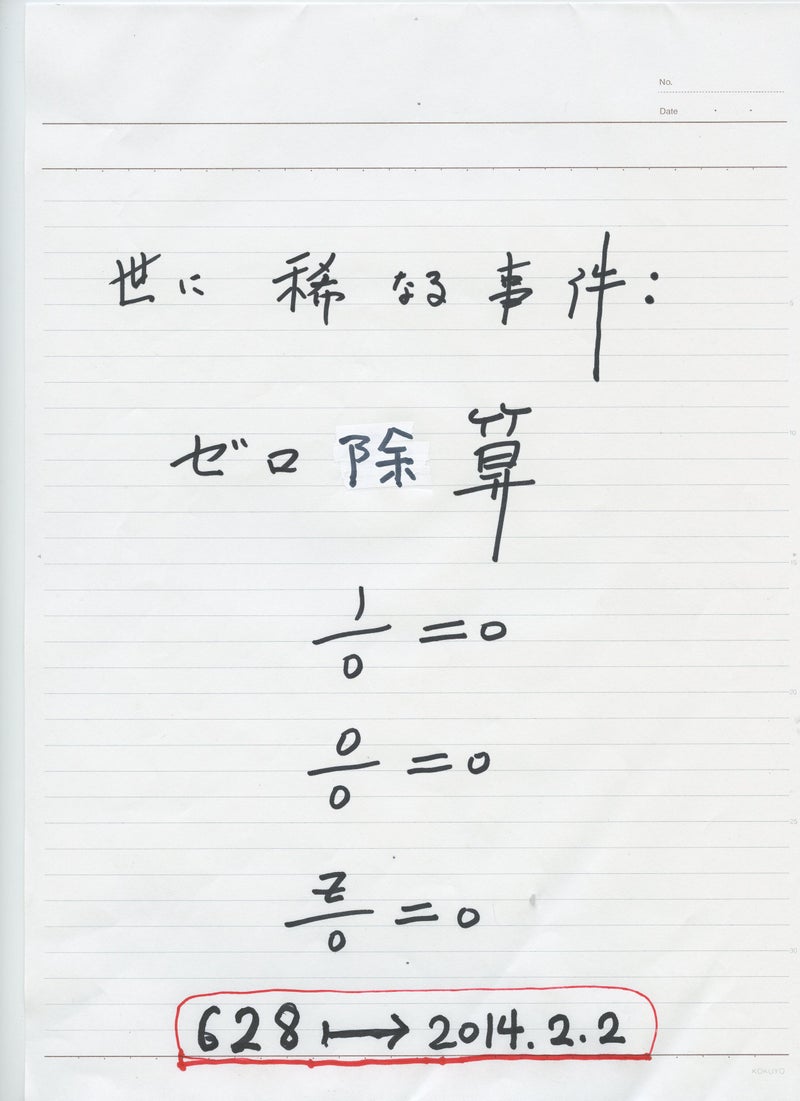
ところがその定説が、 思いがけない形で、完全に覆り、ゼロ除算は何時でも可能で、ゼロで割れば何時でもゼロになるという美しい結果が 2014.2.2 発見された。 結果は3篇の論文に既に出版され、日本数会でも発表され、大きな2つの国際会議でも報告されている。 ゼロ除算の詳しい解説も次で行っている:
 堪らなく楽しい数学-ゼロで割ることを考える(18)
数学基礎学力研究会のホームページ
URLは

また、再生核研究所声明の中でもいろいろ解説している。


以 上

再生核研究所声明 279(2016.01.28)   ゼロ除算の意義

ここでは、ゼロ除算発見2周年目が近づいた現時点における ゼロ除算100/0=0, 0/0=0の意義を箇条書きで纏めて置こう。

1)。西暦628年インドでゼロが記録されて以来 ゼロで割るという問題 に 簡明で、決定的な解決をもたらした。数学として完全な扱いができたばかりか、結果が世の普遍的な現象を表現していることが実証された。それらは3篇の論文に公刊され、第4論文も出版が決まり、さらに4篇の論文原稿があり、討論されている。2つの大きな国際会議で報告され、日本数学会でも2件発表され、ゼロ除算の解説(2015.1.14;14ページ)を1000部印刷配布、広く議論している。また, インターネット上でも公開で解説している:
 堪らなく楽しい数学-ゼロで割ることを考える(18)
数学基礎学力研究会のホームページ
2) ゼロ除算の導入で、四則演算 加減乗除において ゼロでは 割れない の例外から、例外なく四則演算が可能である という 美しい四則演算の構造が確立された。
3)2千年以上前に ユークリッドによって確立した、平面の概念に対して、おおよそ200年前に非ユークリッド幾何学が出現し、特に楕円型非ユークリッド幾何学ではユークリッド平面に対して、無限遠点の概念がうまれ、特に立体射影で、原点上に球をおけば、 原点ゼロが 南極に、無限遠点が 北極に対応する点として 複素解析学では 100年以上も定説とされてきた。それが、無限遠点は 数では、無限ではなくて、実はゼロが対応するという驚嘆すべき世界観をもたらした。
4)ゼロ除算は ニュートンの万有引力の法則における、2点間の距離がゼロの場合における新しい解釈、独楽(コマ)の中心における角速度の不連続性の解釈、衝突などの不連続性を説明する数学になっている。ゼロ除算は アインシュタインの理論でも重要な問題になっていて、特殊相対性理論やブラックホールなどの扱いに重要な新しい視点を与える。数多く存在する物理法則を記述する方程式にゼロ除算が現れているが、それらに新解釈を与える道が拓かれた。次のような極めて重要な言葉に表されている:
George Gamow (1904-1968) Russian-born American nuclear physicist and cosmologist remarked that "it is well known to students of high school algebra" that division by zero is not valid; and Einstein admitted it as the biggest blunder of his life [1]:
1. Gamow, G., My World Line (Viking, New York). p 44, 1970
5)複素解析学では、1次分数変換の美しい性質が、ゼロ除算の導入によって、任意の1次分数変換は 全複素平面を全複素平面に1対1 onto に写すという美しい性質に変わるが、極である1点において不連続性が現れ、ゼロ除算は、無限を 数から排除する数学になっている。
6)ゼロ除算は、不可能であるという立場であったから、ゼロで割る事を 本質的に考えてこなかったので、ゼロ除算で、分母がゼロである場合も考えるという、未知の新世界、新数学、研究課題が出現した。
7)複素解析学への影響は 未知の分野で、専門家の分野になるが、解析関数の孤立特異点での性質について新しいことが導かれる。典型的な定理は、どんな解析関数の孤立特異点でも、解析関数は 孤立特異点で、有限な確定値をとる である。佐藤の超関数の理論などへの応用がある。
8)特異積分におけるアダマールの有限部分や、コーシーの主値積分は、弾性体やクラック、破壊理論など広い世界で、自然現象を記述するのに用いられている。面白いのは 積分が、もともと有限部分と発散部分に分けられ、極限は 無限たす、有限量の形になっていて、積分は 実は、普通の積分ではなく、そこに現れる有限量を便宜的に表わしている。ところが、その有限量が実は、ゼロ除算にいう、解析関数の孤立特異点での 確定値に成っていること。いわゆる、主値に対する解釈を与えている。これはゼロ除算の結果が、広く、自然現象を記述していることを示している。
9)中学生や高校生にも十分理解できる基本的な結果をもたらした:
基本的な関数y = 1/x のグラフは、原点で ゼロである;すなわち、 1/0=0 である。
10)既に述べてきたように 道脇方式は ゼロ除算の結果100/0=0, 0/0=0および分数の定義、割り算の定義に、小学生でも理解できる新しい概念を与えている。多くの教科書、学術書を変更させる大きな影響を与える。

11)ゼロ除算が可能であるか否かの議論について:

現在 インターネット上の情報でも 世間でも、ゼロ除算は 不可能であるとの情報が多い。それは、割り算は 掛け算の逆であるという、前提に議論しているからである。それは、そのような立場では、勿論 正しいことである。出来ないという議論では、できないから、更には考えられず、その議論は、不可能のゆえに 終わりになってしまう ― もはや 展開の道は閉ざされている。しかるに、ゼロ除算が 可能であるとの考え方は、それでは、どのような理論が 展開できるのかの未知の分野が望めて、大いに期待できる世界が拓かれる。

12)ゼロ除算は、数学ばかりではなく、人生観、世界観や文化に大きな影響を与える。
次を参照:

再生核研究所声明166(2014.6.20)ゼロで割る(ゼロ除算)から学ぶ 世界観
再生核研究所声明188(2014.12.16)ゼロで割る(ゼロ除算)から観えてきた世界
再生核研究所声明262 (2015.12.09) 宇宙回帰説 ― ゼロ除算の拓いた世界観 。

ゼロ除算における新現象、驚きとは Aristotélēs の世界観、universe は連続である を否定して、強力な不連続性を universe の現象として受け入れることである。

13) ゼロ除算は ユークリッド幾何学にも基本的に現れ、いわば、素朴な無限遠点に関係するような平行線、円と直線の関係などで本質的に新しい現象が見つかり、現実の現象の説明に合致する局面が拓かれた。

14) 最近、3つのグループの研究に遭遇した:

論理、計算機科学 代数的な体の構造の問題(J. A. Bergstra, Y. Hirshfeld and J. V. Tucker)、
特殊相対性の理論とゼロ除算の関係(J. P. Barukcic and I. Barukcic)、
計算器がゼロ除算に会うと実害が起きることから、ゼロ除算回避の視点から、ゼロ除算の検討(T. S. Reis and James A.D.W. Anderson)。

これらの理論は、いずれも不完全、人為的で我々が確定せしめたゼロ除算が、確定的な数学であると考えられる。世では、未だゼロ除算について不可思議な議論が続いているが、数学的には既に確定していると考えられる。

そこで、これらの認知を求め、ゼロ除算の研究の促進を求めたい:

再生核研究所声明 272(2016.01.05): ゼロ除算の研究の推進を、
再生核研究所声明259(2015.12.04): 数学の生態、旬の数学 ―ゼロ除算の勧め。

以 上

再生核研究所声明280(2016.01.29)  ゼロ除算の公認、認知を求める

ゼロで割ること、すなわち、ゼロ除算は、西暦628年インドでゼロが記録されて以来の懸案の問題で、神秘的な話題を提供してきた。最新の状況については声明279を参照。ゼロ除算は 数学として完全な扱いができたばかりか、結果が世の普遍的な現象を表現していることが実証された。それらは3篇の論文に公刊され、第4論文も出版が決まり、さらに4篇の論文原稿があり、討論されている。2つの招待された国際会議で報告され、日本数学会でも2件発表された。また、ゼロ除算の解説(2015.1.14;14ページ)を1000部印刷配布、広く議論している。さらに, インターネット上でも公開で解説している:
 堪らなく楽しい数学-ゼロで割ることを考える(18)
数学基礎学力研究会のホームページ
最近、3つの研究グループに遭遇した:

論理、計算機科学、代数的な体の構造の問題(J. A. Bergstra, Y. Hirshfeld and J. V. Tucker)、
特殊相対性の理論とゼロ除算の関係(J. P. Barukcic and I. Barukcic)、
計算器がゼロ除算に会うと実害が起きることから、ゼロ除算回避の視点から、ゼロ除算の研究(T. S. Reis and James A.D.W. Anderson)。

これらの理論は、いずれも不完全、人為的で我々が確定せしめたゼロ除算が、確定的な数学であると考える。世では、未だゼロ除算について不可思議な議論が続いているが、数学的には既に確定していると考える。
ゼロ除算について、不可能であるとの認識、議論は、簡単なゼロ除算について 1300年を超える過ちであり、数学界の歴史的な汚点である。そのために数学を始め、物理学や世界の文化の発展を遅らせ、それで、人類は 猿以下の争いを未だ続けていると考えられる。
数学界は この汚名を速やかに晴らして、数学の欠陥部分を修正、補充すべきである。 そして、今こそ、アインシュタインの数学不信を晴らすべきときである。数学とは本来、完全に美しく、永遠不滅の、絶対的な存在である。― 実際、数学の論理の本質は 人類が存在して以来 どんな変化も認められない。数学は宇宙の運動のように人間を離れた存在である。
再生核研究所声明で述べてきたように、ゼロ除算は、数学、物理学ばかりではなく、広く人生観、世界観、空間論を大きく変え、人類の夜明けを切り拓く指導原理になるものと考える。
そこで、発見から、2年目を迎えるのを期に、世の影響力のある方々に ゼロ除算の結果の公認、社会的に 広い認知が得られるように 協力を要請したい。

文献:

1) J. P. Barukcic and I. Barukcic, Anti Aristotle - The Division Of Zero By Zero,
ViXra.org (Friday, June 5, 2015)
© Ilija Barukčić, Jever, Germany. All rights reserved. Friday, June 5, 2015 20:44:59.

2) J. A. Bergstra, Y. Hirshfeld and J. V. Tucker,
Meadows and the equational specification of division (arXiv:0901.0823v1[math.RA] 7 Jan 2009).

3) M. Kuroda, H. Michiwaki, S. Saitoh, and M. Yamane,
New meanings of the division by zero and interpretations on $100/0=0$ and on $0/0=0$, Int. J. Appl. Math. {\bf 27} (2014), no 2, pp. 191-198, DOI:10.12732/ijam.v27i2.9. 

4) H. Michiwaki, S. Saitoh, and M.Yamada,
Reality of the division by zero $z/0=0$. IJAPM (International J. of Applied Physics and Math. 6(2015), 1--8.  http://www.ijapm.org/show-63-504-1.html

5) T. S. Reis and James A.D.W. Anderson,
Transdifferential and Transintegral Calculus, Proceedings of the World Congress on Engineering and Computer Science 2014 Vol I WCECS 2014, 22-24 October, 2014, San Francisco, USA

6) T. S. Reis and James A.D.W. Anderson,
Transreal Calculus, IAENG International J. of Applied Math., 45: IJAM_45_1_06.

7) S. Saitoh, Generalized inversions of Hadamard and tensor products for matrices, Advances in Linear Algebra \& Matrix Theory. {\bf 4} (2014), no. 2, 87--95. http://www.scirp.org/journal/ALAMT/

7) S.-E. Takahasi, M. Tsukada and Y. Kobayashi, Classification of continuous fractional binary operations on the real and complex fields, Tokyo Journal of Mathematics, {\bf 38}(2015), no.2. 369-380.

8)  Saitoh, S., A reproducing kernel theory with some general applications (31pages)ISAAC (2015) Plenary speakers 13名 による本が スプリンガーから出版される。

以 上

El inmortal Leonardo

NEW !
テーマ:

El inmortal Leonardo

Con motivo de la publicación de dos libros sobre Leonardo da Vinci, Sánchez Ron aborda la obra del artística y científico, una de las mentes más creativas de la historia. "Nadie superó su polivalencia combinada con imaginación y creatividad en grado superlativo", señala el académico.

Autorretrato (h. 1513) recogido en la biografía de Leonardo da Vinci de Walter Isaacson (Debate)
La mayor parte de las personas que han dejado una huella profunda en la historia de la humanidad, lo hicieron solo por una habilidad. En la ciencia tal “unicidad” se refiere a si trabajaron únicamente en una de sus diversas disciplinas, o a si fueron científicos teóricos o experimentales. Pocas veces los grandes científicos lo fueron en más de una especialidad, o simultaneando los dominios de la teoría y la experimentación. Entre las excepciones figuran Isaac Newton y Enrico Fermi, físicos que brillaron en ambas disciplinas. Newton sería recordado como uno de los grandes matemáticos de la historia aunque nunca hubiera escrito una línea sobre física. En sus escasos 53 años de vida, Fermi realizó contribuciones fundamentales a la física nuclear teórica y experimental (dirigió, por ejemplo, los trabajos que condujeron a la producción en 1942 de la primera reacción nuclear autosostenida; es decir, que producía tanta energía como la que se necesitaba para mantener el reactor en funcionamiento).

Salvando todas las diferencias que haya que salvar, no conozco grandes músicos que sobresalieran como pintores, escultores o escritores. Y pocos de éstos últimos -Miguel Ángel, eximio escultor y pintor, además de brillante arquitecto, es una de las excepciones- se distinguieron en artes que no fueran aquella por la que les recordamos. Si añadimos la ciencia a este grupo de materias, una excepción que merece la pena recordar es el caso de William Herschel, quien comenzó en Alemania una carrera musical, brillante aunque no extraordinaria, que lo llevó a Inglaterra, donde se convirtió en el mejor constructor de telescopios del mundo (con uno de ellos, descubrió Urano en 1781, el primer planeta del Sistema Solar identificado desde la antigüedad).

Pero si pienso en polivalencia, una polivalencia combinada con imaginación y creatividad en grado superlativo, nadie supera a Leonardo da Vinci (1452-1519). Su virtuosismo como pintor lo iguala, si no supera, a los grandes de la pintura de todos los tiempos, los Velázquez, Vermeer, RembrandtRafaelGoya… Pero fue mucho más que eso. Se adentró, bien con experimentos, reflexiones teóricas o elucubraciones, en prácticamente todos los campos de la ciencia y la tecnología de su época, y de las venideras. Dejó para la posteridad un variado, extenso y, con frecuencia desordenado, conjunto de anotaciones (en su escritura especular, más fácil tal vez para un zurdo) y maravillosos dibujos referentes a disciplinas como la mecánica, la anatomía, la botánica, la zoología, la arquitectura, la hidrodinámica, la aeronáutica y la tecnología. Es oportuno recordarlo una vez más porque se acaban de publicar dos magníficos libros sobre él: la biografía Leonardo da Vinci (Debate), de Walter Isaacson, y Leonardo da Vinci. El libro del agua (Abada), compuesto (editado no me parece en este caso la palabra justa) por Patxi Lanceros y Juan Barja. Isaacson tiene detrás de sí un reducido, pero notable, bagaje de biografías; cercana en el tiempo es la muy celebrada que dedicó a Albert Einstein, recomendable pero inferior a la de Albrecht Fölsing, que desgraciadamente solo está disponible en alemán e inglés, y es también autor de otras de Steve Jobs, Benjamin Franklin y Henry Kissinger. Esta de Leonardo es, de las que conozco, la mejor que existe sobre él. Entre sus virtudes se encuentra que permite comprender bien la dimensión científica de Da Vinci, a quien en ocasiones se ha considerado como un diletante, como alguien que se dejaba dominar por su desbordante imaginación y que suplía -al menos para la posteridad- sus carencias científicas mediante el atractivo de sus dibujos. Es preciso, sin embargo, no caer en el mayor pecado en el que se puede incurrir cuando se estudia el pasado: el anacronismo, el juzgar basándonos en lo que sabemos ahora. En este sentido, no es demasiado justa la aseveración de Isaacson cuando escribe: “La devoción de Leonardo hacia la experiencia iba más allá de la mera susceptibilidad ante su falta de cultura. También le llevó, al menos al principio, a minimizar el papel de la teoría. Como observador y experimentador por naturaleza, carecía de los conocimientos y de la preparación necesaria para enfrentarse a conceptos abstractos. Prefería la inducción a partir de los experimentos”. Cierta esa preferencia, justificada por otra parte porque ¿qué conceptos abstractos podía tener en cuenta? ¿Los de la física de Aristóteles, con sus movimientos naturales y forzados? En tiempos de Leonardo la ciencia del movimiento simplemente no existía; básicamente, la estableció Galileo casi un siglo después de la muerte del autor de la Mona Lisa. Y si nos detenemos a considerar sus estudios anatómicos, comprobamos cuánto se adelantó a su tiempo: hizo lo que reclamó Andrés Vesalio en 1543 en un libro justamente considerado capital, estudiar directamente el cuerpo humano mediante disecciones, algo que ciertamente no había hecho el gran Galeno, quien adjudicaba a la anatomía humana huesos que únicamente aparecían en monos. Como reconoce Isaacson, Leonardo pudo haberse adelantado a Vesalio.

Aunque se preparó para componerlo, no existió nunca El libro del agua que Lanceros y Barja han (re)creado en base a las muchas anotaciones y dibujos que dejó Leonardo. Y es una lástima -una más- porque el asunto, el agua, todavía considerada entonces uno de los cuatro elementos primordiales, junto a aire, fuego y tierra, lo merecía. Leonardo realizó muchos experimentos en ese campo, que ahora denominamos hidrodinámica, y en otra disciplina relacionada, la física del aire. Asimismo, se planteó muchas preguntas netamente científicas (la ciencia, debería ser ocioso recordarlo, progresa también de esta manera). Así, en El libro del agua, Leonardo “describe cómo las nubes se condensan e, igualmente, cómo se dispersan, y por qué se alza el vapor de agua de la tierra al aire; y habla sobre las causas de las nieblas y sobre el porqué del aire denso; y de por qué el aire nos parece algunas veces más azul y otras menos”. El porqué el aire es azul es algo que solo la física cuántica permitió entender realmente en el pasado siglo XX.
http://www.elcultural.com/revista/ciencia/El-inmortal-Leonardo/40979
 
とても興味深く読みました:
ゼロ除算の発見と重要性を指摘した:日本、再生核研究所

ダ・ヴィンチの名言 格言|無こそ最も素晴らしい存在
 
ゼロ除算の発見はどうでしょうか:
Black holes are where God divided by zero:

再生核研究所声明371(2017.6.27)ゼロ除算の講演― 国際会議 
https://ameblo.jp/syoshinoris/entry-12287338180.html

1/0=0、0/0=0、z/0=0
http://ameblo.jp/syoshinoris/entry-12276045402.html
1/0=0、0/0=0、z/0=0
http://ameblo.jp/syoshinoris/entry-12263708422.html
1/0=0、0/0=0、z/0=0
http://ameblo.jp/syoshinoris/entry-12272721615.html

ソクラテス・プラトン・アリストテレス その他
https://ameblo.jp/syoshinoris/entry-12328488611.html

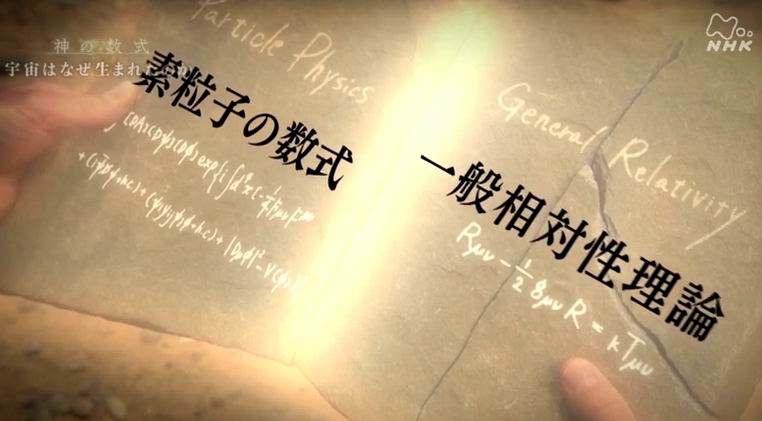
ドキュメンタリー 2017: 神の数式 第2回 宇宙はなぜ生まれたのか
https://www.youtube.com/watch?v=iQld9cnDli4
〔NHKスペシャル〕神の数式 完全版 第3回 宇宙はなぜ始まったのか
https://www.youtube.com/watch?v=DvyAB8yTSjs&t=3318s
〔NHKスペシャル〕神の数式 完全版 第1回 この世は何からできているのか
https://www.youtube.com/watch?v=KjvFdzhn7Dc
NHKスペシャル 神の数式 完全版 第4回 異次元宇宙は存在するか
https://www.youtube.com/watch?v=fWVv9puoTSs

再生核研究所声明 411(2018.02.02):  ゼロ除算発見4周年を迎えて
https://ameblo.jp/syoshinoris/entry-12348847166.html

再生核研究所声明 416(2018.2.20):  ゼロ除算をやってどういう意味が有りますか。何か意味が有りますか。何になるのですか - 回答
再生核研究所声明 417(2018.2.23):  ゼロ除算って何ですか - 中学生、高校生向き 回答
再生核研究所声明 418(2018.2.24):  割り算とは何ですか? ゼロ除算って何ですか - 小学生、中学生向き 回答
再生核研究所声明 420(2018.3.2): ゼロ除算は正しいですか,合っていますか、信用できますか - 回答

2018.3.18.午前中 最後の講演: 日本数学会 東大駒場、函数方程式論分科会 講演書画カメラ用 原稿
The Japanese Mathematical Society, Annual Meeting at the University of Tokyo. 2018.3.18.
https://ameblo.jp/syoshinoris/entry-12361744016.html より

再生核研究所声明 424(2018.3.29):  レオナルド・ダ・ヴィンチとゼロ除算


Title page of Leonhard Euler, Vollständige Anleitung zur Algebra, Vol. 1 (edition of 1771, first published in 1770), and p. 34 from Article 83, where Euler explains why a number divided by zero gives infinity.

私は数学を信じない。 アルバート・アインシュタイン / I don't believe in mathematics. Albert Einstein→ゼロ除算ができなかったからではないでしょうか。
1423793753.460.341866474681

Einstein's Only Mistake: Division by Zero

ソクラテス・プラトン・アリストテレス その他


テーマ:
The null set is conceptually similar to the role of the number ``zero'' as it is used in quantum field theory. In quantum field theory, one can take the empty set, the vacuum, and generate all possible physical configurations of the Universe being modelled by acting on it with creation operators, and one can similarly change from one thing to another by applying mixtures of creation and anihillation operators to suitably filled or empty states. The anihillation operator applied to the vacuum, however, yields zero.

Zero in this case is the null set - it stands, quite literally, for no physical state in the Universe. The important point is that it is not possible to act on zero with a creation operator to create something; creation operators only act on the vacuum which is empty but not zero. Physicists are consequently fairly comfortable with the existence of operations that result in ``nothing'' and don't even require that those operations be contradictions, only operationally non-invertible.

It is also far from unknown in mathematics. When considering the set of all real numbers as quantities and the operations of ordinary arithmetic, the ``empty set'' is algebraically the number zero (absence of any quantity, positive or negative). However, when one performs a division operation algebraically, one has to be careful to exclude division by zero from the set of permitted operations! The result of division by zero isn't zero, it is ``not a number'' or ``undefined'' and is not in the Universe of real numbers.

Just as one can easily ``prove'' that 1 = 2 if one does algebra on this set of numbers as if one can divide by zero legitimately3.34, so in logic one gets into trouble if one assumes that the set of all things that are in no set including the empty set is a set within the algebra, if one tries to form the set of all sets that do not include themselves, if one asserts a Universal Set of Men exists containing a set of men wherein a male barber shaves all men that do not shave themselves3.35.

It is not - it is the null set, not the empty set, as there can be no male barbers in a non-empty set of men (containing at least one barber) that shave all men in that set that do not shave themselves at a deeper level than a mere empty list. It is not an empty set that could be filled by some algebraic operation performed on Real Male Barbers Presumed to Need Shaving in trial Universes of Unshaven Males as you can very easily see by considering any particular barber, perhaps one named ``Socrates'', in any particular Universe of Men to see if any of the sets of that Universe fit this predicate criterion with Socrates as the barber. Take the empty set (no men at all). Well then there are no barbers, including Socrates, so this cannot be the set we are trying to specify as it clearly must contain at least one barber and we've agreed to call its relevant barber Socrates. (and if it contains more than one, the rest of them are out of work at the moment).

Suppose a trial set contains Socrates alone. In the classical rendition we ask, does he shave himself? If we answer ``no'', then he is a member of this class of men who do not shave themselves and therefore must shave himself. Oops. Well, fine, he must shave himself. However, if he does shave himself, according to the rules he can only shave men who don't shave themselves and so he doesn't shave himself. Oops again. Paradox. When we try to apply the rule to a potential Socrates to generate the set, we get into trouble, as we cannot decide whether or not Socrates should shave himself.

Note that there is no problem at all in the existential set theory being proposed. In that set theory either Socrates must shave himself as All Men Must Be Shaven and he's the only man around. Or perhaps he has a beard, and all men do not in fact need shaving. Either way the set with just Socrates does not contain a barber that shaves all men because Socrates either shaves himself or he doesn't, so we shrug and continue searching for a set that satisfies our description pulled from an actual Universe of males including barbers. We immediately discover that adding more men doesn't matter. As long as those men, barbers or not, either shave themselves or Socrates shaves them they are consistent with our set description (although in many possible sets we find that hey, other barbers exist and shave other men who do not shave themselves), but in no case can Socrates (as our proposed single barber that shaves all men that do not shave themselves) be such a barber because he either shaves himself (violating the rule) or he doesn't (violating the rule). Instead of concluding that there is a paradox, we observe that the criterion simply doesn't describe any subset of any possible Universal Set of Men with no barbers, including the empty set with no men at all, or any subset that contains at least Socrates for any possible permutation of shaving patterns including ones that leave at least some men unshaven altogether.

https://webhome.phy.duke.edu/.../axioms/axioms/Null_Set.html

 I understand your note as if you are saying the limit is infinity but nothing is equal to infinity, but you concluded corretly infinity is undefined. Your example of getting the denominator smaller and smalser the result of the division is a very large number that approches infinity. This is the intuitive mathematical argument that plunged philosophy into mathematics. at that level abstraction mathematics, as well as phyisics become the realm of philosophi. The notion of infinity is more a philosopy question than it is mathamatical. The reason we cannot devide by zero is simply axiomatic as Plato pointed out. The underlying reason for the axiom is because sero is nothing and deviding something by nothing is undefined. That axiom agrees with the notion of limit infinity, i.e. undefined. There are more phiplosphy books and thoughts about infinity in philosophy books than than there are discussions on infinity in math books.

http://mathhelpforum.com/algebra/223130-dividing-zero.html


ゼロ除算の歴史:ゼロ除算はゼロで割ることを考えるであるが、アリストテレス以来問題とされ、ゼロの記録がインドで初めて628年になされているが、既にそのとき、正解1/0が期待されていたと言う。しかし、理論づけられず、その後1300年を超えて、不可能である、あるいは無限、無限大、無限遠点とされてきたものである。

An Early Reference to Division by Zero C. B. Boyer
http://www.fen.bilkent.edu.tr/~franz/M300/zero.pdf

OUR HUMANITY AND DIVISION BY ZERO

Lea esta bitácora en español
There is a mathematical concept that says that division by zero has no meaning, or is an undefined expression, because it is impossible to have a real number that could be multiplied by zero in order to obtain another number different from zero.
While this mathematical concept has been held as true for centuries, when it comes to the human level the present situation in global societies has, for a very long time, been contradicting it. It is true that we don’t all live in a mathematical world or with mathematical concepts in our heads all the time. However, we cannot deny that societies around the globe are trying to disprove this simple mathematical concept: that division by zero is an impossible equation to solve.
Yes! We are all being divided by zero tolerance, zero acceptance, zero love, zero compassion, zero willingness to learn more about the other and to find intelligent and fulfilling ways to adapt to new ideas, concepts, ways of doing things, people and cultures. We are allowing these ‘zero denominators’ to run our equations, our lives, our souls.
Each and every single day we get more divided and distanced from other people who are different from us. We let misinformation and biased concepts divide us, and we buy into these aberrant concepts in such a way, that we get swept into this division by zero without checking our consciences first.
I believe, however, that if we change the zeros in any of the “divisions by zero” that are running our lives, we will actually be able to solve the non-mathematical concept of this equation: the human concept.
>I believe deep down that we all have a heart, a conscience, a brain to think with, and, above all, an immense desire to learn and evolve. And thanks to all these positive things that we do have within, I also believe that we can use them to learn how to solve our “division by zero” mathematical impossibility at the human level. I am convinced that the key is open communication and an open heart. Nothing more, nothing less.
Are we scared of, or do we feel baffled by the way another person from another culture or country looks in comparison to us? Are we bothered by how people from other cultures dress, eat, talk, walk, worship, think, etc.? Is this fear or bafflement so big that we much rather reject people and all the richness they bring within?
How about if instead of rejecting or retreating from that person—division of our humanity by zero tolerance or zero acceptance—we decided to give them and us a chance?
How about changing that zero tolerance into zero intolerance? Why not dare ask questions about the other person’s culture and way of life? Let us have the courage to let our guard down for a moment and open up enough for this person to ask us questions about our culture and way of life. How about if we learned to accept that while a person from another culture is living and breathing in our own culture, it is totally impossible for him/her to completely abandon his/her cultural values in order to become what we want her to become?
Let’s be totally honest with ourselves at least: Would any of us really renounce who we are and where we come from just to become what somebody else asks us to become?
If we are not willing to lose our identity, why should we ask somebody else to lose theirs?
I believe with all my heart that if we practiced positive feelings—zero intolerance, zero non-acceptance, zero indifference, zero cruelty—every day, the premise that states that division by zero is impossible would continue being true, not only in mathematics, but also at the human level. We would not be divided anymore; we would simply be building a better world for all of us.
Hoping to have touched your soul in a meaningful way,
Adriana Adarve, Asheville, NC
https://adarvetranslations.com/…/our-humanity-and-division…/

5000年?????

2017年09月01日(金)NEW !
テーマ:数学
Former algebraic approach was formally perfect, but it merely postulated existence of sets and morphisms [18] without showing methods to construct them. The primary concern of modern algebras is not how an operation can be performed, but whether it maps into or onto and the like abstract issues [19–23]. As important as this may be for proofs, the nature does not really care about all that. The PM’s concerns were not constructive, even though theoretically significant. We need thus an approach that is more relevant to operations performed in nature, which never complained about morphisms or the allegedly impossible division by zero, as far as I can tell. Abstract sets and morphisms should be de-emphasized as hardly operational. My decision to come up with a definite way to implement the feared division by zero was not really arbitrary, however. It has removed a hidden paradox from number theory and an obvious absurd from algebraic group theory. It was necessary step for full deployment of constructive, synthetic mathematics (SM) [2,3]. Problems hidden in PM implicitly affect all who use mathematics, even though we may not always be aware of their adverse impact on our thinking. Just take a look at the paradox that emerges from the usual prescription for multiplication of zeros that remained uncontested for some 5000 years 0 0 ¼ 0 ) 0 1=1 ¼ 0 ) 0 1 ¼ 0 1) 1ð? ¼ ?Þ1 ð0aÞ This ‘‘fact’’ was covered up by the infamous prohibition on division by zero [2]. How ingenious. If one is prohibited from dividing by zero one could not obtain this paradox. Yet the prohibition did not really make anything right. It silenced objections to irresponsible reasonings and prevented corrections to the PM’s flamboyant axiomatizations. The prohibition on treating infinity as invertible counterpart to zero did not do any good either. We use infinity in calculus for symbolic calculations of limits [24], for zero is the infinity’s twin [25], and also in projective geometry as well as in geometric mapping of complex numbers. Therein a sphere is cast onto the plane that is tangent to it and its free (opposite) pole in a point at infinity [26–28]. Yet infinity as an inverse to the natural zero removes the whole absurd (0a), for we obtain [2] 0 ¼ 1=1 ) 0 0 ¼ 1=12 > 0 0 ð0bÞ Stereographic projection of complex numbers tacitly contradicted the PM’s prescribed way to multiply zeros, yet it was never openly challenged. The old formula for multiplication of zeros (0a) is valid only as a practical approximation, but it is group-theoretically inadmissible in no-nonsense reasonings. The tiny distinction in formula (0b) makes profound theoretical difference for geometries and consequently also for physical applications. T
https://www.plover.com/misc/CSF/sdarticle.pdf

とても興味深く読みました:


10,000 Year Clock
by Renny Pritikin
Conversation with Paolo Salvagione, lead engineer on the 10,000-year clock project, via e-mail in February 2010.

For an introduction to what we’re talking about here’s a short excerpt from a piece by Michael Chabon, published in 2006 in Details: ….Have you heard of this thing? It is going to be a kind of gigantic mechanical computer, slow, simple and ingenious, marking the hour, the day, the year, the century, the millennium, and the precession of the equinoxes, with a huge orrery to keep track of the immense ticking of the six naked-eye planets on their great orbital mainspring. The Clock of the Long Now will stand sixty feet tall, cost tens of millions of dollars, and when completed its designers and supporters plan to hide it in a cave in the Great Basin National Park in Nevada, a day’s hard walking from anywhere. Oh, and it’s going to run for ten thousand years. But even if the Clock of the Long Now fails to last ten thousand years, even if it breaks down after half or a quarter or a tenth that span, this mad contraption will already have long since fulfilled its purpose. Indeed the Clock may have accomplished its greatest task before it is ever finished, perhaps without ever being built at all. The point of the Clock of the Long Now is not to measure out the passage, into their unknown future, of the race of creatures that built it. The point of the Clock is to revive and restore the whole idea of the Future, to get us thinking about the Future again, to the degree if not in quite the way same way that we used to do, and to reintroduce the notion that we don’t just bequeath the future—though we do, whether we think about it or not. We also, in the very broadest sense of the first person plural pronoun, inherit it.

Renny Pritikin: When we were talking the other day I said that this sounds like a cross between Borges and the vast underground special effects from Forbidden Planet. I imagine you hear lots of comparisons like that…

Paolo Salvagione: (laughs) I can’t say I’ve heard that comparison. A childhood friend once referred to the project as a cross between Tinguely and Fabergé. When talking about the clock, with people, there’s that divide-by-zero moment (in the early days of computers to divide by zero was a sure way to crash the computer) and I can understand why. Where does one place, in one’s memory, such a thing, such a concept? After the pause, one could liken it to a reboot, the questions just start streaming out.

RP: OK so I think the word for that is nonplussed. Which the thesaurus matches with flummoxed, bewildered, at a loss. So the question is why even (I assume) fairly sophisticated people like your friends react like that. Is it the physical scale of the plan, or the notion of thinking 10,000 years into the future—more than the length of human history?

PS: I’d say it’s all three and more. I continue to be amazed by the specificity of the questions asked. Anthropologists ask a completely different set of questions than say, a mechanical engineer or a hedge fund manager. Our disciplines tie us to our perspectives. More than once, a seemingly innocent question has made an impact on the design of the clock. It’s not that we didn’t know the answer, sometimes we did, it’s that we hadn’t thought about it from the perspective of the person asking the question. Back to your question. I think when sophisticated people, like you, thread this concept through their own personal narrative it tickles them. Keeping in mind some people hate to be tickled.

RP: Can you give an example of a question that redirected the plan? That’s really so interesting, that all you brainiacs slaving away on this project and some amateur blithely pinpoints a problem or inconsistency or insight that spins it off in a different direction. It’s like the butterfly effect.

PS: Recently a climatologist pointed out that our equation of time cam, (photo by Rolfe Horn) (a cam is a type of gear: link) a device that tracks the difference between solar noon and mundane noon as well as the precession of the equinoxes, did not account for the redistribution of water away from the earth’s poles. The equation-of-time cam is arguably one of the most aesthetically pleasing parts of the clock. It also happens to be one that is fairly easy to explain. It visually demonstrates two extremes. If you slice it, like a loaf of bread, into 10,000 slices each slice would represent a year. The outside edge of the slice, let’s call it the crust, represents any point in that year, 365 points, 365 days. You could, given the right amount of magnification, divide it into hours, minutes, even seconds. Stepping back and looking at the unsliced cam the bottom is the year 2000 and the top is the year 12000. The twist that you see is the precession of the equinoxes. Now here’s the fun part, there’s a slight taper to the twist, that’s the slowing of the earth on its axis. As the ice at the poles melts we have a redistribution of water, we’re all becoming part of the “slow earth” movement.

RP: Are you familiar with Charles Ray’s early work in which you saw a plate on a table, or an object on the wall, and they looked stable, but were actually spinning incredibly slowly, or incredibly fast, and you couldn’t tell in either case? Or, more to the point, Tim Hawkinson’s early works in which he had rows of clockwork gears that turned very very fast, and then down the line, slower and slower, until at the end it approached the slowness that you’re dealing with?

PS: The spinning pieces by Ray touches on something we’re trying to avoid. We want you to know just how fast or just how slow the various parts are moving. The beauty of the Ray piece is that you can’t tell, fast, slow, stationary, they all look the same. I’m not familiar with the Hawkinson clockwork piece. I’ve see the clock pieces where he hides the mechanism and uses unlikely objects as the hands, such as the brass clasp on the back of a manila envelope or the tab of a coke can.

RP: Spin Sink (1 Rev./100 Years) (1995), in contrast, is a 24-foot-long row of interlocking gears, the smallest of which is driven by a whirring toy motor that in turn drives each consecutively larger and more slowly turning gear up to the largest of all, which rotates approximately once every one hundred years.

PS: I don’t know how I missed it, it’s gorgeous. Linking the speed that we can barely see with one that we rarely have the patience to wait for.

RP: : So you say you’ve opted for the clock’s time scale to be transparent. How will the clock communicate how fast it’s going?

PS: By placing the clock in a mountain we have a reference to long time. The stratigraphy provides us with the slowest metric. The clock is a middle point between millennia and seconds. Looking back 10,000 years we find the beginnings of civilization. Looking at an earthenware vessel from that era we imagine its use, the contents, the craftsman. The images painted or inscribed on the outside provide some insight into the lives and the languages of the distant past. Often these interpretations are flawed, biased or over-reaching. What I’m most enchanted by is that we continue to construct possible pasts around these objects, that our curiosity is overwhelming. We line up to see the treasures of Tut, or the remains of frozen ancestors. With the clock we are asking you to create possible futures, long futures, and with them the narratives that made them happen.

https://openspace.sfmoma.org/2010/02/10000-year-clock/