オイラー物語のはじまり~数の世界のシンフォニー
2016.4.28(木) 桜井 進
すべてはこのために
π、sin、log、そしてネイピア数eと連載を続けてきました。
「驚異の数、円周率 πの世界~現代に甦るラマヌジャンの公式」
「三角比が三角関数に変身するまでの長い旅」
「ジョン・ネイピア物語~対数logはlogos(神の言葉)」
「ジョン・ネイピア物語~対数は天文学者の寿命を2倍にした」
「ジョン・ネイピア物語 対数から生まれた「・」」
「ジョン・ネイピア物語は終わらない~ネイピア数e誕生物語」
これら6回の連載はそれぞれが、その時代の物語として独立しています。しかし、これから語るオイラー物語を知るならば、そのすべてが今回のためにあることが分かります。数学という物語は、つながった物語だということです。
π、sin、log、eのすべてが、1本の数式に統合されていくことになろうとは誰が予想したでしょう。
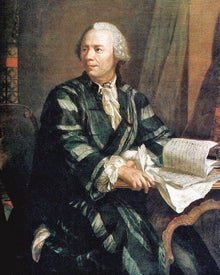
満を持して、その風景にたどり着いた者こそ、数学者オイラー(1707-1783)です。これから、彼が見た原風景にみなさんをナビゲートしていきます。
計算は旅
イコールというレールを数式という列車が走る
サイエンスナビゲーターⓇ 桜井進
すべてがつながるまでの後1歩 虚数誕生物語
虚数i。その不思議な名前の数なくして、π、sin、log、eのすべてが統合されることはありませんでした。
i×i=ー1
という不思議な性質を持つ数です。
数の世界を「拡張」することで虚数は出現します。数と計算の関係から、数の世界が拡張されていきます。
http://jbpress.ismedia.jp/articles/-/46714
「0」には2つの意味があります。最初に考えだされた0は「その位に何もない」という意味の「空位の0(数字の0)」で、古代バビロニアの人たちも使っていました。
ところが7世紀頃のインド人は、「何もないものの個数」という意味の「無の0(数としての0)」を考えだしました。そのおかげで、十進位取り記数法による数の計算ができるようになりました。
インドの数学者プラマグプタ(598-668)は著書の中で、「数としての0」のルール── a+0=a、0+0=0、a-0=a、0-0=0、a×0=0、0×0=0など──を説明しています。
数0を黒点「・」で表したインド数字は8世紀頃にアラビアに伝わり、そこから12世紀頃になりヨーロッパに伝わり、そして16世紀に現在の数字であるアラビア数字になりました。
アラビア数字は計算に適した数字であることからアラビア算用数字とも呼ばれます。
こうして、数0ができあがることで「負の数」が現れます。たし算3+□=0をみたす□がー3という負の数です。自然数(1、2、3、・・・)と0と負の自然数を合わせた数が「整数」です。
この□を用いた式は方程式にほかなりません。自然数と0だけの数の世界とたし算(ひき算)を考えたときに「負の数」が必要となると考えるのです。
同じようにして整数とかけ算を考えることで分数(有理数)という新しい数が必要となります。3×□=ー5をみたす□は、整数の世界には見つかりません。
□=ー5/3という数が有理数です。ちなみに、この用語は英語rational numberの訳なのですが、ratioとは比を意味するので直訳は「比なる数」という意味です。この奇妙な翻訳のいきさつはまた別の機会で述べることにします。
有理数とかけ算を考えることで新しい数が必要になります。□×□=2をみたす□は、有理数(自然数、整数を含む)の中に見つかりません。http://jbpress.ismedia.jp/articles/-/46714?page=2
□=1.41421356・・・は無理数(irrational number)と呼ばれる数です。√2とも表される数で、小数点以下が循環することなく無限に続く数のことです。自然数、0、整数、有理数、無理数をまとめた数の世界が「実数(real number)」です。
普通私たちが使う数は実数です。黄金率φ(1.618・・・)、円周率π(3.14・・・)、ネイピア数e(2.718・・・)も実数です。
数と計算は文明とともに進化してきました。その歴史の中で、数は、自然数、0、負の数、有理数、無理数、実数と、大きく拡張されていきました。
そして問題の拡張に遭遇します。方程式□×□=2は実数の中に□が見つかりますが、□×□=ー2という問題です。
この方程式をみたす□という数は実数の世界には存在しません。そこで登場するのが、虚数です。
虚数i
この新しい数「虚数」が発見され認められるまで実に長い年月が必要でした。
そもそも0や負の数という実数でさえ、長い時間を経てようやく普及したのですから、虚数が人間の中でリアリティを獲得するのに長い時間が必要なのは当然です。
16世紀、イタリアの数学者カルダノ(1501-1576)は、3次方程式の解く際にはじめて虚数の概念を導入しました。http://jbpress.ismedia.jp/articles/-/46714?page=3
フランスの哲学者・数学者デカルト(1596-1650)が虚数を「想像上の数」と名付けたことが英語のimaginary numberの語源となりました。
デカルトによるこの命名は新しい数を否定的に捉えていたからでした。デカルトの時代、0や負の数ですら架空の数と考えられていました。
□×□=-2をみたす数を数学者ですら容易に受け入れることはできませんでした。面白いことに、現在、わが国の理工系学生でさえ虚数は「実在しない数」だと思っている人が大勢います。
その原因は、実数にはあるリアリティ(例えば、定規にかかれた数字は実数を表しています)が虚数にはないからだと考えられます。
さらにそのことが「虚数」や「imaginary number」という否定的な言葉によって後押しされているのではないでしょうか。まさにデカルトのネガティブ思考は今に生きています。
ところで、虚数は実在します。数の世界に実在します。実数も同じで、数の世界に実数は存在します。実数も虚数も、どちらも人間が考え出した“imaginary”numberだということです。この内容は、容易でない問題ですからいずれ連載でとりあげます。
ところで、数の拡張はどこまでいくのでしょうか。
虚数iと2つの実数xとyを合わせた、複合的な(complex)数x+iyを複素数(complex number)と呼びます。これは2元数とも呼ばれます。2次元の数という意味です。
興味深いことに、3元数(3次元の数)は“役に立たない(論理的整合性を持たないという意味)”数なのですが、4元数(4次元の数)は“役に立つ”数です。
発見者にちなんでハミルトン数とも呼ばれます。コンピューター・グラフィックスの世界では、3次元の回転を計算するのに4元数が応用されています。
このような数の世界の拡張に関する分野を「超複素数理論」といいます。超複素数理論は驚くべき定理を私たちに突きつけてくることになるのですが、話を元に戻さなくてはなりません。http://jbpress.ismedia.jp/articles/-/46714?page=4
そして、すべてがつながる
かくして、数の主人公
π、sin、log、e、そしてi
はすべて揃い、驚異の風景を描く準備ができました。
1748年、オイラーは著書『無限解析序説』の中で、その風景を淡々と描いていきます。
あえて、もう1つここに加えておきましょう。
π、sin、log、e、i、そして∞
これで本当に準備は整いました。
連載「ジョン・ネイピア物語~対数は天文学者の寿命を2倍にした」で紹介しましたが、logを考え出したジョン・ネイピアの原書に私は偶然にも京都大学で遭遇しました。
その同じ本棚に、『無限解析序説』の原書もあり、手にとることができました。
『無限解析序説』(京都大学数学教室所蔵)
第7章 指数と対数の級数表示と第8章 円から生じる超越量が舞台です。
前回の連載で、ネイピア数eが次のように表されることを紹介しました。
現代の教科書にはこう書かれます。第7章では、この詳細が述べられていきます。ここから先はオイラーの記法にできるだけ従って見ていきます。その方がある意味、簡潔で分かりやすいからです。http://jbpress.ismedia.jp/articles/-/46714?page=5
Announcement 179: Division by zero is clear as z/0=0 and it is fundamental in mathematics
\documentclass[12pt]{article}
\usepackage{latexsym,amsmath,amssymb,amsfonts,amstext,amsthm}
\numberwithin{equation}{section}
\begin{document}
\title{\bf Announcement 179: Division by zero is clear as z/0=0 and it is fundamental in mathematics\\
}
\author{{\it Institute of Reproducing Kernels}\\
Kawauchi-cho, 5-1648-16,\\
Kiryu 376-0041, Japan\\
\date{\today}
\maketitle
{\bf Abstract: } In this announcement, we shall introduce the zero division $z/0=0$. The result is a definite one and it is fundamental in mathematics.
\bigskip
\section{Introduction}
%\label{sect1}
By a natural extension of the fractions
\begin{equation}
\frac{b}{a}
\end{equation}
for any complex numbers $a$ and $b$, we, recently, found the surprising result, for any complex number $b$
\begin{equation}
\frac{b}{0}=0,
\end{equation}
incidentally in \cite{s} by the Tikhonov regularization for the Hadamard product inversions for matrices, and we discussed their properties and gave several physical interpretations on the general fractions in \cite{kmsy} for the case of real numbers. The result is a very special case for general fractional functions in \cite{cs}.
The division by zero has a long and mysterious story over the world (see, for example, google site with division by zero) with its physical viewpoints since the document of zero in India on AD 628, however,
Sin-Ei, Takahasi (\cite{taka}) (see also \cite{kmsy}) established a simple and decisive interpretation (1.2) by analyzing some full extensions of fractions and by showing the complete characterization for the property (1.2). His result will show that our mathematics says that the result (1.2) should be accepted as a natural one:
\bigskip
{\bf Proposition. }{\it Let F be a function from ${\bf C }\times {\bf C }$ to ${\bf C }$ such that
$$
F (b, a)F (c, d)= F (bc, ad)
$$
for all
$$
a, b, c, d \in {\bf C }
$$
and
$$
F (b, a) = \frac {b}{a }, \quad a, b \in {\bf C }, a \ne 0.
$$
Then, we obtain, for any $b \in {\bf C } $
$$
F (b, 0) = 0.
$$
}
\medskip
\section{What are the fractions $ b/a$?}
For many mathematicians, the division $b/a$ will be considered as the inverse of product;
that is, the fraction
\begin{equation}
\frac{b}{a}
\end{equation}
is defined as the solution of the equation
\begin{equation}
a\cdot x= b.
\end{equation}
The idea and the equation (2.2) show that the division by zero is impossible, with a strong conclusion. Meanwhile, the problem has been a long and old question:
As a typical example of the division by zero, we shall recall the fundamental law by Newton:
\begin{equation}
F = G \frac{m_1 m_2}{r^2}
\end{equation}
for two masses $m_1, m_2$ with a distance $r$ and for a constant $G$. Of course,
\begin{equation}
\lim_{r \to +0} F =\infty,
\end{equation}
however, in our fraction
\begin{equation}
F = G \frac{m_1 m_2}{0} = 0.
\end{equation}
\medskip
Now, we shall introduce an another approach. The division $b/a$ may be defined {\bf independently of the product}. Indeed, in Japan, the division $b/a$ ; $b$ {\bf raru} $a$ ({\bf jozan}) is defined as how many $a$ exists in $b$, this idea comes from subtraction $a$ repeatedly. (Meanwhile, product comes from addition).
In Japanese language for "division", there exists such a concept independently of product.
H. Michiwaki and his 6 years old girl said for the result $ 100/0=0$ that the result is clear, from the meaning of the fractions independently the concept of product and they said:
$100/0=0$ does not mean that $100= 0 \times 0$. Meanwhile, many mathematicians had a confusion for the result.
Her understanding is reasonable and may be acceptable:
$100/2=50 \quad$ will mean that we divide 100 by 2, then each will have 50.
$100/10=10 \quad$ will mean that we divide 100 by10, then each will have 10.
$100/0=0 \quad$ will mean that we do not divide 100, and then nobody will have at all and so 0.
Furthermore, she said then the rest is 100; that is, mathematically;
$$
100 = 0\cdot 0 + 100.
$$
Now, all the mathematicians may accept the division by zero $100/0=0$ with natural feelings as a trivial one?
\medskip
For simplicity, we shall consider the numbers on non-negative real numbers. We wish to define the division (or fraction) $b/a$ following the usual procedure for its calculation, however, we have to take care for the division by zero:
The first principle, for example, for $100/2 $ we shall consider it as follows:
$$
100-2-2-2-,...,-2.
$$
How may times can we subtract $2$? At this case, it is 50 times and so, the fraction is $50$.
The second case, for example, for $3/2$ we shall consider it as follows:
$$
3 - 2 = 1
$$
and the rest (remainder) is $1$, and for the rest $1$, we multiple $10$,
then we consider similarly as follows:
$$
10-2-2-2-2-2=0.
$$
Therefore $10/2=5$ and so we define as follows:
$$
\frac{3}{2} =1 + 0.5 = 1.5.
$$
By these procedures, for $a \ne 0$ we can define the fraction $b/a$, usually. Here we do not need the concept of product. Except the zero division, all the results for fractions are valid and accepted.
Now, we shall consider the zero division, for example, $100/0$. Since
$$
100 - 0 = 100,
$$
that is, by the subtraction $100 - 0$, 100 does not decrease, so we can not say we subtract any from $100$. Therefore, the subtract number should be understood as zero; that is,
$$
\frac{100}{0} = 0.
$$
We can understand this: the division by $0$ means that it does not divide $100$ and so, the result is $0$.
Similarly, we can see that
$$
\frac{0}{0} =0.
$$
As a conclusion, we should define the zero divison as, for any $b$
$$
\frac{b}{0} =0.
$$
See \cite{kmsy} for the details.
\medskip
\section{In complex analysis}
We thus should consider, for any complex number $b$, as (1.2);
that is, for the mapping
\begin{equation}
w = \frac{1}{z},
\end{equation}
the image of $z=0$ is $w=0$. This fact seems to be a curious one in connection with our well-established popular image for the point at infinity on the Riemann sphere.
However, we shall recall the elementary function
\begin{equation}
W(z) = \exp \frac{1}{z}
\end{equation}
$$
= 1 + \frac{1}{1! z} + \frac{1}{2! z^2} + \frac{1}{3! z^3} + \cdot \cdot \cdot .
$$
The function has an essential singularity around the origin. When we consider (1.2), meanwhile, surprisingly enough, we have:
\begin{equation}
W(0) = 1.
\end{equation}
{\bf The point at infinity is not a number} and so we will not be able to consider the function (3.2) at the zero point $z = 0$, meanwhile, we can consider the value $1$ as in (3.3) at the zero point $z = 0$. How do we consider these situations?
In the famous standard textbook on Complex Analysis, L. V. Ahlfors (\cite{ahlfors}) introduced the point at infinity as a number and the Riemann sphere model as well known, however, our interpretation will be suitable as a number. We will not be able to accept the point at infinity as a number.
As a typical result, we can derive the surprising result: {\it At an isolated singular point of an analytic function, it takes a definite value }{\bf with a natural meaning.} As the important applications for this result, the extension formula of functions with analytic parameters may be obtained and singular integrals may be interpretated with the division by zero, naturally (\cite{msty}).
\bigskip
\section{Conclusion}
The division by zero $b/0=0$ is possible and the result is naturally determined, uniquely.
The result does not contradict with the present mathematics - however, in complex analysis, we need only to change a little presentation for the pole; not essentially, because we did not consider the division by zero, essentially.
The common understanding that the division by zero is impossible should be changed with many text books and mathematical science books. The definition of the fractions may be introduced by {\it the method of Michiwaki} in the elementary school, even.
Should we teach the beautiful fact, widely?:
For the elementary graph of the fundamental function
$$
y = f(x) = \frac{1}{x},
$$
$$
f(0) = 0.
$$
The result is applicable widely and will give a new understanding for the universe ({\bf Announcement 166}).
\medskip
If the division by zero $b/0=0$ is not introduced, then it seems that mathematics is incomplete in a sense, and by the intoduction of the division by zero, mathematics will become complete in a sense and perfectly beautiful.
\bigskip
section{Remarks}
For the procedure of the developing of the division by zero and for some general ideas on the division by zero, we presented the following announcements in Japanese:
\medskip
{\bf Announcement 148} (2014.2.12): $100/0=0, 0/0=0$ -- by a natural extension of fractions -- A wish of the God
\medskip
{\bf Announcement 154} (2014.4.22): A new world: division by zero, a curious world, a new idea
\medskip
{\bf Announcement 157} (2014.5.8): We wish to know the idea of the God for the division by zero; why the infinity and zero point are coincident?
\medskip
{\bf Announcement 161} (2014.5.30): Learning from the division by zero, sprits of mathematics and of looking for the truth
\medskip
{\bf Announcement 163} (2014.6.17): The division by zero, an extremely pleasant mathematics - shall we look for the pleasant division by zero: a proposal for a fun club looking for the division by zero.
\medskip
{\bf Announcement 166} (2014.6.29): New general ideas for the universe from the viewpoint of the division by zero
\medskip
{\bf Announcement 171} (2014.7.30): The meanings of product and division -- The division by zero is trivial from the own sense of the division independently of the concept of product
\medskip
{\bf Announcement 176} (2014.8.9): Should be changed the education of the division by zero
\bigskip
\bibliographystyle{plain}
\begin{thebibliography}{10}
\bibitem{ahlfors}
L. V. Ahlfors, Complex Analysis, McGraw-Hill Book Company, 1966.
\bibitem{cs}
L. P. Castro and S.Saitoh, Fractional functions and their representations, Complex Anal. Oper. Theory {\bf7} (2013), no. 4, 1049-1063.
\bibitem{kmsy}
S. Koshiba, H. Michiwaki, S. Saitoh and M. Yamane,
An interpretation of the division by zero z/0=0 without the concept of product
(note).
\bibitem{kmsy}
M. Kuroda, H. Michiwaki, S. Saitoh, and M. Yamane,
New meanings of the division by zero and interpretations on $100/0=0$ and on $0/0=0$,
Int. J. Appl. Math. Vol. 27, No 2 (2014), pp. 191-198, DOI: 10.12732/ijam.v27i2.9.
\bibitem{msty}
H. Michiwaki, S. Saitoh, M. Takagi and M. Yamada,
A new concept for the point at infinity and the division by zero z/0=0
(note).
\bibitem{s}
S. Saitoh, Generalized inversions of Hadamard and tensor products for matrices, Advances in Linear Algebra \& Matrix Theory. Vol.4 No.2 (2014), 87-95. http://www.scirp.org/journal/ALAMT/
\bibitem{taka}
S.-E. Takahasi,
{On the identities $100/0=0$ and $ 0/0=0$}
(note).
\bibitem{ttk}
S.-E. Takahasi, M. Tsukada and Y. Kobayashi, Classification of continuous fractional binary operators on the real and complex fields. (submitted)
\end{thebibliography}
\end{document}
アインシュタインも解決できなかった「ゼロで割る」問題
http://matome.naver.jp/odai/2135710882669605901
Title page of Leonhard Euler, Vollständige Anleitung zur Algebra, Vol. 1 (edition of 1771, first published in 1770), and p. 34 from Article 83, where Euler explains why a number divided by zero gives infinity.
https://notevenpast.org/dividing-nothing/
私は数学を信じない。 アルバート・アインシュタイン / I don't believe in mathematics. Albert Einstein→ゼロ除算ができなかったからではないでしょうか。
1423793753.460.341866474681。
Einstein's Only Mistake: Division by Zero
http://refully.blogspot.jp/2012/05/einsteins-only-mistake-division-by-zero.html



0 件のコメント:
コメントを投稿