Gravity: it is all in your head
February 1, 2018 - 06:25
We take it for granted that gravity pulls things towards the Earth. But in reality this is just one of many explanations. And they are all equally made up.
Keywords: Physics, Researcher Zone
By: Niels Jakob Søe Loft, PhD student, department of Physics and Astronomy, Aarhus University, Denmark.

If Newton’s ideas about gravity had not won over other scientists’ competing explanations, then perhaps we would have a different idea of why an apple falls to the ground. (Photo: Shutterstock)
Does gravity exist? If I ask anyone that question they would look at me curiously and reply: “Of course gravity exists!”
We cannot see it with the naked eye, but that doesn’t mean it doesn’t exist. After all, we see the effects of gravity.
It is the reason why things on Earth fall down while objects in space float around. So how can I postulate that gravity doesn’t exist?
Read More: Can large objects exist in a quantum state?
Newton invents gravity
Let’s go back in time, to when gravity was first discovered. It’s 1666 and Isaac Newton is sitting under an apple tree in Lincolnshire, England, his childhood home.
According to legend, he sees an apple fall from the tree and this gets him thinking. He asks himself, why does the apple fall down to Earth?
The Earth must attract the apple, he thinks. And that is why it falls down. He called this attraction, gravity.
All massive objects attracts each other by gravity, and this also allows Newton to explain the movement of the celestial bodies. Newton’s theory on gravity works extraordinarily well, so you may well think that, yes, gravity must exist.
But instead of saying that Newton “discovered” gravity, we should instead say that he “invented” it.
Disagreement in the orchard
Imagine Newton sitting in the orchard with a friend (rumour has it that he didn’t have many). Let’s call him Joseph-Louis Lagrange.
Lagrange actually lived 100 years after Newton, but that doesn’t matter for the purposes of our thought experiment. The important thing is that Lagrange takes a completely different approach to mechanics than Newton.
Both of them watch the apple fall. And Newton, who has just discovered gravity, decides to challenge his friend. With a sly smile he asks Lagrange to explain why the apple fell to the ground.
Newton waits in suspense to see whether Lagrange is clever enough to figure it out. After some time, Lagrange exclaims, “aha!”

If that apple had never hit Newton's head, would we instead explain falling objects in terms of their energy and not gravity? (Illustration: Shutterstock)
“The apple falls because from an energy perspective, it follows a stable path,” says Lagrange with confidence.
“In the time it takes the apple to fall, it follows a direct path towards the Earth,” notes Lagrange. “But why does it follow a straight line? In the same period of time it could have followed any other imaginable path.”
Lagrange ascribes each possible path a quantity, which he calls “the action.” For any given path, one can compute its action by looking at the apple’s velocity and energy along that specific path.
Mathematically, the action is the kinetic energy (energy associated with movement) minus the potential energy (energy associated with position) integrated over the time it takes to complete the motion along path.
Lagrange postulates that among the many possible routes, the apple follows the path of least action. It’s is known as the principle of least action in physics. In the case of an apple falling to the ground, the straight line path that we observe is the one of least action.
This leaves Newton utterly confused as Lagrange talks about the apple’s energy, but does not name any type of attraction between the apple and the Earth.
But Lagrange does not need a force of attraction to describe the apple’s fall. As he sees it, gravity only exists in Newton’s head.
Newton cannot see anything wrong with Lagrange’s analysis but he is confident in his own abilities and convinced that gravity is the correct explanation.
Lagrange must be wrong and his ideas on energy are surely pure fantasy.
More than one way to the same answer
Before Newton and Lagrange come to blows, another friend appears. He suggests a simple experiment to resolve the conflict. He will collect the apple and let it fall again. He asks both of them to predict the time it takes to fall using their preferred method.
“Thus,” he says, “we can reveal which of you gentlemen is correct.”
Both Newton and Lagrange grab a piece of paper and get to work. Their mutual friend asks them to show their predictions, and to their astonishment they both proclaim at the same time: “Half a second!”

The principle of least action. (Illustration: Niels Jakob Søe Loft)
The two methods give the same answer and the experiment doesn’t clear the matter up.
Read More: New satellite will test Einstein’s theory
Different explanations can be equally good
For the rest of the day, the three friends try to design an experiment that will reveal whether Newton’s gravity or Lagrange’s energy is the true explanation.
But time and time again, both methods give the same answer. By the evening they give up—a sensible choice as there is no experiment that can tell the difference between the two methods. They are completely equivalent.
They conclude that both methods are both right and wrong. If Newton prefers to think about the apple’s fall as a consequence of gravity, then that is a valid model.
As Lagrange suggests, it is nothing more than a model, a “computational trick” if you will, just like his own method.
They both agree on all of the physical parameters measured, such as time of fall, speed, and so on. Where they differ is the model used to explain it—the mathematical apparatus they use to reach their identical predictions.
There are numerous mathematical formalisms that describe the same physics. The packaging is different but they are equal as physical theories. They always give the same measurable results.
The physicist Richard Feynman thought that every theoretical physicist should familiarise themselves with six or seven formalisms for the same physical phenomenon. The smart physicist chooses the one that is easiest to work with or that gives the most insight into the problem.
Read More: Dark matter: how can we know if it exists?
Physics classes could have been very different
In daily conversations, the idea of gravity emerged as the winner. This is probably due to the passage of history, but also because it appears simple or more intuitive. But it didn’t have to be this way.
Had Newton never been born, we could all have grown up learning about Lagrange’s principle of least action, or perhaps something else entirely.
It is fascinating to think that all of our language used in physics could have turned out very differently.
If we one day meet aliens from another world, we will agree how an apple falls from a tree. But we probably won’t agree why.
とても興味深く読みました:
\documentclass[12pt]{article}
\usepackage{latexsym,amsmath,amssymb,amsfonts,amstext,amsthm}
\numberwithin{equation}{section}
\begin{document}
\title{\bf Announcement 412: The 4th birthday of the division by zero $z/0=0$ \\
(2018.2.2)}
\author{{\it Institute of Reproducing Kernels}\\
Kawauchi-cho, 5-1648-16,\\
Kiryu 376-0041, Japan\\
}
\date{\today}
\maketitle
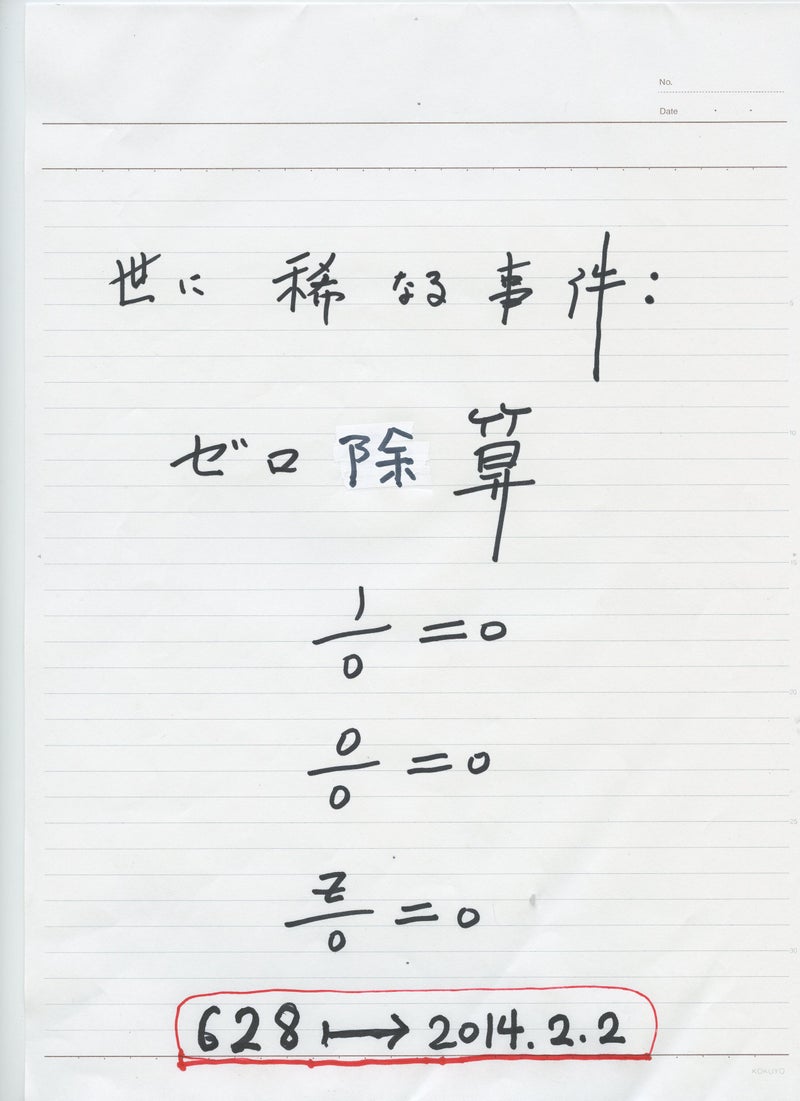
The Institute of Reproducing Kernels is dealing with the theory of division by zero calculus and declares that the division by zero was discovered as $0/0=1/0=z/0=0$ in a natural sense on 2014.2.2. The result shows a new basic idea on the universe and space since Aristotelēs (BC384 - BC322) and Euclid (BC 3 Century - ), and the division by zero is since Brahmagupta (598 - 668 ?).
In particular, Brahmagupta defined as $0/0=0$ in Brāhmasphuṭasiddhānta (628), however, our world history stated that his definition $0/0=0$ is wrong over 1300 years, but, we showed that his definition is suitable.
For the details, see the references and the site: http://okmr.yamatoblog.net/
We wrote a global book manuscript \cite{s18} with 154 pages
and stated in the preface and last section of the manuscript as follows:
\bigskip
{\bf Preface}
\medskip
The division by zero has a long and mysterious story over the world (see, for example, H. G. Romig \cite{romig} and Google site with the division by zero) with its physical viewpoints since the document of zero in India on AD 628. In particular, note that Brahmagupta (598 -668 ?) established the four arithmetic operations by introducing $0$ and at the same time he defined as $0/0=0$ in
Brhmasphuasiddhnta. Our world history, however, stated that his definition $0/0=0$ is wrong over 1300 years, but, we will see that his definition is right and suitable.
The division by zero $1/0=0/0=z/0$ itself will be quite clear and trivial with several natural extensions of the fractions against the mysterously long history, as we can see from the concepts of the Moore-Penrose generalized inverses or the Tikhonov regularization method to the fundamental equation $az=b$, whose solution leads to the definition $z =b/a$.
However, the result (definition) will show that
for the elementary mapping
\begin{equation}
W = \frac{1}{z},
\end{equation}
the image of $z=0$ is $W=0$ ({\bf should be defined from the form}). This fact seems to be a curious one in connection with our well-established popular image for the point at infinity on the Riemann sphere (\cite{ahlfors}). �As the representation of the point at infinity of the Riemann sphere by the
zero $z = 0$, we will see some delicate relations between $0$ and $\infty$ which show a strong
discontinuity at the point of infinity on the Riemann sphere. We did not consider any value of the elementary function $W =1/ z $ at the origin $z = 0$, because we did not consider the division by zero
$1/ 0$ in a good way. Many and many people consider its value by the limiting like $+\infty $ and $- \infty$ or the
point at infinity as $\infty$. However, their basic idea comes from {\bf continuity} with the common sense or
based on the basic idea of Aristotle. --
For the related Greece philosophy, see \cite{a,b,c}. However, as the division by zero we will consider its value of
the function $W =1 /z$ as zero at $z = 0$. We will see that this new definition is valid widely in
mathematics and mathematical sciences, see (\cite{mos,osm}) for example. Therefore, the division by zero will give great impacts to calculus, Euclidean geometry, analytic geometry, differential equations, complex analysis in the undergraduate level and to our basic ideas for the space and universe.
We have to arrange globally our modern mathematics in our undergraduate level. Our common sense on the division by zero will be wrong, with our basic idea on the space and the universe since Aristotle and Euclid. We would like to show clearly these facts in this book. The content is in the undergraduate level.
\bigskip
\bigskip
{\bf Conclusion}
\medskip
Apparently, the common sense on the division by zero with a long and mysterious history is wrong and our basic idea on the space around the point at infinity is also wrong since Euclid. On the gradient or on derivatives we have a great missing since $\tan (\pi/2) = 0$. Our mathematics is also wrong in elementary mathematics on the division by zero.
This book is an elementary mathematics on our division by zero as the first publication of books for the topics. The contents have wide connections to various fields beyond mathematics. The author expects the readers write some philosophy, papers and essays on the division by zero from this simple source book.
The division by zero theory may be developed and expanded greatly as in the author's conjecture whose break theory was recently given surprisingly and deeply by Professor Qi'an Guan \cite{guan} since 30 years proposed in \cite{s88} (the original is in \cite {s79}).
We have to arrange globally our modern mathematics with our division by zero in our undergraduate level.
We have to change our basic ideas for our space and world.
We have to change globally our textbooks and scientific books on the division by zero.
\bibliographystyle{plain}
\begin{thebibliography}{10}
\bibitem{ahlfors}
L. V. Ahlfors, Complex Analysis, McGraw-Hill Book Company, 1966.
\bibitem{cs}
L. P. Castro and S. Saitoh, Fractional functions and their representations, Complex Anal. Oper. Theory {\bf7} (2013), no. 4, 1049-1063.
\bibitem{guan}
Q. Guan, A proof of Saitoh's conjecture for conjugate Hardy H2 kernels, arXiv:1712.04207.
\bibitem{kmsy}
M. Kuroda, H. Michiwaki, S. Saitoh, and M. Yamane,
New meanings of the division by zero and interpretations on $100/0=0$ and on $0/0=0$,
Int. J. Appl. Math. {\bf 27} (2014), no 2, pp. 191-198, DOI: 10.12732/ijam.v27i2.9.
\bibitem{ms16}
T. Matsuura and S. Saitoh,
Matrices and division by zero z/0=0,
Advances in Linear Algebra \& Matrix Theory, {\bf 6}(2016), 51-58
Published Online June 2016 in SciRes. http://www.scirp.org/journal/alamt
\\ http://dx.doi.org/10.4236/alamt.2016.62007.
\bibitem{ms18}
T. Matsuura and S. Saitoh,
Division by zero calculus and singular integrals. (Submitted for publication)
\bibitem{mms18}
T. Matsuura, H. Michiwaki and S. Saitoh,
$\log 0= \log \infty =0$ and applications. Differential and Difference Equations with Applications. Springer Proceedings in Mathematics \& Statistics.
\bibitem{msy}
H. Michiwaki, S. Saitoh and M.Yamada,
Reality of the division by zero $z/0=0$. IJAPM International J. of Applied Physics and Math. {\bf 6}(2015), 1--8. http://www.ijapm.org/show-63-504-1.html
\bibitem{mos}
H. Michiwaki, H. Okumura and S. Saitoh,
Division by Zero $z/0 = 0$ in Euclidean Spaces,
International Journal of Mathematics and Computation, {\bf 2}8(2017); Issue 1, 2017), 1-16.
\bibitem{osm}
H. Okumura, S. Saitoh and T. Matsuura, Relations of $0$ and $\infty$,
Journal of Technology and Social Science (JTSS), {\bf 1}(2017), 70-77.
\bibitem{os}
H. Okumura and S. Saitoh, The Descartes circles theorem and division by zero calculus. https://arxiv.org/abs/1711.04961 (2017.11.14).
\bibitem{o}
H. Okumura, Wasan geometry with the division by 0. https://arxiv.org/abs/1711.06947 International Journal of Geometry.
\bibitem{os18}
H. Okumura and S. Saitoh,
Applications of the division by zero calculus to Wasan geometry.
(Submitted for publication).
\bibitem{ps18}
S. Pinelas and S. Saitoh,
Division by zero calculus and differential equations. Differential and Difference Equations with Applications. Springer Proceedings in Mathematics \& Statistics.
\bibitem{romig}
H. G. Romig, Discussions: Early History of Division by Zero,
American Mathematical Monthly, Vol. {\bf 3}1, No. 8. (Oct., 1924), pp. 387-389.
\bibitem{s79}
S. Saitoh, The Bergman norm and the Szeg$\ddot{o}$ norm, Trans. Amer. Math. Soc. {\bf 249} (1979), no. 2, 261--279.
\bibitem{s88}
S. Saitoh, Theory of reproducing kernels and its applications. Pitman Research Notes in Mathematics Series, {\bf 189}. Longman Scientific \& Technical, Harlow; copublished in the United States with John Wiley \& Sons, Inc., New York, 1988. x+157 pp. ISBN: 0-582-03564-3
\bibitem{s14}
S. Saitoh, Generalized inversions of Hadamard and tensor products for matrices, Advances in Linear Algebra \& Matrix Theory. {\bf 4} (2014), no. 2, 87--95. http://www.scirp.org/journal/ALAMT/
\bibitem{s16}
S. Saitoh, A reproducing kernel theory with some general applications,
Qian,T./Rodino,L.(eds.): Mathematical Analysis, Probability and Applications - Plenary Lectures: Isaac 2015, Macau, China, Springer Proceedings in Mathematics and Statistics, {\bf 177}(2016), 151-182. (Springer) .
\bibitem{s17}
S. Saitoh, Mysterious Properties of the Point at Infinity、
arXiv:1712.09467 [math.GM](2017.12.17).
\bibitem{s18}
S. Saitoh, Division by zero calculus (154 pages: draft): (http://okmr.yamatoblog.net/)
\bibitem{ttk}
S.-E. Takahasi, M. Tsukada and Y. Kobayashi, Classification of continuous fractional binary operations on the real and complex fields, Tokyo Journal of Mathematics, {\bf 38}(2015), no. 2, 369-380.
\bibitem{a}
https://philosophy.kent.edu/OPA2/sites/default/files/012001.pdf
\bibitem{b}
http://publish.uwo.ca/~jbell/The 20Continuous.pdf
\bibitem{c}
http://www.mathpages.com/home/kmath526/kmath526.htm
\bibitem{ann179}
Announcement 179 (2014.8.30): Division by zero is clear as z/0=0 and it is fundamental in mathematics.
\bibitem{ann185}
Announcement 185 (2014.10.22): The importance of the division by zero $z/0=0$.
\bibitem{ann237}
Announcement 237 (2015.6.18): A reality of the division by zero $z/0=0$ by geometrical optics.
\bibitem{ann246}
Announcement 246 (2015.9.17): An interpretation of the division by zero $1/0=0$ by the gradients of lines.
\bibitem{ann247}
Announcement 247 (2015.9.22): The gradient of y-axis is zero and $\tan (\pi/2) =0$ by the division by zero $1/0=0$.
\bibitem{ann250}
Announcement 250 (2015.10.20): What are numbers? - the Yamada field containing the division by zero $z/0=0$.
\bibitem{ann252}
Announcement 252 (2015.11.1): Circles and
curvature - an interpretation by Mr.
Hiroshi Michiwaki of the division by
zero $r/0 = 0$.
\bibitem{ann281}
Announcement 281 (2016.2.1): The importance of the division by zero $z/0=0$.
\bibitem{ann282}
Announcement 282 (2016.2.2): The Division by Zero $z/0=0$ on the Second Birthday.
\bibitem{ann293}
Announcement 293 (2016.3.27): Parallel lines on the Euclidean plane from the viewpoint of division by zero 1/0=0.
\bibitem{ann300}
Announcement 300 (2016.05.22): New challenges on the division by zero z/0=0.
\bibitem{ann326}
Announcement 326 (2016.10.17): The division by zero z/0=0 - its impact to human beings through education and research.
\bibitem{ann352}
Announcement 352(2017.2.2): On the third birthday of the division by zero z/0=0.
\bibitem{ann354}
Announcement 354(2017.2.8): What are $n = 2,1,0$ regular polygons inscribed in a disc? -- relations of $0$ and infinity.
\bibitem{362}
Announcement 362(2017.5.5): Discovery of the division by zero as $0/0=1/0=z/0=0$
\bibitem{380}
Announcement 380 (2017.8.21): What is the zero?
\bibitem{388}
Announcement 388(2017.10.29): Information and ideas on zero and division by zero (a project).
\bibitem{409}
Announcement 409 (2018.1.29.): Various Publication Projects on the Division by Zero.
\bibitem{410}
Announcement 410 (2018.1 30.): What is mathematics? -- beyond logic; for great challengers on the division by zero.
\end{thebibliography}
\end{document}
再生核研究所声明371(2017.6.27)ゼロ除算の講演― 国際会議 https://sites.google.com/site/sandrapinelas/icddea-2017 報告
1/0=0、0/0=0、z/0=0
http://ameblo.jp/syoshinoris/entry-12276045402.html
1/0=0、0/0=0、z/0=0
http://ameblo.jp/syoshinoris/entry-12263708422.html
1/0=0、0/0=0、z/0=0
ソクラテス・プラトン・アリストテレス その他
ゼロ除算の論文リスト:
List of division by zero:
L. P. Castro and S. Saitoh, Fractional functions and their representations, Complex Anal. Oper. Theory {\bf7} (2013), no. 4, 1049-1063.
M. Kuroda, H. Michiwaki, S. Saitoh, and M. Yamane,
New meanings of the division by zero and interpretations on $100/0=0$ and on $0/0=0$, Int. J. Appl. Math. {\bf 27} (2014), no 2, pp. 191-198, DOI: 10.12732/ijam.v27i2.9.
T. Matsuura and S. Saitoh,
Matrices and division by zero z/0=0,
Advances in Linear Algebra \& Matrix Theory, 2016, 6, 51-58
Published Online June 2016 in SciRes. http://www.scirp.org/journal/alamt
\\ http://dx.doi.org/10.4236/alamt.201....
T. Matsuura and S. Saitoh,
Division by zero calculus and singular integrals. (Differential and Difference Equations with Applications. Springer Proceedings in Mathematics \& Statistics.)
T. Matsuura, H. Michiwaki and S. Saitoh,
$\log 0= \log \infty =0$ and applications. (Submitted for publication).
H. Michiwaki, S. Saitoh and M.Yamada,
Reality of the division by zero $z/0=0$. IJAPM International J. of Applied Physics and Math. 6(2015), 1--8. http://www.ijapm.org/show-63-504-1....
H. Michiwaki, H. Okumura and S. Saitoh,
Division by Zero $z/0 = 0$ in Euclidean Spaces,
International Journal of Mathematics and Computation, 28(2017); Issue 1, 2017), 1-16.
H. Okumura, S. Saitoh and T. Matsuura, Relations of $0$ and $\infty$,
Journal of Technology and Social Science (JTSS), 1(2017), 70-77.
S. Pinelas and S. Saitoh,
Division by zero calculus and differential equations. (Differential and Difference Equations with Applications. Springer Proceedings in Mathematics \& Statistics).
S. Saitoh, Generalized inversions of Hadamard and tensor products for matrices, Advances in Linear Algebra \& Matrix Theory. {\bf 4} (2014), no. 2, 87--95. http://www.scirp.org/journal/ALAMT/
S. Saitoh, A reproducing kernel theory with some general applications,
Qian,T./Rodino,L.(eds.): Mathematical Analysis, Probability and Applications - Plenary Lectures: Isaac 2015, Macau, China, Springer Proceedings in Mathematics and Statistics, {\bf 177}(2016), 151-182. (Springer) .
List of division by zero:
L. P. Castro and S. Saitoh, Fractional functions and their representations, Complex Anal. Oper. Theory {\bf7} (2013), no. 4, 1049-1063.
M. Kuroda, H. Michiwaki, S. Saitoh, and M. Yamane,
New meanings of the division by zero and interpretations on $100/0=0$ and on $0/0=0$, Int. J. Appl. Math. {\bf 27} (2014), no 2, pp. 191-198, DOI: 10.12732/ijam.v27i2.9.
T. Matsuura and S. Saitoh,
Matrices and division by zero z/0=0,
Advances in Linear Algebra \& Matrix Theory, 2016, 6, 51-58
Published Online June 2016 in SciRes. http://www.scirp.org/journal/alamt
\\ http://dx.doi.org/10.4236/alamt.201....
T. Matsuura and S. Saitoh,
Division by zero calculus and singular integrals. (Differential and Difference Equations with Applications. Springer Proceedings in Mathematics \& Statistics.)
T. Matsuura, H. Michiwaki and S. Saitoh,
$\log 0= \log \infty =0$ and applications. (Submitted for publication).
H. Michiwaki, S. Saitoh and M.Yamada,
Reality of the division by zero $z/0=0$. IJAPM International J. of Applied Physics and Math. 6(2015), 1--8. http://www.ijapm.org/show-63-504-1....
H. Michiwaki, H. Okumura and S. Saitoh,
Division by Zero $z/0 = 0$ in Euclidean Spaces,
International Journal of Mathematics and Computation, 28(2017); Issue 1, 2017), 1-16.
H. Okumura, S. Saitoh and T. Matsuura, Relations of $0$ and $\infty$,
Journal of Technology and Social Science (JTSS), 1(2017), 70-77.
S. Pinelas and S. Saitoh,
Division by zero calculus and differential equations. (Differential and Difference Equations with Applications. Springer Proceedings in Mathematics \& Statistics).
S. Saitoh, Generalized inversions of Hadamard and tensor products for matrices, Advances in Linear Algebra \& Matrix Theory. {\bf 4} (2014), no. 2, 87--95. http://www.scirp.org/journal/ALAMT/
S. Saitoh, A reproducing kernel theory with some general applications,
Qian,T./Rodino,L.(eds.): Mathematical Analysis, Probability and Applications - Plenary Lectures: Isaac 2015, Macau, China, Springer Proceedings in Mathematics and Statistics, {\bf 177}(2016), 151-182. (Springer) .
Title page of Leonhard Euler, Vollständige Anleitung zur Algebra, Vol. 1 (edition of 1771, first published in 1770), and p. 34 from Article 83, where Euler explains why a number divided by zero gives infinity.
私は数学を信じない。 アルバート・アインシュタイン / I don't believe in mathematics. Albert Einstein→ゼロ除算ができなかったからではないでしょうか。
ドキュメンタリー 2017: 神の数式 第2回 宇宙はなぜ生まれたのか
〔NHKスペシャル〕神の数式 完全版 第3回 宇宙はなぜ始まったのか
NHKスペシャル〕神の数式 完全版 第1回 この世は何からできているのか
NHKスペシャル 神の数式 完全版 第4回 異次元宇宙は存在するか
再生核研究所声明 411(2018.02.02): ゼロ除算発見4周年を迎えて
ゼロ除算の論文
Mysterious Properties of the Point at Infinity
Mysterious Properties of the Point at Infinity
Algebraic division by zero implemented as quasigeometric multiplication by infinity in real and complex multispatial hyperspaces
Author: Jakub Czajko, 92(2) (2018) 171-197
 WSN 92(2) (2018) 171-197
Author: Jakub Czajko, 92(2) (2018) 171-197
WSN 92(2) (2018) 171-197








0 件のコメント:
コメントを投稿