アインシュタインの相対性理論は、星間宇宙旅行が不可能であることを示唆しているわけではない。
「あらゆるものは、光より早く動くことはできない」とは、アルバート・アインシュタインは。
では星間宇宙旅行が不可能ということなのか?
実は逆である。相対性理論は星間旅行の実現を手助けしてくれるのだ。少なくとも人間の寿命の範囲においてはそうだ。
【加速による重力に耐えられない体】
その理由は加速だ。
人間はかなり脆弱な生き物で、極端な加速に耐えられない。加速によって、人体に長時間1G以上がかかると、さまざまな健康問題が生じる。それが10Gにもなれば、即座に失神し、死亡する。
どこかへ行くには、まず移動速度まで加速して、それから減速せねばならない。仮に我々が1.5Gしか長時間耐えられないのだとすれば、非相対論的ニュートン学派の世界においては大問題となる。
目的地に行くまで我々の寿命が保たないのだ。これを克服するにはさらに加速するしかない。したがってロボットなど、人体のようなデリケートな水袋よりも頑丈なものを送らねばならない。
【相対性理論がその手助けをしてくれる】
ところが相対性理論がその手助けをしてくれる。
光速に近づけば、宇宙船で流れる時間は遅くなり、ニュートン学派的宇宙のそれよりも(宇宙船の中では)ずっと早く目的地に到達できるようになる(宇宙船の乗員の視点からは、距離が縮まって感じられる。その効果は同じで、ずっと早く到着する)。
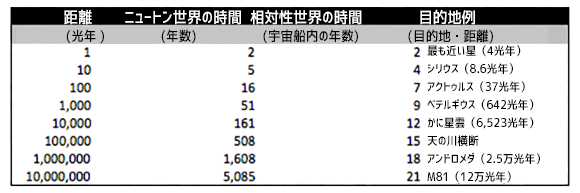
以下は、先ほどの人体が1.5Gまでの加速なら耐えらえるという仮定に基づいて作成した表だ。道筋の半分をその割合で加速し、残り半分をその割合で減速した場合に目的地に到着するまでの年月を示してある。
【目的地が遠いほど大きな恩恵がもたらされる】
目的地が50光年離れた場所になると、相対性が大きな恩恵をもたらすことが分かるだろう。さらに1000光年を超えると、我々が生きている間に目的地に到着できるのは相対性があってこそのことである。
この表にはないが、さらに遠い距離まで考察するなら、相対性の効果のおかげで、実に目で見ることのできる宇宙の隅々(約470億光年)まで生きているうちに(約28年)たどり着くことができる。
つまり相対性を利用すれば、我々はどこでも好きな場所に行けそうだということだ。

【だが実現するには2つの問題が】
だがしかし、そうは問屋が卸さない。2つ問題がある。
まず、相対性の効果は旅行者にしか得られない。地球時間ではずっと早く時間が経過している(大雑把に言うと、帰還までの地球時間の年数は、表内の光年数を2倍して、0.25を加える)。つまり彼らが地球に帰還すると数千年が経過していることになる。
したがって、たとえ調査隊を派遣したとしても、地球に残る者たちがその成果を知ることは決してない。が、宇宙旅行のついでに、時間旅行までしたいという人なら構わないのかもしれない。
2つ目の問題は、より直接的・実践的な問題だ。相対性の効果を得られるまで加速するには、文字通り天文学的なエネルギーを要する。仮にかに星雲へ向かうとすれば、宇宙船1キログラムあたり7×10²⁰ジュールの運動エネルギーが必要になる。
膨大なエネルギー量ではあるが、手にすることは可能だ。太陽の出力は3 × 1026ワットである。したがって理論上は宇宙船を必要な速度まで加速させるには、太陽エネルギー数秒分で事足りる。
なお、ここではこうしたエネルギーを質量を増大させることなく宇宙船の加速力に転換できると仮定している(例えば、レーザーの利用など)。
もし宇宙船に化学燃料あるいは物質/反物質燃料を搭載し、それもまた加速させねばならないのだとすれば、”ロケット公式の暴君”に直面して、お手上げとなる。燃料を搭載するために、さらに何桁も多くの燃料が必要になるからだ。

だが、これらは楽しい技術的課題だろう。光速まで加速できさえすれば、星間旅行を試みる我々を相対性が助けてくれる。直感には反するが、本当のことだ。
References:quora/ translated by hiroching / edited by parumo
では星間宇宙旅行が不可能ということなのか?
実は逆である。相対性理論は星間旅行の実現を手助けしてくれるのだ。少なくとも人間の寿命の範囲においてはそうだ。
【加速による重力に耐えられない体】
その理由は加速だ。
人間はかなり脆弱な生き物で、極端な加速に耐えられない。加速によって、人体に長時間1G以上がかかると、さまざまな健康問題が生じる。それが10Gにもなれば、即座に失神し、死亡する。
どこかへ行くには、まず移動速度まで加速して、それから減速せねばならない。仮に我々が1.5Gしか長時間耐えられないのだとすれば、非相対論的ニュートン学派の世界においては大問題となる。
目的地に行くまで我々の寿命が保たないのだ。これを克服するにはさらに加速するしかない。したがってロボットなど、人体のようなデリケートな水袋よりも頑丈なものを送らねばならない。
【相対性理論がその手助けをしてくれる】
ところが相対性理論がその手助けをしてくれる。
光速に近づけば、宇宙船で流れる時間は遅くなり、ニュートン学派的宇宙のそれよりも(宇宙船の中では)ずっと早く目的地に到達できるようになる(宇宙船の乗員の視点からは、距離が縮まって感じられる。その効果は同じで、ずっと早く到着する)。
以下は、先ほどの人体が1.5Gまでの加速なら耐えらえるという仮定に基づいて作成した表だ。道筋の半分をその割合で加速し、残り半分をその割合で減速した場合に目的地に到着するまでの年月を示してある。
image credit:quora
【目的地が遠いほど大きな恩恵がもたらされる】
目的地が50光年離れた場所になると、相対性が大きな恩恵をもたらすことが分かるだろう。さらに1000光年を超えると、我々が生きている間に目的地に到着できるのは相対性があってこそのことである。
この表にはないが、さらに遠い距離まで考察するなら、相対性の効果のおかげで、実に目で見ることのできる宇宙の隅々(約470億光年)まで生きているうちに(約28年)たどり着くことができる。
つまり相対性を利用すれば、我々はどこでも好きな場所に行けそうだということだ。
【だが実現するには2つの問題が】
だがしかし、そうは問屋が卸さない。2つ問題がある。
まず、相対性の効果は旅行者にしか得られない。地球時間ではずっと早く時間が経過している(大雑把に言うと、帰還までの地球時間の年数は、表内の光年数を2倍して、0.25を加える)。つまり彼らが地球に帰還すると数千年が経過していることになる。
したがって、たとえ調査隊を派遣したとしても、地球に残る者たちがその成果を知ることは決してない。が、宇宙旅行のついでに、時間旅行までしたいという人なら構わないのかもしれない。
2つ目の問題は、より直接的・実践的な問題だ。相対性の効果を得られるまで加速するには、文字通り天文学的なエネルギーを要する。仮にかに星雲へ向かうとすれば、宇宙船1キログラムあたり7×10²⁰ジュールの運動エネルギーが必要になる。
膨大なエネルギー量ではあるが、手にすることは可能だ。太陽の出力は3 × 1026ワットである。したがって理論上は宇宙船を必要な速度まで加速させるには、太陽エネルギー数秒分で事足りる。
なお、ここではこうしたエネルギーを質量を増大させることなく宇宙船の加速力に転換できると仮定している(例えば、レーザーの利用など)。
もし宇宙船に化学燃料あるいは物質/反物質燃料を搭載し、それもまた加速させねばならないのだとすれば、”ロケット公式の暴君”に直面して、お手上げとなる。燃料を搭載するために、さらに何桁も多くの燃料が必要になるからだ。
だが、これらは楽しい技術的課題だろう。光速まで加速できさえすれば、星間旅行を試みる我々を相対性が助けてくれる。直感には反するが、本当のことだ。
References:quora/ translated by hiroching / edited by parumo
とても興味深く読みました:ゼロ除算の発見・・・・・・
\documentclass[12pt]{article}
\usepackage{latexsym,amsmath,amssymb,amsfonts,amstext,amsthm}
\numberwithin{equation}{section}
\begin{document}
\title{\bf Announcement410 : What is mathematics? -- beyond logic; for great challengers on the division by zero\\
(2018.1.30.)}
\author{{\it Institute of Reproducing Kernels}\\
Kawauchi-cho, 5-1648-16,\\
Kiryu 376-0041, Japan\\
}
\date{\today}
\maketitle
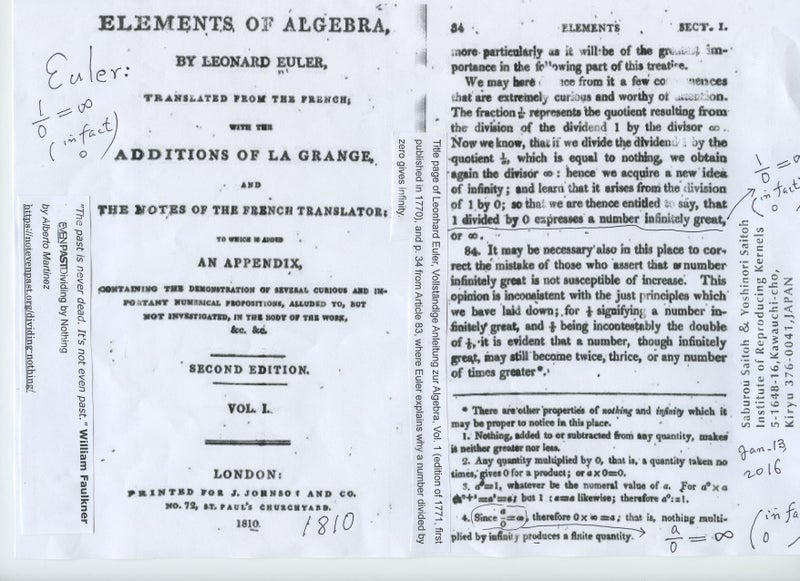
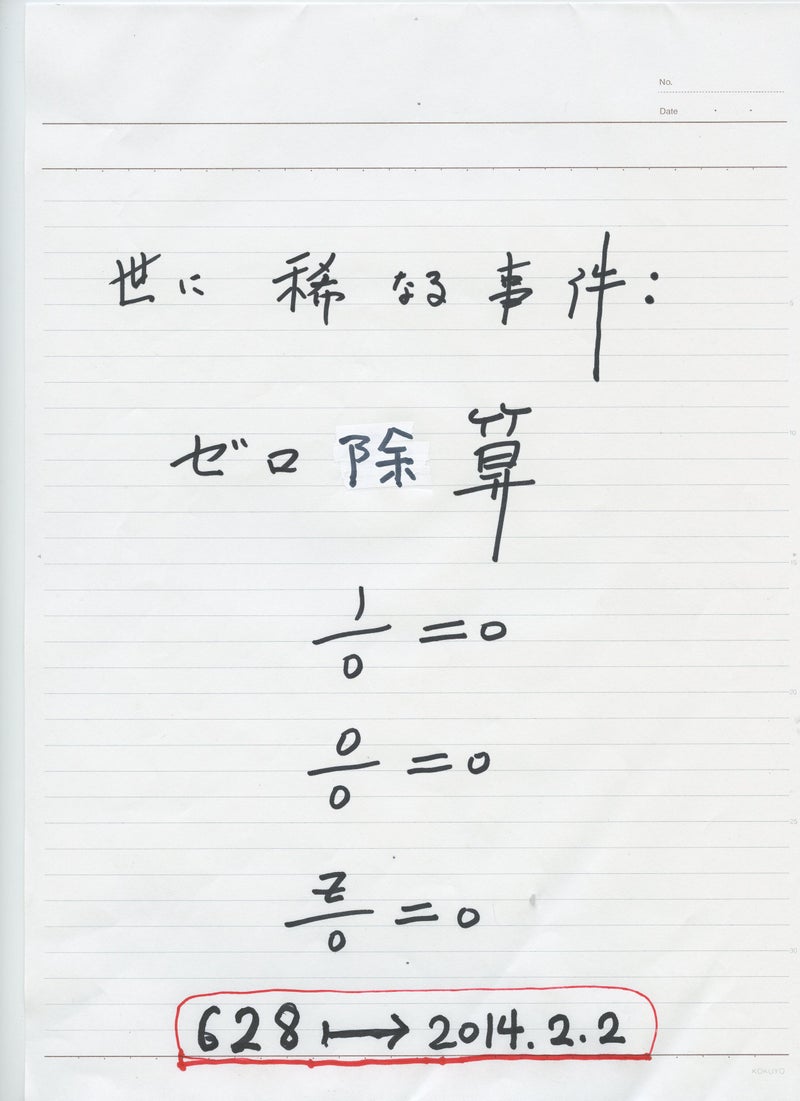
The Institute of Reproducing Kernels is dealing with the theory of division by zero calculus and declares that the division by zero was discovered as $0/0=1/0=z/0=0$ in a natural sense on 2014.2.2. The result shows a new basic idea on the universe and space since Aristotelēs (BC384 - BC322) and Euclid (BC 3 Century - ), and the division by zero is since Brahmagupta (598 - 668 ?).
In particular, Brahmagupta defined as $0/0=0$ in Brāhmasphuṭasiddhānta (628), however, our world history stated that his definition $0/0=0$ is wrong over 1300 years, but, we showed that his definition is suitable.
For the details, see the references and the site: http://okmr.yamatoblog.net/
We wrote a global book manuscript \cite{s18} with 154 pages
and stated that the division by zero is trivial and clear, and in the last section of the manuscript we stated as follows:
\bigskip
\bigskip
{\bf Conclusion}
\medskip
Apparently, the common sense on the division by zero with a long and mysterious history is wrong and our basic idea on the space around the point at infinity is also wrong since Euclid. On the gradient or on derivatives we have a great missing since $\tan (\pi/2) = 0$. Our mathematics is also wrong in elementary mathematics on the division by zero.
This book is an elementary mathematics on our division by zero as the first publication of books for the topics. The contents have wide connections to various fields beyond mathematics. The author expects the readers write some philosophy, papers and essays on the division by zero from this simple source book.
The division by zero theory may be developed and expanded greatly as in the author's conjecture whose break theory was recently given surprisingly and deeply by Professor Qi'an Guan \cite{guan} since 30 years proposed in \cite{s88} (the original is in \cite {s79}).
We have to arrange globally our modern mathematics with our division by zero in our undergraduate level.
We have to change our basic ideas for our space and world.
We have to change globally our textbooks and scientific books on the division by zero.
\bigskip
However, we have still curious situations and opinions for us on the division by zero; in particular, the two great challengers Jakub Czajko and Ilija Barukčić on the division by zero in connection with physics stated that we do not have the definition of the division $0/0$, however $0/0=1$.
They seem to think that a truth is based on physical objects and is not on our mathematics. In such a cases, we will not be able to continue discussions on the division by zero more, because for mathematicians, they will not be able to follow their logics more. However, then we will ask for the question that what are the values and contributions of your articles and discussions. We will expect some contributions, of course.
This question will reflect to mathematicians contrary. We stated for the estimation of mathematisc in \cite{s97}: Mathematics is the collection of relations and, good results are fundamental,
beautiful, and give
great good impacts to human beings.
With this estimation, we stated that the Euler formula
$$
e^{\pi i} = -1
$$
is the best result in mathematics in details in:
\medskip
No.81, May 2012(pdf 432kb)
www.jams.or.jp/kaiho/kaiho-81.pdf
\medskip
In order to show the importance of our division by zero and division by zero calculus we are requested to show their importance.
It seems that the long and mysterious confusions for the division by zero is on the definition. --
Indeed, when we consider the division by zero $a/0$ in the usual sense of the fundamental equation $0 \cdot z= a$, we have immediately the simple contradiction, however, we have such cases may happen, in particular, in mathematical formulas and physical formulas on the universe.
\bibliographystyle{plain}
\begin{thebibliography}{10}
\bibitem{bar}
I. Barukčić,
Dialectical Logic – Negation Of Classical Logic,
http://vixra.org/abs/1801.0256
\bibitem{jake}
J. Czajko, Algebraic division by zero implemented as quasigeometric multiplication by infinity in real and complex multispatial hyperspaces,
Available online at www.worldscientificnews.com
WSN 92(2) (2018) 171-197
\bibitem{guan}
Q. Guan, A proof of Saitoh's conjecture for conjugate Hardy H2 kernels, arXiv:1712.04207.
\bibitem{kmsy}
M. Kuroda, H. Michiwaki, S. Saitoh, and M. Yamane,
New meanings of the division by zero and interpretations on $100/0=0$ and on $0/0=0$,
Int. J. Appl. Math. {\bf 27} (2014), no 2, pp. 191-198, DOI: 10.12732/ijam.v27i2.9.
\bibitem{ms16}
T. Matsuura and S. Saitoh,
Matrices and division by zero z/0=0,
Advances in Linear Algebra \& Matrix Theory, {\bf 6}(2016), 51-58
Published Online June 2016 in SciRes. http://www.scirp.org/journal/alamt
\\ http://dx.doi.org/10.4236/alamt.2016.62007.
\bibitem{ms18}
T. Matsuura and S. Saitoh,
Division by zero calculus and singular integrals. (Submitted for publication)
\bibitem{mms18}
T. Matsuura, H. Michiwaki and S. Saitoh,
$\log 0= \log \infty =0$ and applications. Differential and Difference Equations with Applications. Springer Proceedings in Mathematics \& Statistics.
\bibitem{msy}
H. Michiwaki, S. Saitoh and M.Yamada,
Reality of the division by zero $z/0=0$. IJAPM International J. of Applied Physics and Math. {\bf 6}(2015), 1--8. http://www.ijapm.org/show-63-504-1.html
\bibitem{mos}
H. Michiwaki, H. Okumura and S. Saitoh,
Division by Zero $z/0 = 0$ in Euclidean Spaces,
International Journal of Mathematics and Computation, {\bf 2}8(2017); Issue 1, 2017), 1-16.
\bibitem{osm}
H. Okumura, S. Saitoh and T. Matsuura, Relations of $0$ and $\infty$,
Journal of Technology and Social Science (JTSS), {\bf 1}(2017), 70-77.
\bibitem{os}
H. Okumura and S. Saitoh, The Descartes circles theorem and division by zero calculus. https://arxiv.org/abs/1711.04961 (2017.11.14).
\bibitem{o}
H. Okumura, Wasan geometry with the division by 0. https://arxiv.org/abs/1711.06947 International Journal of Geometry.
\bibitem{os18}
H. Okumura and S. Saitoh,
Applications of the division by zero calculus to Wasan geometry.
(Submitted for publication).
\bibitem{ps18}
S. Pinelas and S. Saitoh,
Division by zero calculus and differential equations. Differential and Difference Equations with Applications. Springer Proceedings in Mathematics \& Statistics.
\bibitem{romig}
H. G. Romig, Discussions: Early History of Division by Zero,
American Mathematical Monthly, Vol. {\bf 3}1, No. 8. (Oct., 1924), pp. 387-389.
\bibitem{s97}
T. M. Rassias, Editor, Nonlinear Mathematical Analysis and Applications, HadronicPress,Palm Harbor,FL34682-1577,USA:ISBN1-57485-044-X,1998, pp.223–234: Nonlinear transforms and analyticity of functions, Saburou Saitoh.
\bibitem{s79}
S. Saitoh, The Bergman norm and the Szeg$\ddot{o}$ norm, Trans. Amer. Math. Soc. {\bf 249} (1979), no. 2, 261--279.
\bibitem{s88}
S. Saitoh, Theory of reproducing kernels and its applications. Pitman Research Notes in Mathematics Series, {\bf 189}. Longman Scientific \& Technical, Harlow; copublished in the United States with John Wiley \& Sons, Inc., New York, 1988. x+157 pp. ISBN: 0-582-03564-3
\bibitem{s14}
S. Saitoh, Generalized inversions of Hadamard and tensor products for matrices, Advances in Linear Algebra \& Matrix Theory. {\bf 4} (2014), no. 2, 87--95. http://www.scirp.org/journal/ALAMT/
\bibitem{s16}
S. Saitoh, A reproducing kernel theory with some general applications,
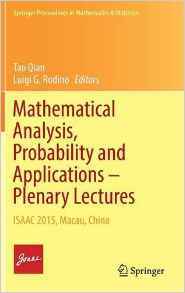
Qian,T./Rodino,L.(eds.): Mathematical Analysis, Probability and Applications - Plenary Lectures: Isaac 2015, Macau, China, Springer Proceedings in Mathematics and Statistics, {\bf 177}(2016), 151-182. (Springer) .
\bibitem{s17}
S. Saitoh, Mysterious Properties of the Point at Infinity、
arXiv:1712.09467 [math.GM](2017.12.17).
\bibitem{s18}
S. Saitoh, Division by zero calculus (154 pages: draft): (http://okmr.yamatoblog.net/)
\bibitem{ttk}
S.-E. Takahasi, M. Tsukada and Y. Kobayashi, Classification of continuous fractional binary operations on the real and complex fields, Tokyo Journal of Mathematics, {\bf 38}(2015), no. 2, 369-380.
\end{thebibliography}
\end{document}






















0 件のコメント:
コメントを投稿