「無限」とはいったい何なのか?単なる抽象的概念なのか?現実に存在するものなのか?
「無限」ってなんだろう?深く考えなければそれは単純に「限界のない」ことである。だが、その意味を深く考えれば考えるほど良くわからなくなってくる。
無限とは単なる抽象的概念だろうか?
それとも現実に存在するものなのであろうか?
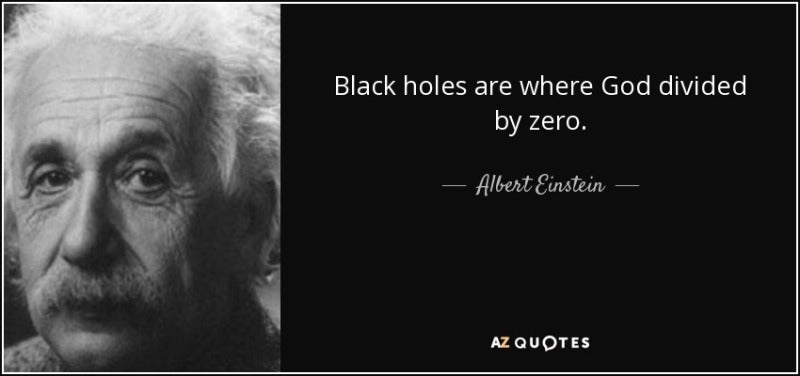
かの天才物理学者、アインシュタインはこんな名言を残した。
無限なものが2つある。宇宙と人間の愚かさだ。
宇宙については断言できないがね
アリストテレスからドイツの数学者ゲオルク・カントールまで、古今東西の偉大な頭脳たちが「無限」について思索してきた。では結局無限とは何なのか?
【無限は一種類だけではない】
無限は数学の世界にはきっちり根付いている。だが米コーネル大学の数学者ジャスティン・ムーアによれば、この分野のそれは世の中のそれとは少々異なっている。
「多くの場合、実数直線の終わりにある一種の仮想数を意味しています。あるいは整数で数えるには大きすぎるものを指す場合もあります」
iStock-487086330_e
また無限は一種類だけではない。
例えば、数を数えるという行為は、終わりのないある種の無限を象徴している。いわゆる可能無限というやつだ。
理論的には、最大の数に到達することはなく、永遠に数え続けることができる。しかし例えば無限の記号のように、無限に境界を設けることもできる。そしてその境界内にある限りは、際限なく繰り返すことができる。
あらゆる無限が等しく等価であるわけでもない。19世紀末、カントールは、自然数のある集合は、整数自体よりも大きいことを証明したと主張して議論を巻き起こした。整数はすでにして無限であるために、一部の無限は他の無限よりも大きいということになる。またその整数のような集合と対照的に、ある種の無限が不可算である可能性も示した。
「当時、それは衝撃的なことでした」とノルウェー、オスロ大学で論理学と数学を哲学するオイスタイン・リネボは説明する。「しかし数十年をかけて数学の中に取り込まれていきました」
無限がなければ、多くの数学的概念は破綻してしまう。
例えば、円、球、楕円が関係する幾何学の公式に必須である円周率πは、本質的に無限と繋がりがある。それが無理数(分数として表すことができない数)であり、無限に続く小数で構成されているからだ。
また無限が存在しなければ、最大の数というものもあることになる。それは完全なナンセンスである。あらゆる数にさらに大きな数がなければ、きちんと機能しないのだ。
【測定不能なものを測定できるか?】
しかしながら実世界ではまだ無限は見つかっていない。
もしかしたら、向かい合わせた鏡の表面で無限に反射する様子は見たことがあるかもしれないが、それは光の効果に過ぎず、物体自体はもちろん無限ではない。
「現実に無限が存在するのかどうか、それは大いに疑義のあることです。それに無限は測ることもできません」とリネボ。
その存在を証明するために無限を計測しようと試みても無駄だ。計測できるとは、それはつまり有限であることを意味しているのだ。そう試みても具体的な量を掴めないという結果になる。
「メーターが振り切れます。分かるのはそれだけです」とリネボは説明する。
実世界で無限を探し求めようという試みでは、大抵は宇宙に目が向けられる。我々が知る中では最大の実体だ。それでも、それが無限なのか、それともただやたらと大きいだけなのか証明するものはない。
planet-1543713_640_e
アインシュタインは、宇宙は有限であるが、境界がないと提唱した。無限と有限の中間のようなものだ。彼は、それを想像できない一種の球であると説明した。
無限というと大きいものが連想されがちだが、数学者の中には無限に小さいものを見つけようとする者もいる。
理論上、線に2つの点の間の区間をとれば、それを二分し続けることができるはずである(これは二分法として知られるゼノンのパラドックスの一種である)。
同じ理屈を物質に当てはめようとすれば、たちまち壁に突き当たる。現実世界の物体を原子やそれを構成する素粒子にまで小さく分解することは可能だ。しかし現在の科学では、亜原子粒子をそれ以上分解できないことになっている。
【特異点の無限】
現実世界で無限が見つかるとすれば、その最有力候補はブラックホールかもしれない。ブラックホールの中心には、特異点と呼ばれる膨大な質量を内包すると考えられている1次元の点がある。物理学者によれば、この奇妙な1点の密度や曲率といった特性は無限であるという。
特異点において、そうした無限によって多くの等式が破綻するために、ほとんどの物理法則は通用しなくなる。例えば、時空はもはや別個の存在ではなく、融合すると考えられる。
fractal-1280110_640_e
しかしリネボに言わせれば、ブラックホールは実体としての無限の実例には程遠いものだ。「私の印象ですが、物理学者の大半はそこで彼らの理論が破綻すると言っているように思います。無限の曲率や密度になってしまえば、理論が適用できる範囲を超えているというわけです」
ゆえに特異点を説明する新しい理論が必要になるだろう。それは物理世界での可能性を超越するように思える。
現時点において、無限は抽象的概念に留まっている。人間の頭脳によって作り出された概念であるが、果たしてあなたにはそれを思い描くことができるだろうか? そのためには我々の頭脳もまた無限でなければならないに違いない。
via:What Is Infinity? | Mental Floss/ translated by hiroching / edited by parumo
無限とは単なる抽象的概念だろうか?
それとも現実に存在するものなのであろうか?
かの天才物理学者、アインシュタインはこんな名言を残した。
無限なものが2つある。宇宙と人間の愚かさだ。
宇宙については断言できないがね
アリストテレスからドイツの数学者ゲオルク・カントールまで、古今東西の偉大な頭脳たちが「無限」について思索してきた。では結局無限とは何なのか?
【無限は一種類だけではない】
無限は数学の世界にはきっちり根付いている。だが米コーネル大学の数学者ジャスティン・ムーアによれば、この分野のそれは世の中のそれとは少々異なっている。
「多くの場合、実数直線の終わりにある一種の仮想数を意味しています。あるいは整数で数えるには大きすぎるものを指す場合もあります」
iStock-487086330_e
また無限は一種類だけではない。
例えば、数を数えるという行為は、終わりのないある種の無限を象徴している。いわゆる可能無限というやつだ。
理論的には、最大の数に到達することはなく、永遠に数え続けることができる。しかし例えば無限の記号のように、無限に境界を設けることもできる。そしてその境界内にある限りは、際限なく繰り返すことができる。
あらゆる無限が等しく等価であるわけでもない。19世紀末、カントールは、自然数のある集合は、整数自体よりも大きいことを証明したと主張して議論を巻き起こした。整数はすでにして無限であるために、一部の無限は他の無限よりも大きいということになる。またその整数のような集合と対照的に、ある種の無限が不可算である可能性も示した。
「当時、それは衝撃的なことでした」とノルウェー、オスロ大学で論理学と数学を哲学するオイスタイン・リネボは説明する。「しかし数十年をかけて数学の中に取り込まれていきました」
無限がなければ、多くの数学的概念は破綻してしまう。
例えば、円、球、楕円が関係する幾何学の公式に必須である円周率πは、本質的に無限と繋がりがある。それが無理数(分数として表すことができない数)であり、無限に続く小数で構成されているからだ。
また無限が存在しなければ、最大の数というものもあることになる。それは完全なナンセンスである。あらゆる数にさらに大きな数がなければ、きちんと機能しないのだ。
【測定不能なものを測定できるか?】
しかしながら実世界ではまだ無限は見つかっていない。
もしかしたら、向かい合わせた鏡の表面で無限に反射する様子は見たことがあるかもしれないが、それは光の効果に過ぎず、物体自体はもちろん無限ではない。
「現実に無限が存在するのかどうか、それは大いに疑義のあることです。それに無限は測ることもできません」とリネボ。
その存在を証明するために無限を計測しようと試みても無駄だ。計測できるとは、それはつまり有限であることを意味しているのだ。そう試みても具体的な量を掴めないという結果になる。
「メーターが振り切れます。分かるのはそれだけです」とリネボは説明する。
実世界で無限を探し求めようという試みでは、大抵は宇宙に目が向けられる。我々が知る中では最大の実体だ。それでも、それが無限なのか、それともただやたらと大きいだけなのか証明するものはない。
planet-1543713_640_e
アインシュタインは、宇宙は有限であるが、境界がないと提唱した。無限と有限の中間のようなものだ。彼は、それを想像できない一種の球であると説明した。
無限というと大きいものが連想されがちだが、数学者の中には無限に小さいものを見つけようとする者もいる。
理論上、線に2つの点の間の区間をとれば、それを二分し続けることができるはずである(これは二分法として知られるゼノンのパラドックスの一種である)。
同じ理屈を物質に当てはめようとすれば、たちまち壁に突き当たる。現実世界の物体を原子やそれを構成する素粒子にまで小さく分解することは可能だ。しかし現在の科学では、亜原子粒子をそれ以上分解できないことになっている。
【特異点の無限】
現実世界で無限が見つかるとすれば、その最有力候補はブラックホールかもしれない。ブラックホールの中心には、特異点と呼ばれる膨大な質量を内包すると考えられている1次元の点がある。物理学者によれば、この奇妙な1点の密度や曲率といった特性は無限であるという。
特異点において、そうした無限によって多くの等式が破綻するために、ほとんどの物理法則は通用しなくなる。例えば、時空はもはや別個の存在ではなく、融合すると考えられる。
fractal-1280110_640_e
しかしリネボに言わせれば、ブラックホールは実体としての無限の実例には程遠いものだ。「私の印象ですが、物理学者の大半はそこで彼らの理論が破綻すると言っているように思います。無限の曲率や密度になってしまえば、理論が適用できる範囲を超えているというわけです」
ゆえに特異点を説明する新しい理論が必要になるだろう。それは物理世界での可能性を超越するように思える。
現時点において、無限は抽象的概念に留まっている。人間の頭脳によって作り出された概念であるが、果たしてあなたにはそれを思い描くことができるだろうか? そのためには我々の頭脳もまた無限でなければならないに違いない。
via:What Is Infinity? | Mental Floss/ translated by hiroching / edited by parumo
とても興味深く読みました:ゼロ除算、実は0だった:
\documentclass[12pt]{article}
\usepackage{latexsym,amsmath,amssymb,amsfonts,amstext,amsthm}
\numberwithin{equation}{section}
\begin{document}
\title{\bf Announcement 412: The 4th birthday of the division by zero $z/0=0$ \\
(2018.2.2)}
\author{{\it Institute of Reproducing Kernels}\\
Kawauchi-cho, 5-1648-16,\\
Kiryu 376-0041, Japan\\
}
\date{\today}
\maketitle
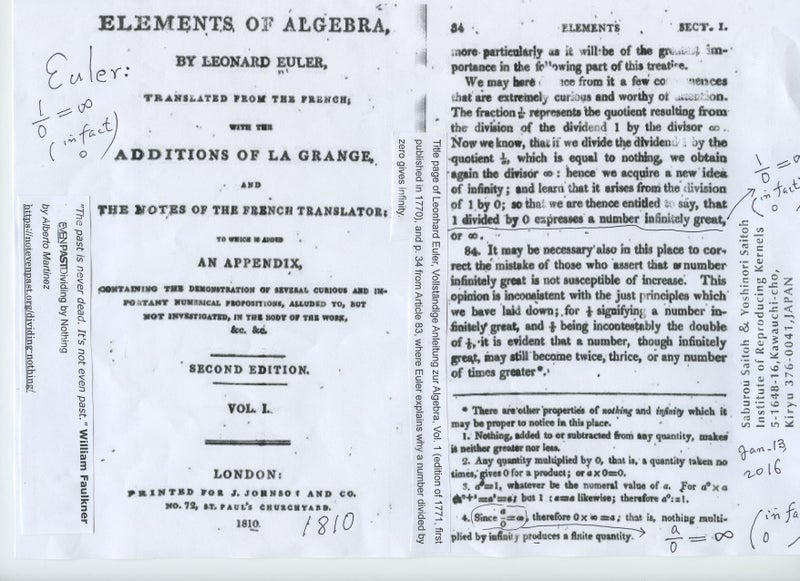
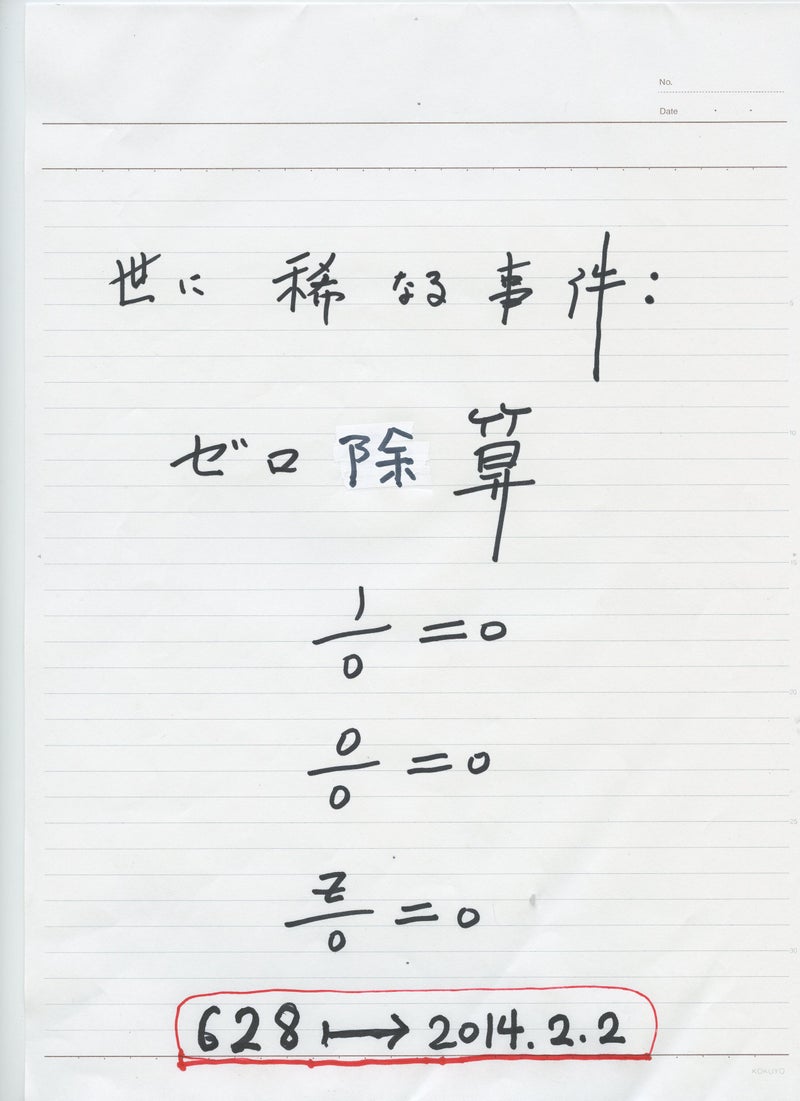
The Institute of Reproducing Kernels is dealing with the theory of division by zero calculus and declares that the division by zero was discovered as $0/0=1/0=z/0=0$ in a natural sense on 2014.2.2. The result shows a new basic idea on the universe and space since Aristotelēs (BC384 - BC322) and Euclid (BC 3 Century - ), and the division by zero is since Brahmagupta (598 - 668 ?).
In particular, Brahmagupta defined as $0/0=0$ in Brāhmasphuṭasiddhānta (628), however, our world history stated that his definition $0/0=0$ is wrong over 1300 years, but, we showed that his definition is suitable.
For the details, see the references and the site: http://okmr.yamatoblog.net/
We wrote a global book manuscript \cite{s18} with 154 pages
and stated in the preface and last section of the manuscript as follows:
\bigskip
{\bf Preface}
\medskip
The division by zero has a long and mysterious story over the world (see, for example, H. G. Romig \cite{romig} and Google site with the division by zero) with its physical viewpoints since the document of zero in India on AD 628. In particular, note that Brahmagupta (598 -668 ?) established the four arithmetic operations by introducing $0$ and at the same time he defined as $0/0=0$ in
Brhmasphuasiddhnta. Our world history, however, stated that his definition $0/0=0$ is wrong over 1300 years, but, we will see that his definition is right and suitable.
The division by zero $1/0=0/0=z/0$ itself will be quite clear and trivial with several natural extensions of the fractions against the mysterously long history, as we can see from the concepts of the Moore-Penrose generalized inverses or the Tikhonov regularization method to the fundamental equation $az=b$, whose solution leads to the definition $z =b/a$.
However, the result (definition) will show that
for the elementary mapping
\begin{equation}
W = \frac{1}{z},
\end{equation}
the image of $z=0$ is $W=0$ ({\bf should be defined from the form}). This fact seems to be a curious one in connection with our well-established popular image for the point at infinity on the Riemann sphere (\cite{ahlfors}). �As the representation of the point at infinity of the Riemann sphere by the
zero $z = 0$, we will see some delicate relations between $0$ and $\infty$ which show a strong
discontinuity at the point of infinity on the Riemann sphere. We did not consider any value of the elementary function $W =1/ z $ at the origin $z = 0$, because we did not consider the division by zero
$1/ 0$ in a good way. Many and many people consider its value by the limiting like $+\infty $ and $- \infty$ or the
point at infinity as $\infty$. However, their basic idea comes from {\bf continuity} with the common sense or
based on the basic idea of Aristotle. --
For the related Greece philosophy, see \cite{a,b,c}. However, as the division by zero we will consider its value of
the function $W =1 /z$ as zero at $z = 0$. We will see that this new definition is valid widely in
mathematics and mathematical sciences, see (\cite{mos,osm}) for example. Therefore, the division by zero will give great impacts to calculus, Euclidean geometry, analytic geometry, differential equations, complex analysis in the undergraduate level and to our basic ideas for the space and universe.
We have to arrange globally our modern mathematics in our undergraduate level. Our common sense on the division by zero will be wrong, with our basic idea on the space and the universe since Aristotle and Euclid. We would like to show clearly these facts in this book. The content is in the undergraduate level.
\bigskip
\bigskip
{\bf Conclusion}
\medskip
Apparently, the common sense on the division by zero with a long and mysterious history is wrong and our basic idea on the space around the point at infinity is also wrong since Euclid. On the gradient or on derivatives we have a great missing since $\tan (\pi/2) = 0$. Our mathematics is also wrong in elementary mathematics on the division by zero.
This book is an elementary mathematics on our division by zero as the first publication of books for the topics. The contents have wide connections to various fields beyond mathematics. The author expects the readers write some philosophy, papers and essays on the division by zero from this simple source book.
The division by zero theory may be developed and expanded greatly as in the author's conjecture whose break theory was recently given surprisingly and deeply by Professor Qi'an Guan \cite{guan} since 30 years proposed in \cite{s88} (the original is in \cite {s79}).
We have to arrange globally our modern mathematics with our division by zero in our undergraduate level.
We have to change our basic ideas for our space and world.
We have to change globally our textbooks and scientific books on the division by zero.
\bibliographystyle{plain}
\begin{thebibliography}{10}
\bibitem{ahlfors}
L. V. Ahlfors, Complex Analysis, McGraw-Hill Book Company, 1966.
\bibitem{cs}
L. P. Castro and S. Saitoh, Fractional functions and their representations, Complex Anal. Oper. Theory {\bf7} (2013), no. 4, 1049-1063.
\bibitem{guan}
Q. Guan, A proof of Saitoh's conjecture for conjugate Hardy H2 kernels, arXiv:1712.04207.
\bibitem{kmsy}
M. Kuroda, H. Michiwaki, S. Saitoh, and M. Yamane,
New meanings of the division by zero and interpretations on $100/0=0$ and on $0/0=0$,
Int. J. Appl. Math. {\bf 27} (2014), no 2, pp. 191-198, DOI: 10.12732/ijam.v27i2.9.
\bibitem{ms16}
T. Matsuura and S. Saitoh,
Matrices and division by zero z/0=0,
Advances in Linear Algebra \& Matrix Theory, {\bf 6}(2016), 51-58
Published Online June 2016 in SciRes. http://www.scirp.org/journal/alamt
\\ http://dx.doi.org/10.4236/alamt.2016.62007.
\bibitem{ms18}
T. Matsuura and S. Saitoh,
Division by zero calculus and singular integrals. (Submitted for publication)
\bibitem{mms18}
T. Matsuura, H. Michiwaki and S. Saitoh,
$\log 0= \log \infty =0$ and applications. Differential and Difference Equations with Applications. Springer Proceedings in Mathematics \& Statistics.
\bibitem{msy}
H. Michiwaki, S. Saitoh and M.Yamada,
Reality of the division by zero $z/0=0$. IJAPM International J. of Applied Physics and Math. {\bf 6}(2015), 1--8. http://www.ijapm.org/show-63-504-1.html
\bibitem{mos}
H. Michiwaki, H. Okumura and S. Saitoh,
Division by Zero $z/0 = 0$ in Euclidean Spaces,
International Journal of Mathematics and Computation, {\bf 2}8(2017); Issue 1, 2017), 1-16.
\bibitem{osm}
H. Okumura, S. Saitoh and T. Matsuura, Relations of $0$ and $\infty$,
Journal of Technology and Social Science (JTSS), {\bf 1}(2017), 70-77.
\bibitem{os}
H. Okumura and S. Saitoh, The Descartes circles theorem and division by zero calculus. https://arxiv.org/abs/1711.04961 (2017.11.14).
\bibitem{o}
H. Okumura, Wasan geometry with the division by 0. https://arxiv.org/abs/1711.06947 International Journal of Geometry.
\bibitem{os18}
H. Okumura and S. Saitoh,
Applications of the division by zero calculus to Wasan geometry.
(Submitted for publication).
\bibitem{ps18}
S. Pinelas and S. Saitoh,
Division by zero calculus and differential equations. Differential and Difference Equations with Applications. Springer Proceedings in Mathematics \& Statistics.
\bibitem{romig}
H. G. Romig, Discussions: Early History of Division by Zero,
American Mathematical Monthly, Vol. {\bf 3}1, No. 8. (Oct., 1924), pp. 387-389.
\bibitem{s79}
S. Saitoh, The Bergman norm and the Szeg$\ddot{o}$ norm, Trans. Amer. Math. Soc. {\bf 249} (1979), no. 2, 261--279.
\bibitem{s88}
S. Saitoh, Theory of reproducing kernels and its applications. Pitman Research Notes in Mathematics Series, {\bf 189}. Longman Scientific \& Technical, Harlow; copublished in the United States with John Wiley \& Sons, Inc., New York, 1988. x+157 pp. ISBN: 0-582-03564-3
\bibitem{s14}
S. Saitoh, Generalized inversions of Hadamard and tensor products for matrices, Advances in Linear Algebra \& Matrix Theory. {\bf 4} (2014), no. 2, 87--95. http://www.scirp.org/journal/ALAMT/
\bibitem{s16}
S. Saitoh, A reproducing kernel theory with some general applications,
Qian,T./Rodino,L.(eds.): Mathematical Analysis, Probability and Applications - Plenary Lectures: Isaac 2015, Macau, China, Springer Proceedings in Mathematics and Statistics, {\bf 177}(2016), 151-182. (Springer) .
\bibitem{s17}
S. Saitoh, Mysterious Properties of the Point at Infinity、
arXiv:1712.09467 [math.GM](2017.12.17).
\bibitem{s18}
S. Saitoh, Division by zero calculus (154 pages: draft): (http://okmr.yamatoblog.net/)
\bibitem{ttk}
S.-E. Takahasi, M. Tsukada and Y. Kobayashi, Classification of continuous fractional binary operations on the real and complex fields, Tokyo Journal of Mathematics, {\bf 38}(2015), no. 2, 369-380.
\bibitem{a}
https://philosophy.kent.edu/OPA2/sites/default/files/012001.pdf
\bibitem{b}
http://publish.uwo.ca/~jbell/The 20Continuous.pdf
\bibitem{c}
http://www.mathpages.com/home/kmath526/kmath526.htm
\bibitem{ann179}
Announcement 179 (2014.8.30): Division by zero is clear as z/0=0 and it is fundamental in mathematics.
\bibitem{ann185}
Announcement 185 (2014.10.22): The importance of the division by zero $z/0=0$.
\bibitem{ann237}
Announcement 237 (2015.6.18): A reality of the division by zero $z/0=0$ by geometrical optics.
\bibitem{ann246}
Announcement 246 (2015.9.17): An interpretation of the division by zero $1/0=0$ by the gradients of lines.
\bibitem{ann247}
Announcement 247 (2015.9.22): The gradient of y-axis is zero and $\tan (\pi/2) =0$ by the division by zero $1/0=0$.
\bibitem{ann250}
Announcement 250 (2015.10.20): What are numbers? - the Yamada field containing the division by zero $z/0=0$.
\bibitem{ann252}
Announcement 252 (2015.11.1): Circles and
curvature - an interpretation by Mr.
Hiroshi Michiwaki of the division by
zero $r/0 = 0$.
\bibitem{ann281}
Announcement 281 (2016.2.1): The importance of the division by zero $z/0=0$.
\bibitem{ann282}
Announcement 282 (2016.2.2): The Division by Zero $z/0=0$ on the Second Birthday.
\bibitem{ann293}
Announcement 293 (2016.3.27): Parallel lines on the Euclidean plane from the viewpoint of division by zero 1/0=0.
\bibitem{ann300}
Announcement 300 (2016.05.22): New challenges on the division by zero z/0=0.
\bibitem{ann326}
Announcement 326 (2016.10.17): The division by zero z/0=0 - its impact to human beings through education and research.
\bibitem{ann352}
Announcement 352(2017.2.2): On the third birthday of the division by zero z/0=0.
\bibitem{ann354}
Announcement 354(2017.2.8): What are $n = 2,1,0$ regular polygons inscribed in a disc? -- relations of $0$ and infinity.
\bibitem{362}
Announcement 362(2017.5.5): Discovery of the division by zero as $0/0=1/0=z/0=0$
\bibitem{380}
Announcement 380 (2017.8.21): What is the zero?
\bibitem{388}
Announcement 388(2017.10.29): Information and ideas on zero and division by zero (a project).
\bibitem{409}
Announcement 409 (2018.1.29.): Various Publication Projects on the Division by Zero.
\bibitem{410}
Announcement 410 (2018.1 30.): What is mathematics? -- beyond logic; for great challengers on the division by zero.
\end{thebibliography}
\end{document}

















0 件のコメント:
コメントを投稿