Zero Divided by Zero

That zero divided by zero may simply be any quantity is implied by the following chart. This would make zero/zero an indeterminable quantity in its own terms, but determinable in the context of other information. But on its face, the diagram raises a challenge to the foundations of mathematics. It is Euclid's First Axiom of geometry that "Things which are equal to the same thing are also equal to one another." Yet we see here that 0/0 = 1/4 and 0/0 = 3/4, which should mean that 1/4 = 3/4. But that is not the case. The axiom therefore should be false. If it is not, what does the diagram mean?
Here there is a regular array of fractions. The numerator increases by one with each column to the right, the denominator increases by one with each row down. All the columns and rows are equally spaced, and lines are drawn precisely through the middle of familiar fractions (i.e. 1/2, etc.) that are of equal value. It turns out that fractions of equal value are connected by straight lines. Red lines highlight values equal to 1/4, 1/2, and 3/4; green lines highlight values equal to 1/3 and 2/3. All the lines, however, converge on 0/0. If the lines connect equal values with all other fractions, then it would seem that 0/0 is equal to every fraction.

The chart does not extend into values larger than one, but it could. Indeed, the row with any number divided by zero would simply extend horizontally, which implies, in the same way as above, that 0/0 would be equal to all those values too.
Now, this has been criticized on the basis that x/0 is "undefined." "Undefined" can literally mean that it does not occur as an axiom, definition, or theorem in an axiomatic (i.e. set theoretical) number system. However, "undefined" is usually used casually to mean "meaningless," which would only be true if natural number problems outside of axiomatic systems are meaningless, which is not the case. There are axiomatic number systems only because numbers and number problems have natural and intuitive meanings. In those terms, "undefined" often really means "we don't want to think about it." A more relevant or honest answer would be, "No axiomatic number system has yet been able to deal with this, so I don't know what to say."
But it is really not too difficult to reason a bit about x/0. In a fraction x/y, if x is any integer, and y is an extremely small decimal, x/y is going to be very large. It will become larger as y gets smaller. As y approaches 0, x/y will become indefinitely large. The obvious step to take, which I think had already occurred to my friends and me in Junior High, would be to say that x/0 is infinite -- we had a natural impatience with this "undefined" business. This is similar to what we see in the tangent of 90 degrees, which sometimes is given as "undefined" and sometimes as infinite. In the trigonometric function, we can visualize the side of the triangle becoming longer and longer as the angle approaches 90 degrees. At 90 degrees it cannot have a finite length -- though a camera lens will still show the two sides of the triangle converging at "infinity." Infinite and other trans-finite numbers are something that have been dealt with in serious mathematics, though evidently x/0 hasn't made it into any results yet. But we have aleady seen, as with Fermat's Last Theorem, that some of the simplest traditional problems require the most sophisticated modern answers.
The device of using a diagram like this for a mathematical proof goes back to the Pythagoreans but is also familiar in 20th century mathematics, as in Cantor's demonstration that there are different sizes of infinity (i.e. there are actually more real numbers than integers) -- also a strange and counter-intuitive result, but not something that has been disputed, I gather, by any serious mathematicians (except for those, the "intuitionists," who don't like infinite quantities at all). The interpretation of such a diagram is open to question, since it is not itself a conceptual deduction of a theorem. However, it does display a curious regularity -- it need not have been the case that fractions of equal value are connected by straight lines, or that the lines converge on 0/0 -- and it seems to me that anyone who would just dismiss the graphic result as of no significance is therefore simply not a person of much curiosity. The refuge of "undefined" for x/0 is certainly a way of simplifying one's problems, but it also means that an avenue of inquiry has been blocked off by a self-imposed know-nothing-ism. Now in science, simplifying one's problems can be a good thing, but neither mathematics nor philosophical meta-mathematics can be quite so content -- and it is especially the business of philosophy to question what everyone else thinks is obvious: though I still haven't heard anyone say that x/0 being "undefined" is "obvious" -- that would be a kind of category error, since "undefined" is about operations and decisions, while "obvious" is about insight and understanding.
What I think this diagram demostrates, is not that Euclid's First Axiom is false, but that there are infinitesimals. Indeed, we could say that the diagram is a reductio ad absurdum of the First Axiom; but this can be avoided by allowing that there are infinitesimals. Without infinitesimals, only the ad hoc prohibition of 0/0 prevents the contradiction, and the falsification, of the First Axiom. 0/0 = 1/4 is true only if 0/0 conceals of ratio of infinitesimals in which there is a determinant and definite quantity, namely 1/4. The 0/0 in "0/0 = 1/4" and the 0/0 in "0/0 = 3/4" are thus not actually the same quantity. This is a little awkward, but then we need only ask where the problem of 0/0 arises. Since it arises in relation to the derivative, and since the derivative provides a way of dealing with infinitesimals, we have the problem and the solution all at once.
The logical problem of 0/0 has a real world application. Photons, subatomic particles that are the field quanta, the bosons, of electromagnetic radiation, have zero rest mass. However, they do have momentum, which ordinarily is mass times velocity. Since their mass is zero, and zero times anything is zero, one might think that, whatever their velocity, their momentum would be zero. Not so. And we can see why. Photons instantaneously travel at the velocity of light. Indeed, they are light. According to Einstein's theory of Special Relativity, any moving object approaching the velocity of light has its mass multiplied to the extent that its mass would be infinite at the velocity of light. This is the physical reason why things can't go faster than light, since it would take an infinite force to accelerate something that has an infinite mass. With light itself, however, it's already going the velocity of light. So in effect, we have zero mass times infinity. Zero times anything is zero, but then infinity times anything is infinite. So what happens to the photon? Well, its zero rest mass times the infinite multiplication of Relativity results in... a finite momentum, as though it had a non-zero rest mass times a velocity less than light. Since the reciprocal of zero (1/0) is infinite (or that "undefined" thing again), zero times infinity is equivalent to our problem of 0/0.
A correspondent recently complained that the momentum of a photon is derived from its frequency and is not simple result of velocity times mass, and that zero times infinity is actually zero.
First of all, while we should indeed wonder about the application of the definition of momentum, as mass times velocity, to photos, nevertheless, the point here was the application of the equations of Relativity, where a factor derived from velocity is multiplied by rest mass. Since, at the velocity of light, this factor is infinite, we have the problem that I am addressing.
The de Broglie wavelength for particles is given by the equation  = h/p -- with "h" here for Planck's Constant and "p" for momentum. Since the wavelength of light is = c/
 (the velocity of light divided by the frequency), the equation can be rewritten = cp/h. So it looks like we can derive the frequency from the momentum, rather than the other way around. Since these are equations, however, we can go either way: p = h/c is just as good. So this really tells us nothing about the origin of the momentum for a massless particle. In fact, the ordinary meaning of momentum and the ordinary Relativistic effect of velocity on mass are only a puzzle here because we do end up with particles with zero rest mass but finite momentum.
= h/p -- with "h" here for Planck's Constant and "p" for momentum. Since the wavelength of light is = c/ (the velocity of light divided by the frequency), the equation can be rewritten = cp/h. So it looks like we can derive the frequency from the momentum, rather than the other way around. Since these are equations, however, we can go either way: p = h/c is just as good. So this really tells us nothing about the origin of the momentum for a massless particle. In fact, the ordinary meaning of momentum and the ordinary Relativistic effect of velocity on mass are only a puzzle here because we do end up with particles with zero rest mass but finite momentum.
As for the assertion that zero times infinity is zero, this would mean that a particle going at the velocity of light, with zero rest mass, would have a momentum of zero, according to the equations of Special Relativity. Also, if we multiply infinity by any number, and get infinity, this result does not change as the number becomes smaller and approaches zero. If an infinitesimal times infinity is still infinity, it would be surprising if the number suddenly became zero at infinity. Instead, we can consider a definition of infinity as the reciprocal of zero: 1/0 x 0. Any number multiplied by its reciprocal should result in unity, which is one of the results we could get from 1/0 x 0. The ordinary rules of algebra enable us to evaluate 1/0 x 0/1 either as 1/1 or 0/0, depending on which factors we regard as canceling each other out. In the diagram above, 1/1 is one of the results of 0/0, but of course there are others. Dividing zero by zero for photons enables us to have finite results that are not unity, but as in Calculus it allows the same thing. What that is going to be is indeed, in the former case, specified by the de Broglie wavelength or frequency, just as the derivative of particular equation gives us the value of 0/0 for that particular equation.
There is a 1991 science fiction story by Ted Chiang, "Division by Zero," which begins with the statement:
Dividing a number by zero doesn't produce an infinitely large number as an answer. The reason is that division is defined as the inverse of multiplication; if you divide by zero, and then multiply by zero, you should regain the number you started with. However, multiplying infinity by zero produces only zero, not any other number. There is nothing which can be multiplied by zero to produce a nonzero result; therefore, the result of a division by zero is literally "undefined." [Stories of Your Life and Others, Vintage Books, 2002, 2016, p.71]
The problem with this reasoning is the statement, "multiplying infinity by zero produces only zero." This is true if we apply the rule "anything multiplied by zero is zero," but it encounters problems if we also want to apply a comparable rule, "anything multiplied by infinity is infinity." This is the irresistable force meeting the immovable object. But the resolution is the conclusion that zero multiplied by infinity is a finite number, any finite number. This is what the diagram for 0/0 demonstrates. What the expression "literally 'undefined'" is supposed to mean is itself something that is left (literally) undefined.
As it happens, the story references a trick proof, without showing it, that results in "a=2a." It is explained that the trick turns on dividing by zero. From the diagram, we can see how this is possible, if 0/0 = 1/4 and 0/0 = 3/4. The rest of the story is how a mathematician discovers a proof of "1=2," demonstrating that arithmetic is inconsistent. As Aristotle knew, if you allow a contradiction, you can prove anything. So the mathematician of the story realizes that she has destroyed mathematics: "I've just disproved most of mathematics: it's all meaningless now" [p.81]. The mathematician contemplates suicide, but the story ends without any particular resolution.
While the consistency of arithmetic is a good question, a story with an imaginary disproof of it can only be of limited interest. Division by zero is of much greater and more real interest, yet the story does not really get into it, beginning with the questionable assertions quoted above. The interest there is just how Ted Chiang is tripped up.
とても興味深く読みました:
再生核研究所声明 148(2014.2.12) 100/0=0, 0/0=0 - 割り算の考えを自然に拡張すると ― 神の意志
100割る0 の意味を質問されたが(なぜ 100÷0は100ではないのか? なぜ 100÷1は100なのか… 0とは何...aitaitokidakenimoさん)、これは、定義によれば、その解、答えが有るとして、a と仮に置けば、 100=a x0 = 0 で矛盾、すなわち、解は、答えは存在しないとなる。
方程式 a x0= b は b=0 でなければ 解は無く、答えが求まらない。(特に、bが0ならば、解 a は 何でも良いと言うことに成る。)
解が、存在しなかったり、沢山の解が有ったりすると言う、状況である。
そこで、何時でも解が存在するように、しかも唯一つに定まるように、さらに 従来成り立っていた結果が そのまま成り立つように(形式不変の原理)、割り算の考えを拡張できないかと考えるのは、数学では よくやることである。数学の世界を 美しくしたいからである。
実際、文献の論文で 任意関数で割る概念を導入している。
現在の状況では、b 割るa の意味を ax – b の2乗を最小にする x で、しかも x の2乗を最小にする数 x で定義する。後半の部分が無いと、a が0の場合 x が定まらない。後半が有ると0として、唯一つに定まる。この意味で割り算の意味を考えれば、100割る0は 0 であるとなる。
上記で もちろん、2乗を最小にする の最小値が0である場合が、 普通の割り算の解、
b 割るa を与える。
もちろん、我々の意味で、0割る0は 曖昧なく、解は唯一つに定まって、0となる。
f 割る g を ロシアの著名な数学者 チコノフの考えた正則化法 と 再生核の理論 を併用すると 一般的な割り算を 任意関数g で定義できて、上記の場合は、100割る0は 0 という解に成る。
すなわち、解が存在しなかった場合に、割り算の意味を 自然に拡張すると 唯一つに解は存在して それは0であると言う、結果である。
上記で、ax – b の2乗を最小にする x で、と考えるのは、近似の考え方から、極めて自然と考えられるが、さらに、x の2乗を最小にする数 x とは、神は、最も簡単なものを選択する、これはエネルギー最小のもの、できれば横着したい という 世に普遍的に存在する 神の意志 が現れていると考えられる(光は、最短時間で到達するような経路で進むという ― フェルマーの原理)、神が2を愛している、好きだ とは 繰り返し述べてきた(神は 2を愛し給う)(http://www.jams.or.jp/kaiho/kaiho-81.pdf)。
これで、0で割るときの心配が無くなった。この考えの 実のある展開と応用は多い。
― 哲学とは 真智への愛 であり、真智とは 神の意志 のことである。哲学することは、人間の本能であり、それは 神の意志 であると考えられる。愛の定義は 声明146で与えられ、神の定義は 声明122と132で与えられている。―
以 上
文献:
Castro, L.P.; Saitoh, S. Fractional functions and their representations. Complex Anal. Oper. Theory 7, No. 4, 1049-1063 (2013).
ゼロの発見には大きく分けると二つの事が在ると言われています。
一つは数学的に、位取りが出来るということ。今一つは、哲学的に無い状態が在るという事実を知ること。http://detail.chiebukuro.yahoo.co.jp/qa/question_detail/q1462816269
世界中で、ゼロ除算は 不可能 か
可能とすれば ∞ だと考えられていたが・・・
しかし、ゼロ除算 はいつでも可能で、解は いつでも0であるという意外な結果が得られた。
原点を中心とする単位円に関する原点の鏡像は、どこにあるのでしょうか・・・・
∞ では
無限遠点はどこにあるのでしょうか・・・・・
無限遠点は存在するが、無限大という数は存在しない・・・・
ゼロ除算(1/0=0)は、ピタゴラスの定理(a2 + b2 = c2 )を超えた基本的な結果であると考えられる。
地球平面説→地球球体説
天動説→地動説
何年かかったでしょうか????
1/0=∞若しくは未定義 →1/0=0
何年かかるでしょうか????
Title page of Leonhard Euler, Vollständige Anleitung zur Algebra, Vol. 1 (edition of 1771, first published in 1770), and p. 34 from Article 83, where Euler explains why a number divided by zero gives infinity.
もし1+1=2を否定するならば、どのような方法があると思いますか? http://detail.chiebukuro.yahoo.co.jp/qa/question_detail/q12153951522 #知恵袋_
一つの無限と一つの∞を足したら、一つの無限で、二つの無限にはなりません。
割り算のできる人には、どんなことも難しくない
世の中には多くのむずかしいものがあるが、加減乗除の四則演算ほどむずかしいものはほかにない。
ベーダ・ヴェネラビリス
数学名言集:ヴィルチェンコ編:松野武 山崎昇 訳大竹出版1989年
数学で「A÷0」(ゼロで割る)がダメな理由を教えてください。 http://detail.chiebukuro.yahoo.co.jp/qa/question_detail/q1411588849 #知恵袋_
割り算を掛け算の逆だと定義した人は、誰でしょう???
0×0=0・・・・・・・・・だから0で割れないと考えた。
唯根拠もなしに、出鱈目に言っている人は世に多い。
multiplication・・・・・増える 掛け算(×) 1より小さい数を掛けたら小さくなる。 大きくなるとは限らない。
ビッグバン宇宙論と定常宇宙論について、http://detail.chiebukuro.yahoo.co.jp/qa/question_detail/q1243254887 #知恵袋_
ゼロ除算(100/0=0, 0/0=0)が、当たり前だと最初に言った人は誰でしょうか・・・・ 1+1=2が当たり前のように
『ゼロをめぐる衝突は、哲学、科学、数学、宗教の土台を揺るがす争いだった』 ⇒ http://ameblo.jp/syoshinoris/entry-12089827553.html …… →ゼロ除算(100/0=0, 0/0=0)が、当たり前だと最初に言った人は誰でしょうか・・・ 1+1=2が当たり前のように、
1÷0=0 1÷0=∞・・・・数ではない 1÷0=不定・未定義・・・・狭い考え方をすれば、できない人にはできないが、できる人にはできる。
明治5年(1872)
ゼロ除算の証明・図|ysaitoh|note(ノート) https://note.mu/ysaitoh/n/n2e5fef564997
Q)ピラミッドの高さを無限に高くしたら体積はどうなるでしょうか??? A)答えは何と0です。 ゼロ除算の結果です。
ゼロ除算は1+1より優しいです。 何でも0で割れば、0ですから、簡単で美しいです。 1+1=2は 変なのが出てくるので難しいですね。
∞÷0はいくつですか・・・・・・・
∞とはなんですか・・・・・・・・
分からないものは考えられません・・・・・
1人当たり何個になるかと説いていますが、1人もいないのですから、その問題は意味をなさない。
よってこれは、はじめから問題になりません。
ついでですが、これには数学的に確定した解があって それは0であるという事が、最近発見されました。
Reality of the Division by Zero z/0 = 0
Einstein's Only Mistake: Division by Zero
0を引いても引いたことにならないから:
君に0円の月給を永遠に払いますから心配しないでください:
再生核研究所声明171(2014.7.30)掛け算の意味と割り算の意味 ― ゼロ除算100/0=0は自明である?
(2014.7.11小柴誠一、山根正巳氏との会合で、道脇裕氏の 割り算と掛け算は別であり、ゼロ除算100/0=0は自明であるとの考えを分析して得た考えを纏めたものである。)
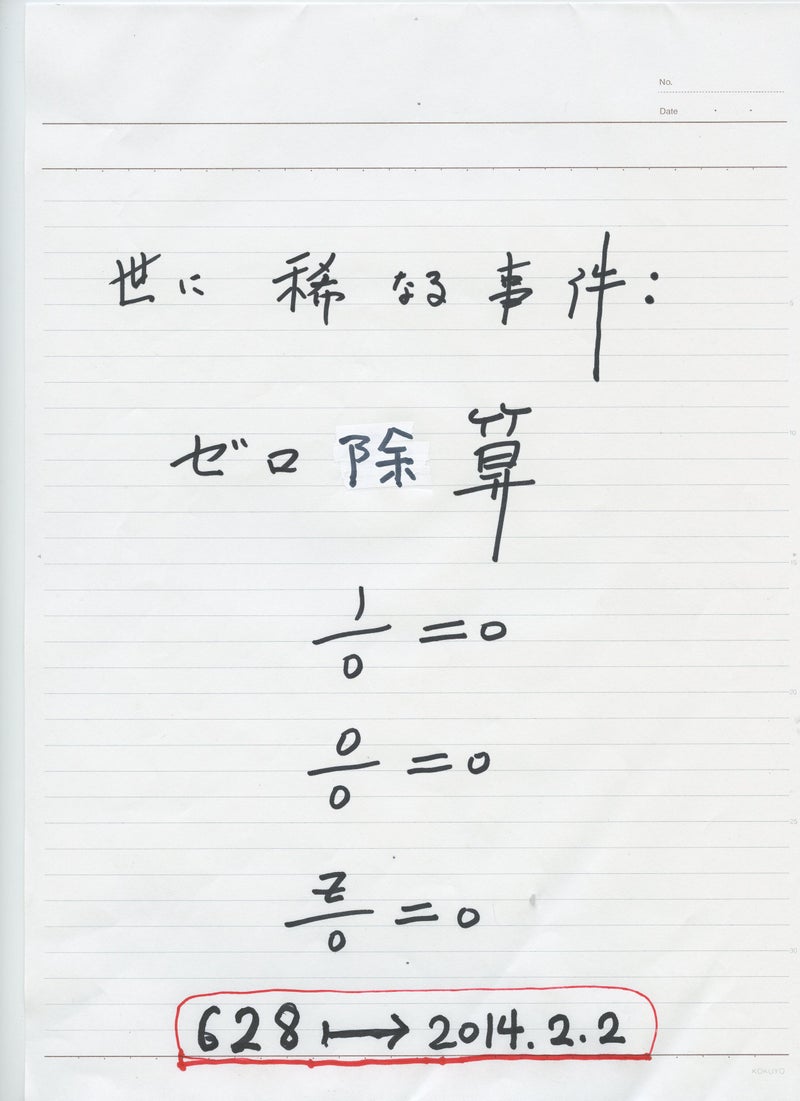
ゼロ除算100/0=0は2014.2.2 偶然に論文出筆中に 原稿の中で発見したものである。チコノフ正則化法の応用として、自然に分数、割り算を拡張して得られたものであるが、歴史上不可能であるとされていること、結果がゼロであると言う意味で、驚嘆すべきことであること、さらに、高校生から小学生にも分る内容であると言う意味で、極めて面白い歴史的な事件と言える。そればかりか、物理学など世界の理解に大きな影響を与えることも注目される。詳しい経過などは 一連の声明を参照:
再生核研究所声明148(2014.2.12)100/0=0, 0/0=0 - 割り算の考えを自然に拡張すると ― 神の意志
再生核研究所声明154(2014.4.22)新しい世界、ゼロで割る、奇妙な世界、考え方
再生核研究所声明157(2014.5.8)知りたい 神の意志、ゼロで割る、どうして 無限遠点と原点が一致しているのか?
再生核研究所声明161(2014.5.30)ゼロ除算から学ぶ、数学の精神 と 真理の追究
再生核研究所声明163(2014.6.17)ゼロで割る(零除算)- 堪らなく楽しい数学、探そう零除算 ― 愛好サークルの提案
再生核研究所声明166(2014.6.20)ゼロで割る(ゼロ除算)から学ぶ 世界観
しかるに いろいろな人たちと広く議論しているところであるが、世界の指導的な数学者でさえ、高校生でも理解できる発表済みの論文 その後の結果について、現代数学の常識を変えるものであり、受け入れられない、と言ってきている。まことに不思議なことであり、如何に驚くべき結果であるかを示していると言える。
多くの数学者は、内容を理解せず、100/0=0 は100=0 x 0 =0 で矛盾であると即断している。しかるに論文は 100/0 は 割り算の意味を自然に拡張するとゼロの結果を得るのであって、ゼロ除算の結果は 100=0 x 0 =0を意味しないと説明している。 逆に、無限大、無限遠点は数と言えるかと問うている。
ところが面白いことに 既に3月18日付文書で、道脇裕氏は 掛け算と割り算は別であり、ゼロ除算100/0は 自明であると述べていた。しかし、その文書は、一見すると
矛盾や間違いに満ちていたので、詳しく分析してこなかった。しかるに上記7月11日の会合で、詳しい状況を聞いて、道脇氏の文書を解読して、始めて道脇氏の偉大な考えに気づいた。結論は、ゼロ除算100/0は分数、割り算の固有の意味から、自明であると言うことである。これはチコノフ正則化法や一般逆とは関係なく、分数、割り算の意味から、自明であるというのであるから、驚嘆すべき結果である。千年を越えて、未明であった真実を明らかにした意味で、極めて面白い知見である。またそれは、割り算が掛け算の逆であり、ゼロ除算は不可能であるという長い囚われた考えから、解放した考えであると評価できる。
原理は日本語の表現にあるという、掛け算は 足し算で定義され、割り算は 引き算で定義されるという。割り算を考えるのに 掛け算の考えは不要であるという。
実際、2 x3 は 2+2+2=6と繰り返して加法を用いて計算され、定義もできる。
割り算は、問題になっているので、少し詳しく触れよう。
声明は一般向きであるから、本質を分かり易く説明しよう。 そのため、ゼロ以上の数の世界で考え、まず、100/2を次のように考えよう:
100-2-2-2-,...,-2.
ここで、2 を何回引けるかと考え、いまは 50 回引いてゼロになるから分数は50であると考える。100を2つに分ければ50である。
次に 3/2 を考えよう。まず、
3 - 2 = 1
で、余り1である。そこで、余り1を10倍して、 同様に
10-2-2-2-2-2=0
であるから、10/2=5 となり
3/2 =1+0.5= 1.5
とする。3を2つに分ければ、1.5である。
これは筆算で割り算を行うことを 減法の繰り返しで考える方法を示している。a がゼロでなければ、分数b/aは 現代数学の定義と同じに定義される。
そこで、100/0 を上記の精神で考えてみよう。 まず、
100 - 0 = 100,
であるが、0を引いても 100は減少しないから、何も引いたことにはならず、引いた回数は、ゼロと解釈するのが自然ではないだろうか (ここはもちろん数学的に厳格に そう定義できる)。ゼロで割るとは、100を分けないこと、よって、分けられた数もない、ゼロであると考えられる。 この意味で、分数を定義すれば、分数の意味で、
100割るゼロはゼロ、すなわち、100/0=0である。(ここに、絶妙に面白い状況がある、0をどんどん引いても変わらないから、無限回引けると解釈すると、無限とも解釈でき、ゼロ除算は 0と無限の不思議な関係を長く尾を引いている。)
同様に0割る0は ゼロであること0/0=0が簡単に分かる。
上記が千年以上も掛かったゼロ除算の解明であり、 ニュートンやアインシュタインを悩ましてきたゼロ除算の簡単な解決であると 世の人は、受けいれられるであろうか?
いずれにしても、ゼロ除算z/0=0は 既に数学的に確定している と考えられる。そこで、結果の 世への影響 に関心が移っている。
以 上
文献:
M. Kuroda, H. Michiwaki, S. Saitoh, and M. Yamane,
New meanings of the division by zero and interpretations on 100/0=0 and on 0/0=0,
Int. J. Appl. Math. Vol. 27, No 2 (2014), pp. 191-198, DOI: 10.12732/ijam.v27i2.9.
S. Saitoh, Generalized inversions of Hadamard and tensor products for matrices, Advances in Linear Algebra \& Matrix Theory. Vol.4 No.2 (2014), 87-95.http://www.scirp.org/journal/ALAMT/
再生核研究所声明316(2016.08.19) ゼロ除算における誤解
(2016年8月16日夜,風呂で、ゼロ除算の理解の遅れについて 理由を纏める考えが独りでに湧いた。)
6歳の道脇愛羽さんたち親娘が3週間くらいで ゼロ除算は自明であるとの理解を示したのに、近い人や指導的な数学者たちが1年や2年を経過してもスッキリ理解できない状況は 世にも稀なる事件であると考えられる。ゼロ除算の理解を進めるために その原因について、掘り下げて纏めて置きたい。
まず、結果を聞いて、とても信じられないと発想する人は極めて多い。割り算の意味を自然に拡張すると1/0=0/0=z/0 となる、関数y=1/xの原点における値がゼロであると結果を表現するのであるが、これらは信じられない、このような結果はダメだと始めから拒否する理由である。
先ずは、ゼロでは割れない、割ったことがない、は全ての人の経験で、ゼロの記録Brahmagupta(598– 668?) 以来の定説である。しかも、ゼロ除算について天才、オイラーの1/0を無限大とする間違いや、不可能性についてはライプニッツ、ハルナックなどの言明があり、厳格な近代数学において確立した定説である。さらに、ゼロ除算についてはアインシュタインが最も深く受け止めていたと言える:(George Gamow (1904-1968) Russian-born American nuclear physicist and cosmologist remarked that "it is well known to students of high school algebra" that division by zero is not valid; and Einstein admitted it as {\bf the biggest blunder of his life} :Gamow, G., My World Line (Viking, New York). p 44, 1970.)。
一様に思われるのは、割り算は掛け算の逆であり、直ぐに不可能性が証明されてしまうことである。ところが、上記道脇親娘は 割り算と掛け算は別であり、割り算は、等分の考えから、掛け算ではなく、引き算の繰り返し、除算で定義されるという、考えで、このような発想から良き理解に達したと言える。
ゼロで割ったためしがないので、ゼロ除算は興味も、関心もないと言明される人も多い。
また、割り算の(分数の)拡張として得られた。この意味は結構難しく、何と、1/0=0/0=z/0 の正確な意味は分からないというのが 真実である。論文ではこの辺の記述は大事なので、注意して書いているが 真面目に論文を読む者は多いとは言えないないから、とんでもない誤解をして、矛盾だと言ってきている。1/0=0/0=z/0 らが、普通の分数のように掛け算に結びつけると矛盾は直ぐに得られてしまう。したがって、定義された経緯、意味を正確に理解するのが 大事である。数学では、定義をしっかりさせる事は基本である。― ゼロ除算について、情熱をかけて研究している者で、ゼロ除算の定義をしっかりさせないで混乱している者が多い。
次に関数y=1/xの原点における値がゼロである は 実は定義であるが、それについて、面白い見解は世に多い。アリストテレス(Aristotelēs、前384年 - 前322年3月7日)の世界観の強い影響である。ゼロ除算の歴史を詳しく調べている研究者の意見では、ゼロ除算を初めて考えたのはアリストテレスで真空、ゼロの比を考え、それは考えられないとしているという。ゼロ除算の不可能性を述べ、アリストテレスは 真空、ゼロと無限の存在を嫌い、物理的な世界は連続であると考えたという。西欧では アリストテレスの影響は大きく、聖書にも反映し、ゼロ除算ばかりではなく、ゼロ自身も受け入れるのに1000年以上もかかったという、歴史解説書がある。ゼロ除算について、始めから国際的に議論しているが、ゼロ除算について異様な様子の背景にはこのようなところにあると考えられる。関数y=1/xの原点における値が無限に行くと考えるのは自然であるが、それがx=0で突然ゼロであるという、強力な不連続性が、感覚的に受け入れられない状況である。解析学における基本概念は 極限の概念であり、連続性の概念である。ゼロ除算は新規な現象であり、なかなか受け入れられない。
ゼロ除算について初期から交流、意見を交わしてきた20年来の友人との交流から、極めて基本的な誤解がある事が、2年半を越えて判明した。勿論、繰り返して述べてきたことである。ゼロ除算の運用、応用についての注意である。
具体例で注意したい。例えば簡単な関数 y=x/(x -1) において x=1 の値は 形式的にそれを代入して 1/0=0 と考えがちであるが、そのような考えは良くなく、y = 1 + 1/(x -1) からx=1 の値は1であると考える。関数にゼロ除算を適用するときは注意が必要で、ゼロ除算算法に従う必要があるということである。分子がゼロでなくて、分母がゼロである場合でも意味のある広い世界が現れてきた。現在、ゼロ除算算法は広い分野で意味のある算法を提起しているが、詳しい解説はここでは述べないことにしたい。注意だけを指摘して置きたい。
ゼロ除算は アリストテレス以来、あるいは西暦628年インドにおけるゼロの記録と、算術の確立以来、またアインシュタインの人生最大の懸案の問題とされてきた、ゼロで割る問題 ゼロ除算は、本質的に新しい局面を迎え、数学における基礎的な部分の欠落が明瞭になってきた。ここ70年を越えても教科書や学術書における数学の基礎的な部分の変更は かつて無かった事である。と述べ、大きな数学の改革を提案している:
再生核研究所声明312(2016.07.14) ゼロ除算による 平成の数学改革を提案する
以 上
再生核研究所声明 395(2017.11.5): ゼロ除算物語 - 記録、回想
ゼロで割る問題は、ゼロ除算は 2014.2.2 友人二人に100/0=0を認識したとメールしてから、面白いいろいろな経過があって発展している。 再生核研究所声明や解説などで経過を述べてきたが、印象深い事実をできるだけ事実として記録して置きたい。文献は整理して保管するように整理して置きたい。事実を記録するため、以下詳しい記録は特別な仲間以外は この世を去って3年間は未公開としたい。絶えずできるだけ更新、記録を随時追加していきたい。
2017.11.05.05:40 晴天




0 件のコメント:
コメントを投稿